"I'm a walking nightmare, an arsenal of doom
I kill conversation as I walk into the room
I'm a three line whip, I'm the sort of thing they ban
I'm a walking disaster, I'm a demolition man ..."
*
A little under a year of training and I finally end up putting somebody out of commission.
We were doing takedown-only line sparring. I’d been through a few times. My takedowns aren’t great, but they are better than average and I’m not an easy guy to take down either. I’ve got a pretty low center of gravity, good strength and balance.
Anyway, I had just managed to throw Brandon the judo guy. He says he was exhausted—and I believe him. But it was still nice to get a throw—not a single-leg, not a double-leg, but an actual throw—on him. So I stayed and he went back into the line.
Next up was this new white belt, probably a weight class below mine. He looked a little nervous and tentative, as most new white belts do. I didn’t think it would be hard to take him down at all and, since I’d just thrown a judo guy, I thought he would probably be pretty susceptible to the same thing.
Well, yes and no. I managed to get grip on his sleeve and my other arm free. I stepped through and reverse pivoted, swinging my free arm under his “trapped” arm. I didn’t catch him at first, so I “seionaged it” by dropping to the mat to roll him. Trouble was, he didn’t roll and instead just sort of collapsed under me to avoid going over my shoulder.
I fell on him. When I heard him cry out, I looked down and thought it was his ankle that he’d hurt. But as it turned out, it was his knee. Rodrigo and Mamazinho checked him out, then Maggie the Blue (who has some sort of medical experience or something) followed up. He was done for the evening. They iced it, and later I helped him out of the academy into the SUV of another new white belt who was giving him a ride home.
The guy had a pretty good spirit about it, saying “it’s part of the game.” I felt really shitty and uninspired afterwards. I rolled with Clint and Robert (both blue belts) while the injured guy was on the sidelines waiting for the class to end, but it was pretty uninspired rolling on my part. I managed to fight off a Clint triangle. Robert caught me with a cross choke toward the end of our five minutes. I don’t think the sparring would have gone any differently. But I just didn’t feel any fire.
These things happen in this sport. A part of me is glad that at least the guy wasn’t preparing for the tournament next week. But another part of me is worried that since the guy just started, getting what is probably a significant ACL or MCL injury might keep him from coming back. I know that new students are a crapshoot in terms of sticking with it. But I hate to feel as if I’ll play a negative role as he ponders his return.
Very much appreciated Maggie telling me not to be too upset about what happened. I remember when Mario got his knee fucked up that Saturday months ago. The guy he was rolling with definitely felt bad about it and I don’t think I’ve seen him since (he wasn’t a regular, anyway, though).
I suspect we’ll be warned to be careful the next time we do takedown sparring. I know that Mamazinho is just trying to get us ready for the tournament. I want to keep working throws because I think my balance is superior to most of the guys I’m likely to fight. But I’m guessing Mamazinho will be emphasizing the single and double-leg takedowns from now until next Saturday.
In other news, I finally nailed that reversal from the scarf hold while doing side control drills with Brandon who, as a judo guy, seems more comfortable with the scarf hold than the traditional jiu jitsu side control. On the negative side, I don’t do well escaping from mount. I can do the Gracie Brothers upa move pretty well. But elbow escaping out of the mount—as a lot of guys are able to do with me—is something I’m still terrible at. I need to work on that, if only to set up the Gracie Brothers upa escape.
Back to the mat Tuesday night. The capoeira folks will be there with their drums and spinning limbs. Might be just the tonic I need to get my mind back on track.
Monday, July 17, 2006
Thursday, July 13, 2006
Rant with Jiu Jitsu Notes
I’m in a massively unenthusiastic mood at present. The market is tanking, and taking my options positions with it. I’m being turned into a hack writer at the office (though there’s some daylight in the form of some ghost writing work I might be able to snag). I live in a country run by the most corrupt, cynical, self-serving son of a bitches imaginable. As the saying goes, I could go on …
A brief aside. I am amazed at people’s tendency to self-promote. I tend to be pretty modest about my accomplishments—such as they are—when talking with other people. You’ll never see me stroll up to somebody and just start talking to him or her about some wonderful thing going on in my life. Why presume that the other person gives a fuck? Why run around looking for people to pat you on the head and tell you how great you are? But that’s how people are, I suppose—and why I can’t stand them.
Fortunately, I’ve got jiu jitsu. Among the myriad graces that jiu jitsu gives us is its thoroughness. When you’re hyperextending somebody’s arm, or choking them to the edge of consciousness, nobody needs to tell you how good you are. It’s obvious. No bullshit. And if there is bullshit, you break their arm or put them to sleep. Talk about your doctrine of infallibility!
Anyway, I want to recap some of the techniques that Mamazinho has been showing us. He does an excellent job of starting with a basic position—side control, the guard—and then showing variations on escapes, sweeps and submissions that can all be applied from that basic position. I take nothing away from Rodrigo—who did much the same thing when he was doing most of the teaching. But insofar as I really didn’t know very much about Mamazinho and his teaching style until only that past few months, I have to say that I’ve been pleasantly surprised.
This week, Mamazinho has been showing us ways to counter when a guy stands up in your guard. The first technique was a sweep. The guy stands up in your guard looking to pass. You open your guard a bit and bring your knees in together. At the same time, you grab behind both of his ankles. Pull on his ankles as you push out with your hips. This should sweep the guy directly backwards.
Now, you need to get superior position. The guy will always try and come back to the top, usually by planting a hand behind him and pushing himself up. What you want to do is to plant your hand behind you—same side that he is planting—and reach over and across to grab the wrist of his “planting hand”. Use his weight to pull you to the top, while also making it hard for him because you’ve grabbed his “planting hand.”
Here’s a variation. Sometimes, in the heat of a fight, they guy will make the mistake of trying to push you back in the chest with his other hand. This leaves him vulnerable to an armbar. I’ll use “left/right” language to make sure the variation is clear.
You get the sweep. He reached to post with his left hand (your right side) and tries to push your chest back with his right hand as you are coming up. Grab his wrist with your left hand and swing your left leg over. You want to put his left arm between your legs, and hook the top of your foot on his neck. It is basically an inverted armbar. You don’t need much torque to get the submission from here. Pull up gradually on the wrist to apply the lock.
A brief aside. I am amazed at people’s tendency to self-promote. I tend to be pretty modest about my accomplishments—such as they are—when talking with other people. You’ll never see me stroll up to somebody and just start talking to him or her about some wonderful thing going on in my life. Why presume that the other person gives a fuck? Why run around looking for people to pat you on the head and tell you how great you are? But that’s how people are, I suppose—and why I can’t stand them.
Fortunately, I’ve got jiu jitsu. Among the myriad graces that jiu jitsu gives us is its thoroughness. When you’re hyperextending somebody’s arm, or choking them to the edge of consciousness, nobody needs to tell you how good you are. It’s obvious. No bullshit. And if there is bullshit, you break their arm or put them to sleep. Talk about your doctrine of infallibility!
Anyway, I want to recap some of the techniques that Mamazinho has been showing us. He does an excellent job of starting with a basic position—side control, the guard—and then showing variations on escapes, sweeps and submissions that can all be applied from that basic position. I take nothing away from Rodrigo—who did much the same thing when he was doing most of the teaching. But insofar as I really didn’t know very much about Mamazinho and his teaching style until only that past few months, I have to say that I’ve been pleasantly surprised.
This week, Mamazinho has been showing us ways to counter when a guy stands up in your guard. The first technique was a sweep. The guy stands up in your guard looking to pass. You open your guard a bit and bring your knees in together. At the same time, you grab behind both of his ankles. Pull on his ankles as you push out with your hips. This should sweep the guy directly backwards.
Now, you need to get superior position. The guy will always try and come back to the top, usually by planting a hand behind him and pushing himself up. What you want to do is to plant your hand behind you—same side that he is planting—and reach over and across to grab the wrist of his “planting hand”. Use his weight to pull you to the top, while also making it hard for him because you’ve grabbed his “planting hand.”
Here’s a variation. Sometimes, in the heat of a fight, they guy will make the mistake of trying to push you back in the chest with his other hand. This leaves him vulnerable to an armbar. I’ll use “left/right” language to make sure the variation is clear.
You get the sweep. He reached to post with his left hand (your right side) and tries to push your chest back with his right hand as you are coming up. Grab his wrist with your left hand and swing your left leg over. You want to put his left arm between your legs, and hook the top of your foot on his neck. It is basically an inverted armbar. You don’t need much torque to get the submission from here. Pull up gradually on the wrist to apply the lock.

Sunday, July 09, 2006
Notes from Promotion Day
I was watching Jesse the Purple during the King of the Guard drills on Saturday. I was sort of surprised to watch him do the basic, Gracie Barra standing guard pass. It's just another reminder that the basics are called "the basics" for a reason: they work.
I need to simplify my game over the next three weeks going into the tournament at the end of the month. One main guard pass. One main finish from on top. One main escape from side control. One main attack/sweep series from the guard. One main takedown. One main finish from the back. One main escape from the back.
The best way to get good quickly is to become master of a few techniques, as I've said before. That will allow you to compete against guys who are much better than you overall, and allow you to improve on other parts of your game at the same time. In other words, because opponents will have to "double team" your best techniques, your other lesser techniques will more open.
So, those six things: guard pass/guard attack-sweep series, finish from top/escape from side control, escape from rear mount/finish from back ... Pick just one technique to respond to each situation, and practice, practice, practice ...
Here's the current Cliff Notes version of the Q3 06 gameplan:
Guard Pass: Cuff, collar, stand on cuff side first, turn sideways and press knee on cuff side as you step back
Guard Attack/Sweep Series: Crossover sweep/omoplata OR spider guard triangle/omoplata/sweep
Escape from Side Control: THROAT, SWIM, WALK, FLAT, PULL, BOOM!
Finish from Top: Side control to mount or S-mount with collar choke/armbar finish OR keylock/armbar finish
Escape from Back: Protect the Neck, then DUCK, SHUCK, SPIN IN
Finish from the Back: Winding choke with collar and half nelson
I need to simplify my game over the next three weeks going into the tournament at the end of the month. One main guard pass. One main finish from on top. One main escape from side control. One main attack/sweep series from the guard. One main takedown. One main finish from the back. One main escape from the back.
The best way to get good quickly is to become master of a few techniques, as I've said before. That will allow you to compete against guys who are much better than you overall, and allow you to improve on other parts of your game at the same time. In other words, because opponents will have to "double team" your best techniques, your other lesser techniques will more open.
So, those six things: guard pass/guard attack-sweep series, finish from top/escape from side control, escape from rear mount/finish from back ... Pick just one technique to respond to each situation, and practice, practice, practice ...
Here's the current Cliff Notes version of the Q3 06 gameplan:
Guard Pass: Cuff, collar, stand on cuff side first, turn sideways and press knee on cuff side as you step back
Guard Attack/Sweep Series: Crossover sweep/omoplata OR spider guard triangle/omoplata/sweep
Escape from Side Control: THROAT, SWIM, WALK, FLAT, PULL, BOOM!
Finish from Top: Side control to mount or S-mount with collar choke/armbar finish OR keylock/armbar finish
Escape from Back: Protect the Neck, then DUCK, SHUCK, SPIN IN
Finish from the Back: Winding choke with collar and half nelson
Saturday, July 08, 2006
Four Stripe White
We had a belts and stripes promotion this morning. I thought there was a decent chance I'd get another stripe, and a fair chance that I wouldn't. On the one hand, I won first place at the Pacific Northwest Jiu Jitsu championship. On the other hand, I've been out with injuries for half of the time since, and haven't exactly looked like a wonder on the mat ...
So what do I get? Two stripes. I'm now a four stripe white belt.
The significance of that, of course, is that the next promotion for me is to blue belt.
I was stunned when Rodrigo and Mamazinho called me up. They had the class do the "king of the guard" drill for quite a while, then the promotions, then the picture. It really makes me all the more motivated to have a good month and perform well at the Copa at the end of the month. I don't want to put a lot of pressure on myself. But I know that I've got the positioning skills to win. Now I need to add finishing skills in order to take things to the next level.
And we now know that the next level is blue.
Lindsey also got four stripes--he's only started a few months ago, but he's progressed really quickly. Jeff (Helicopter Jeff) got his blue belt, which I think was a surprise to him. Jesse the Blue is now Jesse the Purple, which is also very cool. Angela got her blue belt today also. Very good for her.
Oh, and Eric Dahlberg from Demon Jiu Jitsu got his black belt. I know it had been a point of some contention because Dahlberg has spent a LOT of time away from the gi training MMA fighters (including Ivan Salaverry, I suspect, who was there taking pictures and running around with his very pregnant wife ...) But Mamazinho decided that the time had come. It isn't as if Dahlberg doesn't have the skills--nobody doubts that. The issue has been his commitment to the gi and to Gracie Barra Seattle. I guess Mamazinho and Rodrigo were satisfied. Good for him.
I did "The Widow" cardio workout this morning before heading over ...
2.28 miles / 9.1 laps
36:21 minutes
349 cal / 109 fat cal
1 lap silent 3.5 at 3.5 incline
4 laps 3.8 at 3.5 incline
3.5 laps 3.8 at 8 incline
0.5 laps 4.0 flat
Pretty nice grind. It felt like broken field running after about the third or fourth lap. I've gone back and forth about whether or not I should do cardio in the mornings, and I still haven't decided which.
But the four stripe white thing has me more than a little motivated to consider putting an AM Monday/Tuesday/Wednesday/Thursday routine together of alternating "The Widow" and DB complex workouts. We'll see what I come up with. The tournament is three weeks from today.
So what do I get? Two stripes. I'm now a four stripe white belt.
The significance of that, of course, is that the next promotion for me is to blue belt.
I was stunned when Rodrigo and Mamazinho called me up. They had the class do the "king of the guard" drill for quite a while, then the promotions, then the picture. It really makes me all the more motivated to have a good month and perform well at the Copa at the end of the month. I don't want to put a lot of pressure on myself. But I know that I've got the positioning skills to win. Now I need to add finishing skills in order to take things to the next level.
And we now know that the next level is blue.
Lindsey also got four stripes--he's only started a few months ago, but he's progressed really quickly. Jeff (Helicopter Jeff) got his blue belt, which I think was a surprise to him. Jesse the Blue is now Jesse the Purple, which is also very cool. Angela got her blue belt today also. Very good for her.
Oh, and Eric Dahlberg from Demon Jiu Jitsu got his black belt. I know it had been a point of some contention because Dahlberg has spent a LOT of time away from the gi training MMA fighters (including Ivan Salaverry, I suspect, who was there taking pictures and running around with his very pregnant wife ...) But Mamazinho decided that the time had come. It isn't as if Dahlberg doesn't have the skills--nobody doubts that. The issue has been his commitment to the gi and to Gracie Barra Seattle. I guess Mamazinho and Rodrigo were satisfied. Good for him.
I did "The Widow" cardio workout this morning before heading over ...
2.28 miles / 9.1 laps
36:21 minutes
349 cal / 109 fat cal
1 lap silent 3.5 at 3.5 incline
4 laps 3.8 at 3.5 incline
3.5 laps 3.8 at 8 incline
0.5 laps 4.0 flat
Pretty nice grind. It felt like broken field running after about the third or fourth lap. I've gone back and forth about whether or not I should do cardio in the mornings, and I still haven't decided which.
But the four stripe white thing has me more than a little motivated to consider putting an AM Monday/Tuesday/Wednesday/Thursday routine together of alternating "The Widow" and DB complex workouts. We'll see what I come up with. The tournament is three weeks from today.
Friday, July 07, 2006
Free Your Ass ...
and your mind will follow?
If Rickson Gracie made famous his inversion of the saying, "go with the flow" by saying that jiu jitsu at its highest and purest is, instead, the ability to "flow with the go," then why can't I invert the classic line from George Clinton of the 1970s funk band, Funkadelic to suggest that sometimes in jiu jitsu the battle is won or lost by virtue of your ability to "free your ass"?
I'm doing a little homework, and noticing that so much of jiu jitus involves putting your hips in the right place to secure superior leverage versus your opponent. Consider the escape from the scarf hold. You want to get your hips under his hips in order to "twist back" the guy the other way.
I'm trying to train myself to escape side control with the mantra: THROAT, SWIM, WALK, FLAT, PULL, BOOM! All of those steps are important. But one key is the WALK step where, after getting the underhook, you "walk" your legs away from the side control pin in order to get your hips out from under his pressure.
Your hips aren't pinned in side control, but your upper body is. And that limits your ability to move your hips. So you've got to "walk" away in order to FREE YOUR ASS ...
Even the guard replacement drill that Mamazinho showed us involves the FREE YOUR ASS principle. When the guy is passing your guard, you want to get your ass out of there by elbow escaping in the opposite direction.
Anyway, that's my breakthrough discovery. Next up, the DON'T BLOCK THE BODY theorem ...
If Rickson Gracie made famous his inversion of the saying, "go with the flow" by saying that jiu jitsu at its highest and purest is, instead, the ability to "flow with the go," then why can't I invert the classic line from George Clinton of the 1970s funk band, Funkadelic to suggest that sometimes in jiu jitsu the battle is won or lost by virtue of your ability to "free your ass"?
I'm doing a little homework, and noticing that so much of jiu jitus involves putting your hips in the right place to secure superior leverage versus your opponent. Consider the escape from the scarf hold. You want to get your hips under his hips in order to "twist back" the guy the other way.
I'm trying to train myself to escape side control with the mantra: THROAT, SWIM, WALK, FLAT, PULL, BOOM! All of those steps are important. But one key is the WALK step where, after getting the underhook, you "walk" your legs away from the side control pin in order to get your hips out from under his pressure.
Your hips aren't pinned in side control, but your upper body is. And that limits your ability to move your hips. So you've got to "walk" away in order to FREE YOUR ASS ...
Even the guard replacement drill that Mamazinho showed us involves the FREE YOUR ASS principle. When the guy is passing your guard, you want to get your ass out of there by elbow escaping in the opposite direction.
Anyway, that's my breakthrough discovery. Next up, the DON'T BLOCK THE BODY theorem ...
Day Three of the Q3 Gameplan, OR
Why I Suck at Jiu Jitsu ...
Truly, it is easier to write that having won first place at the Pacific Northwest Jiu Jitsu Championships in April. But three days into the new practice gameplan, I'm still feeling as if the time between those tournament wins and the present is a chasm of lost skill and forgotten technique.
Intellectually, I know that's not necessarily the case. I did miss a total of four weeks between now and the end of April due to a pair of injuries that did limit my mobility and ability to use my legs. Arguably what I'm suffering from is a combination of old bad habits I wasn't likely to break anytime soon, with the added handicap of a strained/torn hip adductor muscle (read: groin).
But enough of this. On to the reasons I suck at Brazilian Jiu Jitsu!
1. Cannot break posture of opponent in guard.
2. Cannot pass the guard.
3. Cannot reverse from side control without using strength when on bottom.
4. Cannot submit from side control when on top.
5. Cannot prevent guard from being passed once opened.
There's more to be sure, more specific problems. But these are the big five.
Fortunately, I've got solutions to these problems. The trick for the next few weeks before the next tournament on July 29th is to fanatically dedicate myself to applying those solutions to these problems. I could argue that if I can get past these five problems, then the path to blue belt will be a lot smoother. But that's getting ahead of myself. Right now, I want to fix these problems in order to do better against the blue belts that have been a steady diet ever since I came back from the hip adductor injury.
Solutions.
1. Cannot break posture of opponent in guard.
PUT A FOOT IN THE HIP AND PULL ON THE CUFF OF THE SAME SIDE
GRAB CUFF WITH BOTH HANDS AND PULL ACROSS YOU
If all else fails, CROSS-OVER SWEEP
2. Cannot pass the guard.
PICK UP STAND UP
PICK UP STAND UP
PICK UP STAND UP
3. Cannot reverse from side control without using strength when on bottom.
ELBOW TO THROAT
SWIM ARM UNDER FAR ARM
WALK LEGS AWAY FROM OPPONENT
GO FLAT
GRAB PANTS AND PULL YOURSELF TO KNEES
TUCK HEAD INTO SIDE OF OPPONENTS BODY
COME UP ON HEADSIDE KNEE AND DRIVE OPPONENT OVER
4. Cannot submit from side control when on top.
SIDE CONTROL
MOUNT OR KNEE-ON-BELLY
THREATEN CHOKE, FINISH WITH ARMBAR
5. Cannot prevent guard from being passed once opened.
USE THE GUARD REPLACEMENT DRILL: If the guy is coming to your right side, escape your hips to the left and then swing that same "plant" leg up over his head and across his body to rest on the opposite shoulder. Hook the body, butterfly style, with the other leg/foot.
Easy as all that ... See you on the mat.
Truly, it is easier to write that having won first place at the Pacific Northwest Jiu Jitsu Championships in April. But three days into the new practice gameplan, I'm still feeling as if the time between those tournament wins and the present is a chasm of lost skill and forgotten technique.
Intellectually, I know that's not necessarily the case. I did miss a total of four weeks between now and the end of April due to a pair of injuries that did limit my mobility and ability to use my legs. Arguably what I'm suffering from is a combination of old bad habits I wasn't likely to break anytime soon, with the added handicap of a strained/torn hip adductor muscle (read: groin).
But enough of this. On to the reasons I suck at Brazilian Jiu Jitsu!
1. Cannot break posture of opponent in guard.
2. Cannot pass the guard.
3. Cannot reverse from side control without using strength when on bottom.
4. Cannot submit from side control when on top.
5. Cannot prevent guard from being passed once opened.
There's more to be sure, more specific problems. But these are the big five.
Fortunately, I've got solutions to these problems. The trick for the next few weeks before the next tournament on July 29th is to fanatically dedicate myself to applying those solutions to these problems. I could argue that if I can get past these five problems, then the path to blue belt will be a lot smoother. But that's getting ahead of myself. Right now, I want to fix these problems in order to do better against the blue belts that have been a steady diet ever since I came back from the hip adductor injury.
Solutions.
1. Cannot break posture of opponent in guard.
PUT A FOOT IN THE HIP AND PULL ON THE CUFF OF THE SAME SIDE
GRAB CUFF WITH BOTH HANDS AND PULL ACROSS YOU
If all else fails, CROSS-OVER SWEEP
2. Cannot pass the guard.
PICK UP STAND UP
PICK UP STAND UP
PICK UP STAND UP
3. Cannot reverse from side control without using strength when on bottom.
ELBOW TO THROAT
SWIM ARM UNDER FAR ARM
WALK LEGS AWAY FROM OPPONENT
GO FLAT
GRAB PANTS AND PULL YOURSELF TO KNEES
TUCK HEAD INTO SIDE OF OPPONENTS BODY
COME UP ON HEADSIDE KNEE AND DRIVE OPPONENT OVER
4. Cannot submit from side control when on top.
SIDE CONTROL
MOUNT OR KNEE-ON-BELLY
THREATEN CHOKE, FINISH WITH ARMBAR
5. Cannot prevent guard from being passed once opened.
USE THE GUARD REPLACEMENT DRILL: If the guy is coming to your right side, escape your hips to the left and then swing that same "plant" leg up over his head and across his body to rest on the opposite shoulder. Hook the body, butterfly style, with the other leg/foot.
Easy as all that ... See you on the mat.
Wednesday, July 05, 2006
Day Two of the Q3 Gameplan
Not a bad class tonight. In sparring, I managed an escape to half-guard from side control just as Peligro showed it. I also managed to hit that guard replacement move that Mamazinho showed us (another one that is in The Essential Guard) when sparring Robert, the tall blue belt.
I want to focus on that in particular. I didn't have guys take my side much tonight compared with the past few weeks. If I can get that guard replacement switch down, that might keep them at bay.
I did too much lay and pray against Jeff. He finally reversed the pin, but I had top control on him for much too long without making an effective attack. I kept going for the choke, but he was wrapped up tight. I even had mount for a period of time and couldn't get anything done. There was a brief flash where I could have grabbed an arm and armbarred him again. But I watched that flash rather than become it.
Reminds me of that point Rickson makes about "great fights" being those fights in which one fighter spots a weakness in his opponent, exploits it immediately and wins the fight decisively. A moment happens. And greatness is the ability to seize that moment. Guys who train with Rickson often say the same thing: they roll around for awhile, many times long enough for the guy to probably start feeling pretty good about himself. Then Rickson "starts submitting" him. Over and over and over as if he'd figured out "the trick" to defeating the guy and the guy doesn't even realize it. He just knows that he's being killed on the mat.
What's so cool about Rickson's approach is that it puts a premium on technical knowledge. And that knowledge is the exploitation of leverage. If ever something were to be called "the force" for real ...
At any rate, for all the moments I spend on top, I still need to work on my guard. That part of the gameplan is really lagging. I've still not yet tried a full-hearted crossover sweep ...
Remember. From the guard, cuff out collar down to set up the omoplata. Alternate with cuff in collar down to set up arm-stuff triangle or even scissors sweep toward the stuffed side. If you can't break the posture, then tug hard on the collar as a posture-breaking feint, then drive him backward with the crossover sweep.
I want to focus on that in particular. I didn't have guys take my side much tonight compared with the past few weeks. If I can get that guard replacement switch down, that might keep them at bay.
I did too much lay and pray against Jeff. He finally reversed the pin, but I had top control on him for much too long without making an effective attack. I kept going for the choke, but he was wrapped up tight. I even had mount for a period of time and couldn't get anything done. There was a brief flash where I could have grabbed an arm and armbarred him again. But I watched that flash rather than become it.
Reminds me of that point Rickson makes about "great fights" being those fights in which one fighter spots a weakness in his opponent, exploits it immediately and wins the fight decisively. A moment happens. And greatness is the ability to seize that moment. Guys who train with Rickson often say the same thing: they roll around for awhile, many times long enough for the guy to probably start feeling pretty good about himself. Then Rickson "starts submitting" him. Over and over and over as if he'd figured out "the trick" to defeating the guy and the guy doesn't even realize it. He just knows that he's being killed on the mat.
What's so cool about Rickson's approach is that it puts a premium on technical knowledge. And that knowledge is the exploitation of leverage. If ever something were to be called "the force" for real ...
At any rate, for all the moments I spend on top, I still need to work on my guard. That part of the gameplan is really lagging. I've still not yet tried a full-hearted crossover sweep ...
Remember. From the guard, cuff out collar down to set up the omoplata. Alternate with cuff in collar down to set up arm-stuff triangle or even scissors sweep toward the stuffed side. If you can't break the posture, then tug hard on the collar as a posture-breaking feint, then drive him backward with the crossover sweep.
Two Escapes from Scarf Hold
I've got two escapes from scarf hold. Monday night, Brandon the judo guy put me in scarf hold (or kesa gatame as the judokas call it) and then caught me with an armbar when I extended my trapped arm and he was able to pin it between his legs.
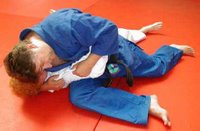
Mamazinho showed me a solid counter to the scarf hold pin--one that is also published in my judo book on pages 110-111. The escape is exactly the same. Here's how "Judo" Gene LeBell describes it:
The other escape is one that Angela showed me--though I've seen it at BJJ.org. If the Mamazinho/LeBell version is good for when the guy on top keeps his posture low, then Angela's version is good for when the guy on top keeps his posture high.
Mamazinho and LeBell have you get your hips close to the guy on top. Angela's version has you get some distance by walking your hips away from the pin (away from the top guy's legs). Then turn your hips into him, throwing your far leg over his head--almost as if you were setting up a googoplata. As you straighten your body and extend your leg, you will create space--and probably break his hold insofar as your leg is across his neck (or least his chin) and creating a lot of pressure.
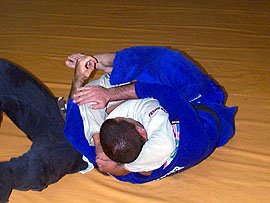
In order to get the guy's head into range for the "leg-over", use your forearm on your far arm to push his head back. If you can grab the far shoulder and bring your forearm across the neck/face, so much the better. Try to turn his head away from you, which will make it easier to you to surprise him with the leg-over.

Mamazinho showed me a solid counter to the scarf hold pin--one that is also published in my judo book on pages 110-111. The escape is exactly the same. Here's how "Judo" Gene LeBell describes it:
If your opponent has you in Kesa Gatame ... and you have your arms around his waist, grab his belt. Push his belt away from your body to your upper right. Lift him at the waist. When his hips are off the ground, shove your right knee under his body ... Pull your opponent close to your body at the belt while shifting him from your right to left side by a strong pull downward and to the left with your left hand and push off strongly with your right foot ... Keep on pulling until you are on your stomach and your opponent is on his back ... From this position, you may go into a hold down of your own.
The other escape is one that Angela showed me--though I've seen it at BJJ.org. If the Mamazinho/LeBell version is good for when the guy on top keeps his posture low, then Angela's version is good for when the guy on top keeps his posture high.
Mamazinho and LeBell have you get your hips close to the guy on top. Angela's version has you get some distance by walking your hips away from the pin (away from the top guy's legs). Then turn your hips into him, throwing your far leg over his head--almost as if you were setting up a googoplata. As you straighten your body and extend your leg, you will create space--and probably break his hold insofar as your leg is across his neck (or least his chin) and creating a lot of pressure.
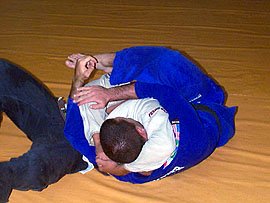
In order to get the guy's head into range for the "leg-over", use your forearm on your far arm to push his head back. If you can grab the far shoulder and bring your forearm across the neck/face, so much the better. Try to turn his head away from you, which will make it easier to you to surprise him with the leg-over.
Tuesday, July 04, 2006
The First Day of the Rest of My Life
Monday's class was a relatively light class. Throws for warm-up. Then a guard replacement drill that I had a hard time catching. Fortunately, it is one of the guard replacement drills in Peligro's The Essential Guard on page 48-49.
You are defending an attempt to stack you. You've got one leg up and over the shoulder, and the other leg butterflied out (knee out) with the hook on that foot on the other side of the body. Both of your feet are on the same side.
Release the hook and kick that leg out to the side. You will elbow escape to that side.
At the same time, bring your up leg down, sliding the hook on that leg on the other side of his torso just above the waist. You're basically sliding it down his face, down his chest to his belly.
After you escape your hips to the side (the butterflied side), swing that leg up and over the other side of the guy's head.
Back and forth you go.
The important thing is the first step, which is to release the body hook and plant that leg out to the side in preparation for a deep elbow escape in that direction. Slide the upper leg down and hook it into place. Then swing the other leg up and over, crossing his face.
I had a tricky time with this one, so I didn't get to practice the next step that Mamazinho was showing the blue belts. I was probably going too fast with Jeff. I'll have to make sure I slow it down next time.
On a similar note, Rodrigo mentioned me working with some of the beginning white belts from time to time. I don't know if it is because I've been struggling in sparring or because of my injuries or what. I want to be prepared for the tournament on the 29th, but I may take him up on his offer.
My biggest "problem" in sparring is letting guys get to my side in the beginning. Basically, I'm lousy at pulling guard. I think I need to be closer when I drop down so that the guy doesn't have as much room to maneuver and set up a pass. Brandon the judo guy caught me in an armbar from scarf hold and then had a kimura on me from the guard that had me feeling like Royler against Sakuraba. I managed to get top position a few times. But couldn't finish him.
I rolled with Mario's friend, Jeff. A strong guy, at least two weight divisions higher than me. Very hard to control from the top. I managed to catch him with a choke and an armbar that I applied too quickly. But it was a real struggle all the way.
I rolled with Casey, and did better this time around--mostly in terms of overall aggression. His advice this time was to "defend everything" ... He went for a few collar chokes that I didn't defend well, which I've got a tendency to do since there is so much "grey area" in most of the chokes I get caught in.
Last I had a short roll with Cindy, who's working her way back from neck surgery. She was no-gi and not being able to use head control against her didn't give me a tremendous amount of options--not that it would have mattered. She caught me in a couple of things: a choke, an armbar, an omoplata and a wristlock. But I think I made it at least worth her while.
As far as Day One of the gameplan was, I'd give it a gentleman's C. I tried one omoplata against Brandon, and it was pretty much more of a sweep. I did get a scissors sweep on him. I wasted too much time on top with Jeff instead of going for the submission early.
The fact of the matter is that my most effective submission has been the armbar from the mount. I don't do it anywhere near perfectly, but if I'm in the mount and your arms go vertical, I'm going to slap an armbar down rapidinho.
That's how something becomes part of a competition gameplan. As much as I wanted to make chokes and shoulder locks the staple of my game, that armbar from the mount is my best submission. I need to work on the far-side armbar (the one with the wrap) and the Cindy (the keylock transition to armbar) and include them as my main finishing moves. Because I seem to be able to work those better than anything else.
So I'll make a post about escapes from side control (Peligro's hook method) and escapes from scarf hold (Mamzinho's Twist Back-style reversal and Angela's Leg Over). But I need to work on not getting caught in side control in the first place.
You are defending an attempt to stack you. You've got one leg up and over the shoulder, and the other leg butterflied out (knee out) with the hook on that foot on the other side of the body. Both of your feet are on the same side.
Release the hook and kick that leg out to the side. You will elbow escape to that side.
At the same time, bring your up leg down, sliding the hook on that leg on the other side of his torso just above the waist. You're basically sliding it down his face, down his chest to his belly.
After you escape your hips to the side (the butterflied side), swing that leg up and over the other side of the guy's head.
Back and forth you go.
The important thing is the first step, which is to release the body hook and plant that leg out to the side in preparation for a deep elbow escape in that direction. Slide the upper leg down and hook it into place. Then swing the other leg up and over, crossing his face.
I had a tricky time with this one, so I didn't get to practice the next step that Mamazinho was showing the blue belts. I was probably going too fast with Jeff. I'll have to make sure I slow it down next time.
On a similar note, Rodrigo mentioned me working with some of the beginning white belts from time to time. I don't know if it is because I've been struggling in sparring or because of my injuries or what. I want to be prepared for the tournament on the 29th, but I may take him up on his offer.
My biggest "problem" in sparring is letting guys get to my side in the beginning. Basically, I'm lousy at pulling guard. I think I need to be closer when I drop down so that the guy doesn't have as much room to maneuver and set up a pass. Brandon the judo guy caught me in an armbar from scarf hold and then had a kimura on me from the guard that had me feeling like Royler against Sakuraba. I managed to get top position a few times. But couldn't finish him.
I rolled with Mario's friend, Jeff. A strong guy, at least two weight divisions higher than me. Very hard to control from the top. I managed to catch him with a choke and an armbar that I applied too quickly. But it was a real struggle all the way.
I rolled with Casey, and did better this time around--mostly in terms of overall aggression. His advice this time was to "defend everything" ... He went for a few collar chokes that I didn't defend well, which I've got a tendency to do since there is so much "grey area" in most of the chokes I get caught in.
Last I had a short roll with Cindy, who's working her way back from neck surgery. She was no-gi and not being able to use head control against her didn't give me a tremendous amount of options--not that it would have mattered. She caught me in a couple of things: a choke, an armbar, an omoplata and a wristlock. But I think I made it at least worth her while.
As far as Day One of the gameplan was, I'd give it a gentleman's C. I tried one omoplata against Brandon, and it was pretty much more of a sweep. I did get a scissors sweep on him. I wasted too much time on top with Jeff instead of going for the submission early.
The fact of the matter is that my most effective submission has been the armbar from the mount. I don't do it anywhere near perfectly, but if I'm in the mount and your arms go vertical, I'm going to slap an armbar down rapidinho.
That's how something becomes part of a competition gameplan. As much as I wanted to make chokes and shoulder locks the staple of my game, that armbar from the mount is my best submission. I need to work on the far-side armbar (the one with the wrap) and the Cindy (the keylock transition to armbar) and include them as my main finishing moves. Because I seem to be able to work those better than anything else.
So I'll make a post about escapes from side control (Peligro's hook method) and escapes from scarf hold (Mamzinho's Twist Back-style reversal and Angela's Leg Over). But I need to work on not getting caught in side control in the first place.
Sunday, July 02, 2006
Brabo Choke
Marcio Feitosa of Gracie Barra shows the brabo choke. There is a gi version, but his explanation of that is still too confusing. The no-gi version is much more straightforward to me.
The brabo is a nice finishing move after you've rolled using the counter to the bear hug guard pass. As soon as you roll over into the side position, push down on the head and reach under with the inside arm to start the brabo.
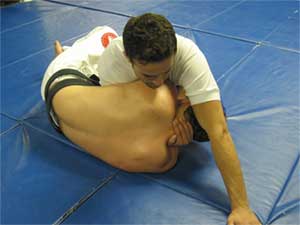

The coup de gras is to pull upward with the inside shoulder, using your outside shoulder and arm to keep you in place.
The brabo is a nice finishing move after you've rolled using the counter to the bear hug guard pass. As soon as you roll over into the side position, push down on the head and reach under with the inside arm to start the brabo.
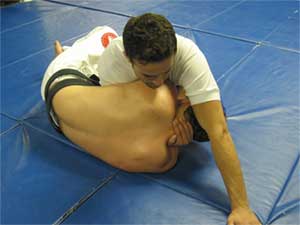

The coup de gras is to pull upward with the inside shoulder, using your outside shoulder and arm to keep you in place.
The Game Plan Q3 2006
The Game Plan Q2 2006 was mostly an exercise in creating a gameplan. That, plus injuries (groin, lower lat) made it pretty much academic: worthwhile, but ultimately impractical.
The Q3 (July, August, September) version will be shorter and more concise. I'll have one major attack from the bottom (the omoplata) with everything else being either a sweep or a set-up for the omoplata (or both).
From the top, to quote Saulo Ribeiro, "I always go for the choke." Collar chokes, winding chokes from the back, brabo chokes from the side ... My signature choke will be the Mamazinho north-south forearm choke.
By "major attack" and "signature choke", I am saying that in EVERY SINGLE SPARRING SESSION these are the ways I will try to get the submission. For example, if I were on bottom for five minutes, then I should try for at least ten full-fledged omoplata attempts. I should be going for that submission every chance I get.
One thing that I've noticed is that the best jiu jitsu fighters (or any fighter for that matter) has a few techniques that nobody does better. Marcelo's arm drag to RNC ... Jacare's takedown and far side kimura ... Viera's arm/shoulder choke ...
I think this is how Lloyd Irvin's top students (i.e., guys like Mike Fowler and Ryan Hall) have become so good so quickly. Mastering a certain technique allows you to dominate at your level, while always being at least competitive with those who are above your level. It's a great situation to be in because you can always roll with those who are better. That will enable you to both constantly refine and improve your signature attacks, while at the same time improving other areas of your game that your superior opponent is less worried about.
In other words, if you are a blue belt with a reputation for a killer omoplata, it will be either to catch those purple and brown belts with your (still improving) crossover sweep.
It also makes it easier to improve faster because you can focus on a single technique. There is a ridiculous amount to learn when studying jiu jitsu. I was at Barnes and Noble this afternoon and stumbled across a copy of of "Judo" Gene LeBell's Encyclopedia of Finishing Holds. Sure, some of those holds aren't competition legal (many are "catch wrestling" moves from the 19th century). But the book is still 576 pages long. Now imagine if that book included all the sweeps, guardwork, takedowns, escapes, that are a part of jiu jitsu and judo.
So overload is often what happens when you're starting out (i.e., white belt) in jiu jitsu. A lot of times, I feel as if I'm starting all over again when I'm training. Finding a specific technique, honing it until you know it inside and out--until you become the academy expert and others are asking you how they can improve their version of the same technique is a better way to go.
This doesn't mean forsaking the basics or learning other techniques. Instead it is a realization of one's limitations to learn so much at a time. Drill and practice as many things as you want. But when you get the chance to spar--especially in the four weeks leading up to a tournament--you should relentlessly hone your best stuff until it is gold.
The Q3 (July, August, September) version will be shorter and more concise. I'll have one major attack from the bottom (the omoplata) with everything else being either a sweep or a set-up for the omoplata (or both).
From the top, to quote Saulo Ribeiro, "I always go for the choke." Collar chokes, winding chokes from the back, brabo chokes from the side ... My signature choke will be the Mamazinho north-south forearm choke.
By "major attack" and "signature choke", I am saying that in EVERY SINGLE SPARRING SESSION these are the ways I will try to get the submission. For example, if I were on bottom for five minutes, then I should try for at least ten full-fledged omoplata attempts. I should be going for that submission every chance I get.
One thing that I've noticed is that the best jiu jitsu fighters (or any fighter for that matter) has a few techniques that nobody does better. Marcelo's arm drag to RNC ... Jacare's takedown and far side kimura ... Viera's arm/shoulder choke ...
I think this is how Lloyd Irvin's top students (i.e., guys like Mike Fowler and Ryan Hall) have become so good so quickly. Mastering a certain technique allows you to dominate at your level, while always being at least competitive with those who are above your level. It's a great situation to be in because you can always roll with those who are better. That will enable you to both constantly refine and improve your signature attacks, while at the same time improving other areas of your game that your superior opponent is less worried about.
In other words, if you are a blue belt with a reputation for a killer omoplata, it will be either to catch those purple and brown belts with your (still improving) crossover sweep.
It also makes it easier to improve faster because you can focus on a single technique. There is a ridiculous amount to learn when studying jiu jitsu. I was at Barnes and Noble this afternoon and stumbled across a copy of of "Judo" Gene LeBell's Encyclopedia of Finishing Holds. Sure, some of those holds aren't competition legal (many are "catch wrestling" moves from the 19th century). But the book is still 576 pages long. Now imagine if that book included all the sweeps, guardwork, takedowns, escapes, that are a part of jiu jitsu and judo.
So overload is often what happens when you're starting out (i.e., white belt) in jiu jitsu. A lot of times, I feel as if I'm starting all over again when I'm training. Finding a specific technique, honing it until you know it inside and out--until you become the academy expert and others are asking you how they can improve their version of the same technique is a better way to go.
This doesn't mean forsaking the basics or learning other techniques. Instead it is a realization of one's limitations to learn so much at a time. Drill and practice as many things as you want. But when you get the chance to spar--especially in the four weeks leading up to a tournament--you should relentlessly hone your best stuff until it is gold.
Tuesday, June 27, 2006
Mamazinho Chokes and Shoulder Locks
I've got a suspicion that my style of jiu jitsu (such as it is) is the same as Mamazinho's.
Maybe everybody else is finding themselves in the same dominant position and is equally unable to finish as I am. But Mamazinho has shown a number of moves that go directly to situations I've found myself in--both in class and in competition.
Mamazinho is also a muscular guy, and I can't help but believe that plays a part in how his style works. Hell, the Mamazinho got on the mat against Jeff Monson, for God's sake. Mamazinho lists at 185 and Monson fights in the heavyweight division (above 205) of the UFC.
I tried to write about the Mamazinho north-south choke a little while back. I'd been meaning to ask him about a few details. But between my nervousness in approaching him and the four-weeks-missed-out-of-six streak, I never got around to it.
Anyway, here is that choke, plus another one he showed us tonight. I'm writing it here exactly the way I did on the mat after class. I'm going to start taking a legal pad to class and write down one or two of the techniques we were shown--whatever I can remember--right there on the mat while I'm hydrating after my last spar.
Corker
Side control to scarf hold
Outside hand DEEP collar choke grip--palm down
Hip-walk into head. Get near knee under near shoulder
Step over head & choke grip with outside leg
PLANT HEEL RIGHT NEXT TO FAR SIDE OF NECK. TIGHT!
Squeeze both knees. Twist choke grip as you pull upward.
I had a hard time getting the Corker to work. Obviously, "Corker" is not Mamazinho's name for the choke. But it reminds me of trying to pull a cork out of a bottle in some cartoon, where you've got both feet on the bottle and you're pulling up on the cork with everything you've got ...
Anyway, I'll do some research on that choke. Mamazinho told Abel and that Filipino brown belt who's shown me a lot of things lately that it was both a pain and a choke submission. More smash style ...
There's a flourish if the guy tries to block your leg with his far side hand. All you have to do is grab that hand with your north hand (the one that is NOT in place for the choke), release the choke and attack with a keylock. If you get the keylock, switch hips to south-facing to cinch the lock.
Here's the north-south choke.
Mamazinho's North South
Side control to scarf hold
Scarf hold to north-south
... If guy reaches around to grab around your waist with both arms ...
Reach back around arm to grab collar. Trapping his arm.
Go back to side control (double knees)
Drive your north side elbow back between your body and his other arm.
Your elbow is like a wedge.
As your hand comes across the far collar, grip it with a palm down grip
Twist wrist up and lower the forearm to initiate the choke.
Open up hips to south-facing and continue lowering forearm to cinch choke
Maybe everybody else is finding themselves in the same dominant position and is equally unable to finish as I am. But Mamazinho has shown a number of moves that go directly to situations I've found myself in--both in class and in competition.
Mamazinho is also a muscular guy, and I can't help but believe that plays a part in how his style works. Hell, the Mamazinho got on the mat against Jeff Monson, for God's sake. Mamazinho lists at 185 and Monson fights in the heavyweight division (above 205) of the UFC.
I tried to write about the Mamazinho north-south choke a little while back. I'd been meaning to ask him about a few details. But between my nervousness in approaching him and the four-weeks-missed-out-of-six streak, I never got around to it.
Anyway, here is that choke, plus another one he showed us tonight. I'm writing it here exactly the way I did on the mat after class. I'm going to start taking a legal pad to class and write down one or two of the techniques we were shown--whatever I can remember--right there on the mat while I'm hydrating after my last spar.
Corker
Side control to scarf hold
Outside hand DEEP collar choke grip--palm down
Hip-walk into head. Get near knee under near shoulder
Step over head & choke grip with outside leg
PLANT HEEL RIGHT NEXT TO FAR SIDE OF NECK. TIGHT!
Squeeze both knees. Twist choke grip as you pull upward.
I had a hard time getting the Corker to work. Obviously, "Corker" is not Mamazinho's name for the choke. But it reminds me of trying to pull a cork out of a bottle in some cartoon, where you've got both feet on the bottle and you're pulling up on the cork with everything you've got ...
Anyway, I'll do some research on that choke. Mamazinho told Abel and that Filipino brown belt who's shown me a lot of things lately that it was both a pain and a choke submission. More smash style ...
There's a flourish if the guy tries to block your leg with his far side hand. All you have to do is grab that hand with your north hand (the one that is NOT in place for the choke), release the choke and attack with a keylock. If you get the keylock, switch hips to south-facing to cinch the lock.
Here's the north-south choke.
Mamazinho's North South
Side control to scarf hold
Scarf hold to north-south
... If guy reaches around to grab around your waist with both arms ...
Reach back around arm to grab collar. Trapping his arm.
Go back to side control (double knees)
Drive your north side elbow back between your body and his other arm.
Your elbow is like a wedge.
As your hand comes across the far collar, grip it with a palm down grip
Twist wrist up and lower the forearm to initiate the choke.
Open up hips to south-facing and continue lowering forearm to cinch choke
Catching Up
Grapplemania Seattle was a huge success for Gracie Barra Seattle.
According to both Griff and Rodrigo, Team Mamazinho really cleaned up. No doubt that we won the team trophy--and it sounds like much of our success came at the hands of Team Marcelo Alonso. Rodrigo said we Marcelo Alonso had like 10 guys cheering on his fighters, while we had about 40.
It's really got to burn Marcelo something bad so see Rodrigo do so well with Gracie Barra Seattle. Rodrigo said they got into it a little bit, but then made up. All in good spirited competition.
I'm back after missing a week with a combined in-law visit/strained oblique. Compared to the out-three-week groin injury (which I'm starting to believe might be something called Gilmore's Groin)), the oblique injury is relatively minor. I still feel twinges in it when I twist too much. But I rolled tonight and never felt that the obliques made a difference in performance.
The groin is about where the obliques are--which is a pretty decent improvement. I can do leg leviations, but not leg lifts, on that side. Working it and icing it should do the trip. I'm also trying to stretch every day--especially on days when I'm not training. Warming up is more important than stretching as far as injury prevention goes. But it wouldn't hurt to be more flexible.
The next tournament is a Copa here in South Seattle. July 29th is the tentative date, five Saturdays from now. I'm 0-1, 1-1, 2-0 for a 4-2 record over three tournaments. But I don't have any submission wins.
I want to make chokes the staple of my submission game, with shoulder locks second. Since my game is pretty much a Carlson Jr./Ralph smash game (I think my jiu jitsu deal is this guy, Cassio Cardoso), chokes are an ideal attack. They are also very efficient, as I remember Rodrigo pointing out once, making them good for opponents of varying sizes. This is also why shoulder locks are second. Bigger guys typically aren't very flexible in the shoulders.
Anyway, I want to get myself in gear this week and go into pre-tournament mode beginning Tuesday, July 4th (or Monday, if there is no class on the holiday). I'll have a full four weeks to get a competition game plan together, stay healthy, and get into really good conditioning. If I can pull off that trifecta, then I think I can win first place again on the 29th--and do it with submissions. Chokes!
According to both Griff and Rodrigo, Team Mamazinho really cleaned up. No doubt that we won the team trophy--and it sounds like much of our success came at the hands of Team Marcelo Alonso. Rodrigo said we Marcelo Alonso had like 10 guys cheering on his fighters, while we had about 40.
It's really got to burn Marcelo something bad so see Rodrigo do so well with Gracie Barra Seattle. Rodrigo said they got into it a little bit, but then made up. All in good spirited competition.
I'm back after missing a week with a combined in-law visit/strained oblique. Compared to the out-three-week groin injury (which I'm starting to believe might be something called Gilmore's Groin)), the oblique injury is relatively minor. I still feel twinges in it when I twist too much. But I rolled tonight and never felt that the obliques made a difference in performance.
The groin is about where the obliques are--which is a pretty decent improvement. I can do leg leviations, but not leg lifts, on that side. Working it and icing it should do the trip. I'm also trying to stretch every day--especially on days when I'm not training. Warming up is more important than stretching as far as injury prevention goes. But it wouldn't hurt to be more flexible.
The next tournament is a Copa here in South Seattle. July 29th is the tentative date, five Saturdays from now. I'm 0-1, 1-1, 2-0 for a 4-2 record over three tournaments. But I don't have any submission wins.
I want to make chokes the staple of my submission game, with shoulder locks second. Since my game is pretty much a Carlson Jr./Ralph smash game (I think my jiu jitsu deal is this guy, Cassio Cardoso), chokes are an ideal attack. They are also very efficient, as I remember Rodrigo pointing out once, making them good for opponents of varying sizes. This is also why shoulder locks are second. Bigger guys typically aren't very flexible in the shoulders.
Anyway, I want to get myself in gear this week and go into pre-tournament mode beginning Tuesday, July 4th (or Monday, if there is no class on the holiday). I'll have a full four weeks to get a competition game plan together, stay healthy, and get into really good conditioning. If I can pull off that trifecta, then I think I can win first place again on the 29th--and do it with submissions. Chokes!
Thursday, May 18, 2006
Sidelined
Tuesday, I'm ready for class--and for a new Tuesday/Wednesday/Thursday training schedule. Tommy leads the warm-up. A few laps around the mat, high knees, touch-your-heels, sideways facing in, sideways facing out, two-in/two-out ... Fine enough.
Then Tommy has us to judo forward rolls. I do about three, then move over a little bit because Mamazinho is showing a new white belt how to do the rolls properly. I should have paid more attention because my next roll is my last.
I don't know exactly what I did wrong, but when I landed the sting in my hip was pronounced. I tried to get up, and could after a minute, and hobbled back to the line. I was done. Eventually I worked my way to the sidelines and realized that it wasn't my hip as much as it was my groin. Rodrigo, then Mamazinho checked on me. But it was pretty clear that I was done for the night.
I took Wednesday off work to ice my groin non-stop. I'm hobbling around the office today, but I think with more heavy-duty ice tonight, I'll be able to start switching from cold to heat with every other application. My goal is to be back on the mat rolling by next Tuesday (the 23rd) and sparring 100% by the Tuesday after that (the 30th).
A couple of observations: it is clear that I am as strong as I need to be at the under-160 level. So what I need to focus on his muscular endurance (i.e., dumbbell complex and Tabata 4 DB workout) and cardio (treadmill).
But more importantly, I've got to start stretching twice a day. There's just no denying this any more. I think the biggest problem was that I last trained on Thursday the 11th and didn't do any stretching or vigorous activity for four days until the Tuesday night I pulled the groin. Nino Schembri is one of the most flexible guys in jiu jitsu and even HE stretches twice a day. I've just got to do it.
I'd even argue that if I didn't do anything resistance or cardio-wise every day, but got in two stretching sessions every day, that would be plenty fine enough.
So, my recovery schedule is:
Thursday p.m. ice only
Friday p.m. ice only
Saturday p.m. ice/heat alternating
Sunday p.m. ice/heat alternating
Monday p.m. ice/heat alternating: begin light stretching
Tuesday p.m. return to bjj training
Wish me luck.
Then Tommy has us to judo forward rolls. I do about three, then move over a little bit because Mamazinho is showing a new white belt how to do the rolls properly. I should have paid more attention because my next roll is my last.
I don't know exactly what I did wrong, but when I landed the sting in my hip was pronounced. I tried to get up, and could after a minute, and hobbled back to the line. I was done. Eventually I worked my way to the sidelines and realized that it wasn't my hip as much as it was my groin. Rodrigo, then Mamazinho checked on me. But it was pretty clear that I was done for the night.
I took Wednesday off work to ice my groin non-stop. I'm hobbling around the office today, but I think with more heavy-duty ice tonight, I'll be able to start switching from cold to heat with every other application. My goal is to be back on the mat rolling by next Tuesday (the 23rd) and sparring 100% by the Tuesday after that (the 30th).
A couple of observations: it is clear that I am as strong as I need to be at the under-160 level. So what I need to focus on his muscular endurance (i.e., dumbbell complex and Tabata 4 DB workout) and cardio (treadmill).
But more importantly, I've got to start stretching twice a day. There's just no denying this any more. I think the biggest problem was that I last trained on Thursday the 11th and didn't do any stretching or vigorous activity for four days until the Tuesday night I pulled the groin. Nino Schembri is one of the most flexible guys in jiu jitsu and even HE stretches twice a day. I've just got to do it.
I'd even argue that if I didn't do anything resistance or cardio-wise every day, but got in two stretching sessions every day, that would be plenty fine enough.
So, my recovery schedule is:
Thursday p.m. ice only
Friday p.m. ice only
Saturday p.m. ice/heat alternating
Sunday p.m. ice/heat alternating
Monday p.m. ice/heat alternating: begin light stretching
Tuesday p.m. return to bjj training
Wish me luck.
Monday, May 15, 2006
Closed Guard: General Unified Theory
Establish closed guard position: Cuff and cross collar. Cuff-side foot in hip.
I. Opponent's posture too tight? Attacks: Scissor sweep: armbar, cross choke
Scissor sweep
1. Pull with hands while pushing out with foot-in-hip.
2. As opponent postures back, drop the foot-in-hip alongside the leg.
3. Bring other leg up between you and opponent, shin first. Hook the body on that side with the foot.
4. Scissor the legs. Pull on the cuff and cross collar.
Be ready to transition to an armbar or cross choke.
II. Opponent's posture too high? Attacks: Crossover sweep: kimura, guillotine
Crossover sweep
1. Post sweep side arm. Sit up and turn body toward sweep side.
2. Reach over with far arm and grab elbow on sweep side arm.
3. Put sweep side leg on the ground against opponent's leg.
4. Pull opponent over. Roll on top into mount position.
Be ready to transition to kimura or guillotine.
III. Opponent's posture too low? Attacks: Cradle sweep: take-the-back, omoplata
Cradle sweep
1. Escape hip on sweep side and pull cuff toward center.
2. Bring sweep side leg up behind opponet's sweep side arm.
3. Reach down with far arm and underhook opponent's far leg. Hug tightly.
4. With sweep side arm reach around back near belt.
5. Lean back and kick sweep leg up then down. As sweep side leg comes down, swing far side leg up.
6. Roll over sweep side shoulder into mount position.
Be ready to transition to take-the-back or omoplata.
IV. Opponent's posture too wide? Attacks: Spider sweep: omoplata, triangle
Spider sweep
1. Open guard. Cuff with foot/knee in bicep. Opposite grip on pants near knee.
2. Roll back slightly to get opponent's weight on you.
3. Lift far side knee while simultaneously rolling toward the sweep side.
4. Roll over your sweep side shoulder.
Be ready to transition to omoplata or triangle.
I. Opponent's posture too tight? Attacks: Scissor sweep: armbar, cross choke
Scissor sweep
1. Pull with hands while pushing out with foot-in-hip.
2. As opponent postures back, drop the foot-in-hip alongside the leg.
3. Bring other leg up between you and opponent, shin first. Hook the body on that side with the foot.
4. Scissor the legs. Pull on the cuff and cross collar.
Be ready to transition to an armbar or cross choke.
II. Opponent's posture too high? Attacks: Crossover sweep: kimura, guillotine
Crossover sweep
1. Post sweep side arm. Sit up and turn body toward sweep side.
2. Reach over with far arm and grab elbow on sweep side arm.
3. Put sweep side leg on the ground against opponent's leg.
4. Pull opponent over. Roll on top into mount position.
Be ready to transition to kimura or guillotine.
III. Opponent's posture too low? Attacks: Cradle sweep: take-the-back, omoplata
Cradle sweep
1. Escape hip on sweep side and pull cuff toward center.
2. Bring sweep side leg up behind opponet's sweep side arm.
3. Reach down with far arm and underhook opponent's far leg. Hug tightly.
4. With sweep side arm reach around back near belt.
5. Lean back and kick sweep leg up then down. As sweep side leg comes down, swing far side leg up.
6. Roll over sweep side shoulder into mount position.
Be ready to transition to take-the-back or omoplata.
IV. Opponent's posture too wide? Attacks: Spider sweep: omoplata, triangle
Spider sweep
1. Open guard. Cuff with foot/knee in bicep. Opposite grip on pants near knee.
2. Roll back slightly to get opponent's weight on you.
3. Lift far side knee while simultaneously rolling toward the sweep side.
4. Roll over your sweep side shoulder.
Be ready to transition to omoplata or triangle.
Saturday, May 13, 2006
Grappling Game Plan rev Q2 2006
Here's a revised (and much simplified) Grappling Game Plan for Q2 2006 (April, May, June).
TAKEDOWNS
Large outer reaping throw (osoto gari)
Inside thigh sweep (uchi mata)
"The Jacare" (collar drag to single leg)
One arm shoulder throw (ippon seoinage)
BOTTOM GAME
Goal: Sweep, Submit, Transition to Open Guard, Transition to Half Guard
Closed Guard
Position: Cuff and cross collar. Cuff-side foot in hip.
Attacks: Scissor sweep: armbar, cross collar choke
Crossover sweep: kimura, guillotine
Cradle sweep: take-the-back, omoplata
Spider sweep: omoplata, triangle
Open Guard
Position: Double cuffs. Foot in bicep/shoulder. Foot in hip.
Attacks: Triangle-to-armbar, omoplata
Sweeps: Spider sweep
Half Guard
Goal: Sweep
Position: Double underhooks. Lockdown.
Sweeps: Old school: Twist back.
Side Control
Goal: Sweep, Transition to Knees, Transition to Half Guard
Position: Free side underhook. Trapped side palm-up grip on near collar.
Sweeps: Hip roll. Elbow escape to knees.
Mount
Goal: Sweep
Position: Sweep side hand on same side elbow. Far side hand on opposite wrist.
Sweeps: Pole vault.
Detail: Remember to bridge straight up first, then shoulder roll.
TOP GAME
Goal: Choke, armlock or kimura from side control/s-mount
Guard
Goal: Pass
Attack: Saulo Ribeiro ground pass
Detail: Pin leg or scoop leg into side control
Side Control
Goal: Submit, Mount
Attack: Far side kimura, Mamazinhio forearm choke
Detail: Switch to south-facing side control before attempting transition to mount
Mount
Goal: Submit, Transition to S-mount
Attack: Cross choke, armlock
Detail: Look for opportunity to transition to S-mount early in mount control
S-mount
Goal: Submit
Attack: Cross choke, armlock
Detail: Be ready to bail to mount or side control if escape looks imminent.
Note: Staying active on top with 360 drill and switch back and forth from regular side control to south-facing side control (aka "Twister Side Control") will open sbumission opportunities. Keep moving.
TAKEDOWNS
Large outer reaping throw (osoto gari)
Inside thigh sweep (uchi mata)
"The Jacare" (collar drag to single leg)
One arm shoulder throw (ippon seoinage)
BOTTOM GAME
Goal: Sweep, Submit, Transition to Open Guard, Transition to Half Guard
Closed Guard
Position: Cuff and cross collar. Cuff-side foot in hip.
Attacks: Scissor sweep: armbar, cross collar choke
Crossover sweep: kimura, guillotine
Cradle sweep: take-the-back, omoplata
Spider sweep: omoplata, triangle
Open Guard
Position: Double cuffs. Foot in bicep/shoulder. Foot in hip.
Attacks: Triangle-to-armbar, omoplata
Sweeps: Spider sweep
Half Guard
Goal: Sweep
Position: Double underhooks. Lockdown.
Sweeps: Old school: Twist back.
Side Control
Goal: Sweep, Transition to Knees, Transition to Half Guard
Position: Free side underhook. Trapped side palm-up grip on near collar.
Sweeps: Hip roll. Elbow escape to knees.
Mount
Goal: Sweep
Position: Sweep side hand on same side elbow. Far side hand on opposite wrist.
Sweeps: Pole vault.
Detail: Remember to bridge straight up first, then shoulder roll.
TOP GAME
Goal: Choke, armlock or kimura from side control/s-mount
Guard
Goal: Pass
Attack: Saulo Ribeiro ground pass
Detail: Pin leg or scoop leg into side control
Side Control
Goal: Submit, Mount
Attack: Far side kimura, Mamazinhio forearm choke
Detail: Switch to south-facing side control before attempting transition to mount
Mount
Goal: Submit, Transition to S-mount
Attack: Cross choke, armlock
Detail: Look for opportunity to transition to S-mount early in mount control
S-mount
Goal: Submit
Attack: Cross choke, armlock
Detail: Be ready to bail to mount or side control if escape looks imminent.
Note: Staying active on top with 360 drill and switch back and forth from regular side control to south-facing side control (aka "Twister Side Control") will open sbumission opportunities. Keep moving.
Monday, May 08, 2006
Mamazinho's North-South
Times are a-changin' ... It looks like Gracie Barra Seattle will be at the Tully's location from now on. Mamzinho is teaching, the glass case of GB t-shirts etc. is now down here in the warehouse, purple and brown belts popping up all over the place ...
Funny, just as I was looking for more attacks from the north-south position, guess what Mamazinho puts on the menu? We learned three different attacks that involve shifting from north-south back and forth to side control: a devastating choke, an armbar and a kimura.
All three attacks begin from the same north-south position. The set-up begins with the bottom guy reaching around your waist, hugging you toward him.
You reach back and grab the guy's collar, trapping the arm on that side. Scoot over into side control (on both knees) on the side of the arm you trapped. From side control, reach with your other hand (your northmost hand) and get a choke grip on the guy's far collar. Go thumb first.
Make sure the forearm of the choke grip hand is across the neck. Switch your hips to open up to the south. With a firm grip on the collar, bring your forearm down across the front of the neck. Use your weight in south-facing side control to help drive the choke and get the tap.
The next variation is the armbar. Here you start from the same place, but you are going to armbar the far arm. From side control with the arm trapped from the basic north-south grip, you go back to north-south. Wrap up the far arm and turn into the guy, putting your southmost knee into the belly and turning into the armbar.
I don't think that's exactly right. I think this one will work, but I'm not sure if it is the one that Mamazinho showed us. I need to think about it some more--or ask somebody to show it to me on Wednesday when I'm back in class.
The kimura variation comes when you attempt the armbar, but the guy grabs his belt to resist. You switch from the armbar grip to a kimura grip and pull the arm toward you first, then back and away for the kimura. This one I do have correctly. It is the entry into the armbar that I'm still a little confused by.
Funny, just as I was looking for more attacks from the north-south position, guess what Mamazinho puts on the menu? We learned three different attacks that involve shifting from north-south back and forth to side control: a devastating choke, an armbar and a kimura.
All three attacks begin from the same north-south position. The set-up begins with the bottom guy reaching around your waist, hugging you toward him.
You reach back and grab the guy's collar, trapping the arm on that side. Scoot over into side control (on both knees) on the side of the arm you trapped. From side control, reach with your other hand (your northmost hand) and get a choke grip on the guy's far collar. Go thumb first.
Make sure the forearm of the choke grip hand is across the neck. Switch your hips to open up to the south. With a firm grip on the collar, bring your forearm down across the front of the neck. Use your weight in south-facing side control to help drive the choke and get the tap.
The next variation is the armbar. Here you start from the same place, but you are going to armbar the far arm. From side control with the arm trapped from the basic north-south grip, you go back to north-south. Wrap up the far arm and turn into the guy, putting your southmost knee into the belly and turning into the armbar.
I don't think that's exactly right. I think this one will work, but I'm not sure if it is the one that Mamazinho showed us. I need to think about it some more--or ask somebody to show it to me on Wednesday when I'm back in class.
The kimura variation comes when you attempt the armbar, but the guy grabs his belt to resist. You switch from the armbar grip to a kimura grip and pull the arm toward you first, then back and away for the kimura. This one I do have correctly. It is the entry into the armbar that I'm still a little confused by.
Sunday, April 30, 2006
First Place
I won first place in the 158-146 division at the Pacific Northwest Jiu Jitsu Championships yesterday.
There only four of us in the division (there were five in the 145 and under division). So I had two fights, the second one for first and second place against a Gracie Barra guy from Vancouver I think.
I won both matches on points, basically from an overwhelming side control. The first fight, the guy tried a takedown and lost his balance early. I pounced on him, took him down, and got into side control instantly.
Rodrigo, fresh off his neck surgery, did a great job of coaching me. As did Cindy, whose voice I could also hear. I fought for a choke, transitioned to knee-on-belly, then north-south, then back to side control before time ran out.
The second fight was a little more difficult. We clinched up and fell to the ground on a take down attempt that I don't think he got points for. He did end up on top in side control and that may have been where he got his two points. While I was on the bottom, I heard his coach warn: "be careful, he's very strong." A few moments later I reversed him, turning away (which was the wrong direction, but I've gotten away with it) and powering him over.
I wound up in his guard. I never felt in danger of being swept or submitted. But I was down 2-0 and need to pass his guard and get to side control to win. I tried to stand a couple of times, but just couldn't get his guard open. I really, really need to work on guard passing if I'm going to play from the top.
Anyway, one of my efforts finally got his guard open and I shot through to side control. I was pretty tired and Rodrigo was coaching me to rest and relax. My side control was like a vise--just as in the first fight. Keep the grip tight and use your shoulder to press the guy's face away from you to make it harder for him to turn into you and elbow escape.
Rebecca took some pictures that I'm looking forward to seeing. And Griff, who came in second in his division, got some video. The blue belts from Gracie Barra: Robert, Tommy and Jesse all lost their first fights. Tommy got sandbagged by some guy from Demon Jiu Jitsu who Rodrigo said "had been training as long" as he had. That would be about 15 years! Some "blue belt." Tommy was pissed, and I don't blame them. Sandbagging is probably worst at blue belt.
Arnell fought and lost twice in his matches. It was his first tournament and a good experience to get under his belt.
Hopefully these losses will motivate them to really work hard over the next months leading into the fall tournaments. I am about as excited about training as you could imagine. I think this will be the fuel to get me back on my morning cardio/workout routines four mornings a week. I got a little tired in my second fight, and I want my cardio to be much better.
Even though 158-146 isn't the deepest division, it is clearly where I need to be right now. Once my technique level matches my strength level, maybe I'll move up to 171-159. But that would require deliberately trying to gain weight, which I've avoided doing. Besides, that the division that Jesse Singh fights at--though probably soon enough as a blue belt. From a team perspective, it is nice to have somebody at 145 and under and somebody at the next level up. A new white belt, Lindsey, fought at 172-184 and placed second I think. That covers all the lower weights.
Anyway, I'll do more analysis of how I did, how well I followed the gameplan, and any other general observations later. For now, I'm happy that the work I have put in since December and Copa Northwest 6. My record is now 3-2, but still no submission victories. That's where I need to improve next.
There only four of us in the division (there were five in the 145 and under division). So I had two fights, the second one for first and second place against a Gracie Barra guy from Vancouver I think.
I won both matches on points, basically from an overwhelming side control. The first fight, the guy tried a takedown and lost his balance early. I pounced on him, took him down, and got into side control instantly.
Rodrigo, fresh off his neck surgery, did a great job of coaching me. As did Cindy, whose voice I could also hear. I fought for a choke, transitioned to knee-on-belly, then north-south, then back to side control before time ran out.
The second fight was a little more difficult. We clinched up and fell to the ground on a take down attempt that I don't think he got points for. He did end up on top in side control and that may have been where he got his two points. While I was on the bottom, I heard his coach warn: "be careful, he's very strong." A few moments later I reversed him, turning away (which was the wrong direction, but I've gotten away with it) and powering him over.
I wound up in his guard. I never felt in danger of being swept or submitted. But I was down 2-0 and need to pass his guard and get to side control to win. I tried to stand a couple of times, but just couldn't get his guard open. I really, really need to work on guard passing if I'm going to play from the top.
Anyway, one of my efforts finally got his guard open and I shot through to side control. I was pretty tired and Rodrigo was coaching me to rest and relax. My side control was like a vise--just as in the first fight. Keep the grip tight and use your shoulder to press the guy's face away from you to make it harder for him to turn into you and elbow escape.
Rebecca took some pictures that I'm looking forward to seeing. And Griff, who came in second in his division, got some video. The blue belts from Gracie Barra: Robert, Tommy and Jesse all lost their first fights. Tommy got sandbagged by some guy from Demon Jiu Jitsu who Rodrigo said "had been training as long" as he had. That would be about 15 years! Some "blue belt." Tommy was pissed, and I don't blame them. Sandbagging is probably worst at blue belt.
Arnell fought and lost twice in his matches. It was his first tournament and a good experience to get under his belt.
Hopefully these losses will motivate them to really work hard over the next months leading into the fall tournaments. I am about as excited about training as you could imagine. I think this will be the fuel to get me back on my morning cardio/workout routines four mornings a week. I got a little tired in my second fight, and I want my cardio to be much better.
Even though 158-146 isn't the deepest division, it is clearly where I need to be right now. Once my technique level matches my strength level, maybe I'll move up to 171-159. But that would require deliberately trying to gain weight, which I've avoided doing. Besides, that the division that Jesse Singh fights at--though probably soon enough as a blue belt. From a team perspective, it is nice to have somebody at 145 and under and somebody at the next level up. A new white belt, Lindsey, fought at 172-184 and placed second I think. That covers all the lower weights.
Anyway, I'll do more analysis of how I did, how well I followed the gameplan, and any other general observations later. For now, I'm happy that the work I have put in since December and Copa Northwest 6. My record is now 3-2, but still no submission victories. That's where I need to improve next.
Thursday, April 27, 2006
Eureka Moments in Jiu Jitsu
I had another eureka night last night during class. It reminded me a little of the last eureka night I had on April 12th--the last night the Demon Jiu Jitsu guys were training with us. Then, it was chokes and scissor sweep that I was hitting with reguarlity that provided the eureka moment. Last night the chokes were there (I swear I use chokes more than any other white belt I've trained with!), but what really seemed to click was guard passing.
Guard passing?!?! Did I just say guard passing?
You betcha. I finally think I've found the key details that have made my guard passing so terrible. The little primer I posted not too long ago not withstanding, it appears as if it is the little things that have been undermining my guard passing game.
With the standing guard pass, it is important to pump your hips back and forth while "pushing" (remember, we don't push the guy ...) on the knee. The count should be: stand-pump-pump-pump, then DROP to pass the opened guard by dropping your knee down on the lower leg of the newly opened guard. The guard shoud open by the second PUMP. But the third one is there for good measure, to make sure you have opened the guard. Stand! PUMP-PUMP-PUMP! Drop!
With the Saulo Ribeiro ground pass, the trick is to move both legs around as you move in the circle. I had been trying to do this move with my bent leg remaining strictly in place while I walked the other leg around behind me (i.e., from 4 o'clock around toward 6 or 7 o'clock). That won't work. What I've got to do--and finally did successfully in some sparring--is to pivot around on the knee of the bent leg as I walk the other leg around. The same "step out" position you start with, the same posture etc. is the one you maintain until the guard is opened. I just have to move BOTH LEGS, not just the outstretched "walk around" one.
It's always the little details. We'll see if any of this comes in handy Saturday morning at the tournament. But I already feel like my training will be a lot better over the next few months now that I've got some of the kinks worked out of my two main guard passes. I've always thought that if I could get guard passing down, I'd be a lot better because my work from the top is pretty strong.
Speaking of work from the top, I've been doing a better job of getting my elbow OVER when I'm attacking from side control. That's key not just to the kimura and keylock attacks, but also to having good top side control with my weight on the guy's upper body. I think the attack sequence from side control needs to be: kimura-keylock-Cindy's keylock to S-mount armbar, with the option of the straight armlock if I can hit it in between fighting for the kimura or keylock.
I also want to learn some good chokes from side control, in addition to the basic chokes from the mount. Not necessarily for Saturday. But definitely for things to work on over the summer.
Guard passing?!?! Did I just say guard passing?
You betcha. I finally think I've found the key details that have made my guard passing so terrible. The little primer I posted not too long ago not withstanding, it appears as if it is the little things that have been undermining my guard passing game.
With the standing guard pass, it is important to pump your hips back and forth while "pushing" (remember, we don't push the guy ...) on the knee. The count should be: stand-pump-pump-pump, then DROP to pass the opened guard by dropping your knee down on the lower leg of the newly opened guard. The guard shoud open by the second PUMP. But the third one is there for good measure, to make sure you have opened the guard. Stand! PUMP-PUMP-PUMP! Drop!
With the Saulo Ribeiro ground pass, the trick is to move both legs around as you move in the circle. I had been trying to do this move with my bent leg remaining strictly in place while I walked the other leg around behind me (i.e., from 4 o'clock around toward 6 or 7 o'clock). That won't work. What I've got to do--and finally did successfully in some sparring--is to pivot around on the knee of the bent leg as I walk the other leg around. The same "step out" position you start with, the same posture etc. is the one you maintain until the guard is opened. I just have to move BOTH LEGS, not just the outstretched "walk around" one.
It's always the little details. We'll see if any of this comes in handy Saturday morning at the tournament. But I already feel like my training will be a lot better over the next few months now that I've got some of the kinks worked out of my two main guard passes. I've always thought that if I could get guard passing down, I'd be a lot better because my work from the top is pretty strong.
Speaking of work from the top, I've been doing a better job of getting my elbow OVER when I'm attacking from side control. That's key not just to the kimura and keylock attacks, but also to having good top side control with my weight on the guy's upper body. I think the attack sequence from side control needs to be: kimura-keylock-Cindy's keylock to S-mount armbar, with the option of the straight armlock if I can hit it in between fighting for the kimura or keylock.
I also want to learn some good chokes from side control, in addition to the basic chokes from the mount. Not necessarily for Saturday. But definitely for things to work on over the summer.
Tuesday, April 25, 2006
Tommy's Tips
A great class/training to start of tournament week. Rolled with Brandon the judo guy, Adam, the Asian white belt from Ballard (Trevor?) and finished with a long session with Tommy.
I've been rolling a lot with Tommy. This might be the prelude to my first quantum leap, when some of this stuff really starts to click into body memory. Tommy's got a flowing, highly technical game that I like, but never thought I could adopt. It's a nice combination, and helps break me out of my slow, methodical, grinding style.
It also reminds me of what Eddie Bravo said about the guard (Kid Peligro said the same thing): the more comfortable you are being on the bottom, the more willing you are to be adventurous and "flowing" on the top and in other positions.
I'll post again some of the details of the class, the specific techniques, etc. But first here are some of Tommy's Tips:
Go! Go! Go! Don’t stop to think. If you stop to think, that gives your opponent time to think. You know the techniques. Move!
Be ready to open to spider guard. A foot on the biceps becomes a foot on the shoulder and a solid triangle attack or an omoplata.
Against sitting up guard, stand and work to control the knees.
On top against the guard, drop the knee in the middle once the guard opens up. That allows you to switch it to a side to pin, or to bear hug legs and pass to the side.
I've been rolling a lot with Tommy. This might be the prelude to my first quantum leap, when some of this stuff really starts to click into body memory. Tommy's got a flowing, highly technical game that I like, but never thought I could adopt. It's a nice combination, and helps break me out of my slow, methodical, grinding style.
It also reminds me of what Eddie Bravo said about the guard (Kid Peligro said the same thing): the more comfortable you are being on the bottom, the more willing you are to be adventurous and "flowing" on the top and in other positions.
I'll post again some of the details of the class, the specific techniques, etc. But first here are some of Tommy's Tips:
Friday, April 21, 2006
Four Problems, Four Fixes
I'll backfill with some technical stuff from recent classes, including another way of getting an armbar from the mount and a key lock from the mount follow-ups to a choke attack. But here's the latest update:
***
A week out from the Pacific NW Jiu jitsu championships ... I've been doing a pretty poor job of keeping side control updated ... As well as filling in notes on my progress with the Q2 Grappling Gameplan.
I'm coming along. I can't help but wish this tournament were in May rather than next week. I don't feel as if I'm making the progress I should be making--or, at least, that I'd like to be making. Here are the things I'm doing wrong that I don't like.
1. When starting from knees during sparring, I do a very poor job of pulling guard. This leads to more Mighty Joe Young stuff, which wastes energy and does get any learning accomplished.
2. I've been letting guys get to my side, and then into side control. I don't mind working side control (and mount) escapes. But I don't like the way Arnell and Jeff from Demon JJ got to my side Monday and Wednesday.
3. My guard work is still bad. My biggest problem is in not breaking the posture. Both Arnell and Jeff sit WAY high up in the guard, which makes them hard to attack with the omoplata/triangle/armbar combination.
4. My guard passing is pathetic. Seven months of training and I still don't have a consistent approach to passing the guard. Unlike Arnell and Jeff, I am too low in the guard. Against better guys, it makes me vulnerable to triangles. Against equals, it just makes for a lousy guard passing game.
There are plenty of other things that I'm not doing as well as I'd like. I'd like to be more effective from the mount--both in having a more stable base and in being able to finish with the choke or armbar. I also need to remember not to "hang out" in X-guard, but to use it to take the back. I'm also making the mistake of being flat on my back when in half-guard, instead of on my side.
Here are some solutions to the four forementioned problem areas:
1. To pull full guard, grab the sleeve and the collar. Drop back and put the foot in the hip that is on the same side as the collar. Pull on the sleeve to keep the guy in the middle and to not allow him to roll around your foot to your side. Roll over toward the collar-grip side--that will also prevent the guy from taking your side.
2. The best way to avoid having somebody take your side is to lie on your side. I bet most of the time this happens, it happens because I am flat on my back OR sitting up but not using hooks or grips to control the guy. If the guy is trying to take your right side, then lean over so that you are lying on your right side. If he gets too low, then you'll be in position to take his back.
3. Use the Bravo set up for Mission Control to break posture: open guard, reach up and underhook both arms, then either pull him down or use the underhooks to stand or sweep. Mission Control is really a technique worth trying out in practice. Also, high posture guys are vulnerable to the hip bump sweep since their weight is already back. Tommy's used the hip bump sweep on me well when I've postured too far back. The gameplan series, by the way, is to set up the hip bump with the guillotine or the kimura--especially the kimura.
The arm drag to cradle sweep or take-the-back is also a posture breaking option ...
4. Ugh! To speake of the woe that is guard passing ... I adamantly refuse to use the Loiseau. So I've got to come up with something different. Both the Saulo and Cindy passes have me nervous because I don't think I've got a good base when I attempt either of these. With regard to the Cesar, once I've hoisted the guy up, I need to move my hips ("shake the tree") while pushing on the knee. With regard to the Gracie Barra, I'm just not sure. I'm still having a hard time getting the guard opened up. Maybe more "tree-shaking" ...
One thing though, if the guy moves to put a foot in your hip then HIS FUCKING GUARD IS OPEN!!!! I have got to capitalize on that moment when the guard opens to either underhook the leg (scoop-leg) or pass my knee over and pin the leg. As hard of a time as I have getting out of guy's guards, I MUST MUST MUST take advantage of these moments when they come.
I have been doing relatively well with baiting the triangle, and when the guy opens his guard to attack my neck, scoop legging his attacking leg and grabbing the opposite collar as I pass. Two things: (1) I've got to move quickly so that he doesn't get his legs clasped in the over/under around me, (2) the wrist of my other hand can be no higher north than his waist (also to avoid the triangle), and (3) I've got to keep my hips low and working higher north until I get beyond his thigh and can slip into side control. You want to move his attacking leg away from you because it is the only thing that stands between you and side control.
***
A week out from the Pacific NW Jiu jitsu championships ... I've been doing a pretty poor job of keeping side control updated ... As well as filling in notes on my progress with the Q2 Grappling Gameplan.
I'm coming along. I can't help but wish this tournament were in May rather than next week. I don't feel as if I'm making the progress I should be making--or, at least, that I'd like to be making. Here are the things I'm doing wrong that I don't like.
1. When starting from knees during sparring, I do a very poor job of pulling guard. This leads to more Mighty Joe Young stuff, which wastes energy and does get any learning accomplished.
2. I've been letting guys get to my side, and then into side control. I don't mind working side control (and mount) escapes. But I don't like the way Arnell and Jeff from Demon JJ got to my side Monday and Wednesday.
3. My guard work is still bad. My biggest problem is in not breaking the posture. Both Arnell and Jeff sit WAY high up in the guard, which makes them hard to attack with the omoplata/triangle/armbar combination.
4. My guard passing is pathetic. Seven months of training and I still don't have a consistent approach to passing the guard. Unlike Arnell and Jeff, I am too low in the guard. Against better guys, it makes me vulnerable to triangles. Against equals, it just makes for a lousy guard passing game.
There are plenty of other things that I'm not doing as well as I'd like. I'd like to be more effective from the mount--both in having a more stable base and in being able to finish with the choke or armbar. I also need to remember not to "hang out" in X-guard, but to use it to take the back. I'm also making the mistake of being flat on my back when in half-guard, instead of on my side.
Here are some solutions to the four forementioned problem areas:
1. To pull full guard, grab the sleeve and the collar. Drop back and put the foot in the hip that is on the same side as the collar. Pull on the sleeve to keep the guy in the middle and to not allow him to roll around your foot to your side. Roll over toward the collar-grip side--that will also prevent the guy from taking your side.
2. The best way to avoid having somebody take your side is to lie on your side. I bet most of the time this happens, it happens because I am flat on my back OR sitting up but not using hooks or grips to control the guy. If the guy is trying to take your right side, then lean over so that you are lying on your right side. If he gets too low, then you'll be in position to take his back.
3. Use the Bravo set up for Mission Control to break posture: open guard, reach up and underhook both arms, then either pull him down or use the underhooks to stand or sweep. Mission Control is really a technique worth trying out in practice. Also, high posture guys are vulnerable to the hip bump sweep since their weight is already back. Tommy's used the hip bump sweep on me well when I've postured too far back. The gameplan series, by the way, is to set up the hip bump with the guillotine or the kimura--especially the kimura.
The arm drag to cradle sweep or take-the-back is also a posture breaking option ...
4. Ugh! To speake of the woe that is guard passing ... I adamantly refuse to use the Loiseau. So I've got to come up with something different. Both the Saulo and Cindy passes have me nervous because I don't think I've got a good base when I attempt either of these. With regard to the Cesar, once I've hoisted the guy up, I need to move my hips ("shake the tree") while pushing on the knee. With regard to the Gracie Barra, I'm just not sure. I'm still having a hard time getting the guard opened up. Maybe more "tree-shaking" ...
One thing though, if the guy moves to put a foot in your hip then HIS FUCKING GUARD IS OPEN!!!! I have got to capitalize on that moment when the guard opens to either underhook the leg (scoop-leg) or pass my knee over and pin the leg. As hard of a time as I have getting out of guy's guards, I MUST MUST MUST take advantage of these moments when they come.
I have been doing relatively well with baiting the triangle, and when the guy opens his guard to attack my neck, scoop legging his attacking leg and grabbing the opposite collar as I pass. Two things: (1) I've got to move quickly so that he doesn't get his legs clasped in the over/under around me, (2) the wrist of my other hand can be no higher north than his waist (also to avoid the triangle), and (3) I've got to keep my hips low and working higher north until I get beyond his thigh and can slip into side control. You want to move his attacking leg away from you because it is the only thing that stands between you and side control.
Friday, April 14, 2006
Defending the Loiseau
The Loiseau is the technique to get open the guard by digging the elbows into the inner thighs. I call it the Loiseau after David Loiseau, the UFC middleweight known for his brutal elbow attack.
Kid Peligro teaches a counter to this. Peligro has the guy open the guard up just enough to re-close the guard around the guy's upper arms. This prevents him from posting with an arm, easily allowing himself to be swept.
I've had a hard time with this counter. Peligro admits that it has to be done quickly, and I suspect that long legs don't hurt the effort, either.
Here's the counter I'm thinking of: the perfect attack would be the triangle choke. By digging his elbows into your thighs, the top guy is exposing his neck and wrists. This gives two of the necessary handles for the triangle choke.
The first task is to get an underhook. I think you can do this by opening up your guard and stepping on the hip while pulling on the wrist of the same side. This should help isolate the one arm by stretching the guy out. It also makes it easier to attack the neck on the other side because you can use the step on the other side to help lift your hips up.
Push off with the step foot, swinging your other leg around the neck and pulling the arm toward you. You want to get as perpendicular as possible to make the triangle choke efficient.
You can also get a sweep from this motion if the guy's base is not good, or you get an exceptional pivot off of your step foot.
Whatever you do, don't let go of the arm on the step side. He may try to shuck your neck attack leg overhead. Keeping that arm will make it more difficult to pass if he does. It will also make it easier to reset your guard.
Kid Peligro teaches a counter to this. Peligro has the guy open the guard up just enough to re-close the guard around the guy's upper arms. This prevents him from posting with an arm, easily allowing himself to be swept.
I've had a hard time with this counter. Peligro admits that it has to be done quickly, and I suspect that long legs don't hurt the effort, either.
Here's the counter I'm thinking of: the perfect attack would be the triangle choke. By digging his elbows into your thighs, the top guy is exposing his neck and wrists. This gives two of the necessary handles for the triangle choke.
The first task is to get an underhook. I think you can do this by opening up your guard and stepping on the hip while pulling on the wrist of the same side. This should help isolate the one arm by stretching the guy out. It also makes it easier to attack the neck on the other side because you can use the step on the other side to help lift your hips up.
Push off with the step foot, swinging your other leg around the neck and pulling the arm toward you. You want to get as perpendicular as possible to make the triangle choke efficient.
You can also get a sweep from this motion if the guy's base is not good, or you get an exceptional pivot off of your step foot.
Whatever you do, don't let go of the arm on the step side. He may try to shuck your neck attack leg overhead. Keeping that arm will make it more difficult to pass if he does. It will also make it easier to reset your guard.
Thursday, April 13, 2006
Wild Wacky Demon Wednesday
Very behind in the updates. But let me say that Wednesday night's class may have been a milestone.
First off, we had a bunch of no gi guys from Demon Jiu Jitsu in attendance. These are the Eric Dahlberg guys from the Jewish Community Center on Mercer Island. Their gym was closed down for Passover, so they came over to train with us. Some really, really good grapplers. I rolled with a white belt who was about Joaobat's size (Jeff?) and a blue belt (Nathan?) who was about my height but stockier, probably closer to 175. I also rolled with some of our guys: Robert the blue, Arnell and Bruce.
Against Arnell and Bruce I did tremendously well. I was able to work chokes on both, got an armbar on Arnell, and managed to scissors sweep him twice. I HAVE NEVER SCISSOR SWEPT ANYBODY BEFORE WEDNESDAY NIGHT. Robert caught me in an armbar, but during our roll I actually slipped right into X-guard! I couldn't remember the sweep, or exactly how to destabilize him with my legs (hint: push out, extending your legs, instead of trying to "lift" him up with your legs). But suffice it to say that I have never been able to get into X-guard and I just fell into it Wednesday night as if I'd been doing it for weeks.
I couldn't do anything with Nathan, as is typical against these blue belts. I had him briefly in my guard, but he just powered out to pass. I did try and switch to an open guard before he did, but I was too late to establish my position and even managed to pass. Against the Demon white belt Jeff, I threw him around a little bit from the knees, but was never really able to get him into any advantageous position. I'm trying to learn how to pull guard more effectively based on what I saw in the Ryan Hall/Lloyd Irvin "sloppy guard pull" video from the Gameplan: wrist and collar, collar side foot in hip.
Given my little success with the scissors sweep, I'm thinking that I should include it as an attack combination in the Q2 GGP, maybe choke-to-scissors sweep-to-??? I'm determined to work more chokes into my game, and choke attacks help bring the arms up to defend, making it harder for the guy to stop the scissors sweep.
I've printed out some nice 11 X 17 copies of some of my key techniques from Rigan's encyclopedia. That should make it very easy to both study and focus on just those techniques that I want to add to my game. The scissors sweep--and the spider scissors variation--were definitely on that list.
I'm still having a tricky time with guys getting to my side if I don't lock them up with a closed guard. I know that I should turn on my side when that happens--I see guys like Rodrigo do that all the time. But from there, what exactly should I be trying to do? Get them in open guard or spider guard? I think I want to keep the knee down on the side that they are trying to come around and work to take their back by grabbing their near arm with my outside arm and pulling them down and past me as I swing around behind them--with my down leg providing a hook on their near leg. Marcelo winds up in this situation a lot. I need to take a peek at what he's doing.
Some bad news. I jacked up the little toe on my right foot and will probably be out until Monday's class. That will mean missing one class and only doing two classes for the week. Fortunately, Wednesday was a really good night.
Two weeks until the Pacific Northwest Jiu Jitsu championships. Two weeks from this Saturday to be specific. I need to start working my weight down bit by bit--most importantly, not letting it get above 160 this weekend. The toe will keep me off the treadmill unfortunately, so I may have to hit the weight bench instead. I've been thinking about tilting back toward more weights and less cardio anyway, as a way to help ward off injury and increase muscular endurance. That's the way things will go after the tournament anyway.
First off, we had a bunch of no gi guys from Demon Jiu Jitsu in attendance. These are the Eric Dahlberg guys from the Jewish Community Center on Mercer Island. Their gym was closed down for Passover, so they came over to train with us. Some really, really good grapplers. I rolled with a white belt who was about Joaobat's size (Jeff?) and a blue belt (Nathan?) who was about my height but stockier, probably closer to 175. I also rolled with some of our guys: Robert the blue, Arnell and Bruce.
Against Arnell and Bruce I did tremendously well. I was able to work chokes on both, got an armbar on Arnell, and managed to scissors sweep him twice. I HAVE NEVER SCISSOR SWEPT ANYBODY BEFORE WEDNESDAY NIGHT. Robert caught me in an armbar, but during our roll I actually slipped right into X-guard! I couldn't remember the sweep, or exactly how to destabilize him with my legs (hint: push out, extending your legs, instead of trying to "lift" him up with your legs). But suffice it to say that I have never been able to get into X-guard and I just fell into it Wednesday night as if I'd been doing it for weeks.
I couldn't do anything with Nathan, as is typical against these blue belts. I had him briefly in my guard, but he just powered out to pass. I did try and switch to an open guard before he did, but I was too late to establish my position and even managed to pass. Against the Demon white belt Jeff, I threw him around a little bit from the knees, but was never really able to get him into any advantageous position. I'm trying to learn how to pull guard more effectively based on what I saw in the Ryan Hall/Lloyd Irvin "sloppy guard pull" video from the Gameplan: wrist and collar, collar side foot in hip.
Given my little success with the scissors sweep, I'm thinking that I should include it as an attack combination in the Q2 GGP, maybe choke-to-scissors sweep-to-??? I'm determined to work more chokes into my game, and choke attacks help bring the arms up to defend, making it harder for the guy to stop the scissors sweep.
I've printed out some nice 11 X 17 copies of some of my key techniques from Rigan's encyclopedia. That should make it very easy to both study and focus on just those techniques that I want to add to my game. The scissors sweep--and the spider scissors variation--were definitely on that list.
I'm still having a tricky time with guys getting to my side if I don't lock them up with a closed guard. I know that I should turn on my side when that happens--I see guys like Rodrigo do that all the time. But from there, what exactly should I be trying to do? Get them in open guard or spider guard? I think I want to keep the knee down on the side that they are trying to come around and work to take their back by grabbing their near arm with my outside arm and pulling them down and past me as I swing around behind them--with my down leg providing a hook on their near leg. Marcelo winds up in this situation a lot. I need to take a peek at what he's doing.
Some bad news. I jacked up the little toe on my right foot and will probably be out until Monday's class. That will mean missing one class and only doing two classes for the week. Fortunately, Wednesday was a really good night.
Two weeks until the Pacific Northwest Jiu Jitsu championships. Two weeks from this Saturday to be specific. I need to start working my weight down bit by bit--most importantly, not letting it get above 160 this weekend. The toe will keep me off the treadmill unfortunately, so I may have to hit the weight bench instead. I've been thinking about tilting back toward more weights and less cardio anyway, as a way to help ward off injury and increase muscular endurance. That's the way things will go after the tournament anyway.
Tuesday, April 11, 2006
Workout Periodization
More than eight weeks before tournament:
Core resistance (MWF am)
3 of 9
Squats/Deadlifts/Incline Bench
3 of 6
Arnolds/Alternating Curls/Skullcrushers
Tabata abs (MWF am)
Six rounds of 20 seconds on/10 seconds off
Crunches/Leg lifts/Bicycles/
Egg Beaters/Leg lifts/Bicycles
***
Eight to five weeks before tournament:
Dumbbell complex (MTRF am)
Three cycles: Six reps: 90 seconds btw. cycles
Upright rows/High pull snatch/DB thruster/
BUDRS/High pull snatch/Lunge/
Side lunge/Reverse lunge/Shrugs
***
Four weeks before tournament:
Cardio only (MTRF am)
Two miles/8 laps
Lap 1: 1.5 incline, 3.6 mph
Lap 2: 1.5 incline, 3.8 mph
Laps 3-4: 10 incline, 3.6 mph
Laps 5-6: 10 incline, 3.8 mph
Lap 7: 1.5 incline, 4.0 mph
Lap 8: 1.5 incline, 4.2 mph
Core resistance (MWF am)
3 of 9
Squats/Deadlifts/Incline Bench
3 of 6
Arnolds/Alternating Curls/Skullcrushers
Tabata abs (MWF am)
Six rounds of 20 seconds on/10 seconds off
Crunches/Leg lifts/Bicycles/
Egg Beaters/Leg lifts/Bicycles
***
Eight to five weeks before tournament:
Dumbbell complex (MTRF am)
Three cycles: Six reps: 90 seconds btw. cycles
Upright rows/High pull snatch/DB thruster/
BUDRS/High pull snatch/Lunge/
Side lunge/Reverse lunge/Shrugs
***
Four weeks before tournament:
Cardio only (MTRF am)
Two miles/8 laps
Lap 1: 1.5 incline, 3.6 mph
Lap 2: 1.5 incline, 3.8 mph
Laps 3-4: 10 incline, 3.6 mph
Laps 5-6: 10 incline, 3.8 mph
Lap 7: 1.5 incline, 4.0 mph
Lap 8: 1.5 incline, 4.2 mph
Sunday, April 09, 2006
Passing the Guard: Saulo Style
1. DON'T LOOK DOWN
Looking down destroys your posture.
If you are in the correct technical position--hips back, belly forward, chest out--then he won't be able to both keep his guard closed and attack you with triangles, chokes and armbars.
If his guard does open, then scoop-leg or knee-down and pass to the side.
2A. STEP OUT WITH THE LEG
The step-out should be to about 5 o'clock, completed in one sudden move. Don't step out to 3 o'clock and then try and walk your leg back to 5 o'clock.
Practice reverse lunges to perfect move and maintaining of base.
Once you've completed the step-out, stop and make sure your base is solid before opening the guard. His best attack will be a sweep at this point.
2B. TURN YOUR BODY TO THE SIDE
Don't just turn your head to the side.
Turn your whole body perpendicular to the guy on the ground.
You want to be looking in the same direction as the knee you are working on.
3. KEEP YOUR POSTING ELBOW TIGHT
Your elbow must remain in contact with the thigh.
Keep your elbow against your side, as well.
The primary goal is to keep the hip in check. The secondary goal is to block the guy from coming up.
4. OPEN THE GUARD WITH THE "BACK OF YOUR BUTT"
What opens the guard is the pressure your hip blade puts on the crossed ankles of the closed guard.
Keeping a hand on the knee on that side and maintaining a good base, walk from from 5 o'clock around toward 6 o'clock and even farther if necessary, pressing your hip blade (the side of your hip, the "back of your butt") against the crossed ankles.
Be ready to pass the guard as soon as it opens. If the leg stays up, then scoop-leg. If the leg goes down, the knee-down.
Saulo Ribeiro Explains the Passing of the Guard on the Ground
Looking down destroys your posture.
If you are in the correct technical position--hips back, belly forward, chest out--then he won't be able to both keep his guard closed and attack you with triangles, chokes and armbars.
If his guard does open, then scoop-leg or knee-down and pass to the side.
2A. STEP OUT WITH THE LEG
The step-out should be to about 5 o'clock, completed in one sudden move. Don't step out to 3 o'clock and then try and walk your leg back to 5 o'clock.
Practice reverse lunges to perfect move and maintaining of base.
Once you've completed the step-out, stop and make sure your base is solid before opening the guard. His best attack will be a sweep at this point.
2B. TURN YOUR BODY TO THE SIDE
Don't just turn your head to the side.
Turn your whole body perpendicular to the guy on the ground.
You want to be looking in the same direction as the knee you are working on.
3. KEEP YOUR POSTING ELBOW TIGHT
Your elbow must remain in contact with the thigh.
Keep your elbow against your side, as well.
The primary goal is to keep the hip in check. The secondary goal is to block the guy from coming up.
4. OPEN THE GUARD WITH THE "BACK OF YOUR BUTT"
What opens the guard is the pressure your hip blade puts on the crossed ankles of the closed guard.
Keeping a hand on the knee on that side and maintaining a good base, walk from from 5 o'clock around toward 6 o'clock and even farther if necessary, pressing your hip blade (the side of your hip, the "back of your butt") against the crossed ankles.
Be ready to pass the guard as soon as it opens. If the leg stays up, then scoop-leg. If the leg goes down, the knee-down.
Saulo Ribeiro Explains the Passing of the Guard on the Ground
Thursday, April 06, 2006
About That Class
Last night's class was kind of underwhelming. Granted, it was the third night of jiu jitsu in a row so in addition to being a little fatigued, I was in a somewhat less than tolerant mood.
Rodrigo had two new guys--including Tapper, the new guy who swore that he'd tapped out Tommy. Tommy says the guy is a "nice guy." But I don't buy it. Apparently, when he came to look at the class--Tapper, who allegedly has no experience in jiu jitsu--was convinced that there wasn't any body who was "very good" for him to train with. I'm sorry, but "nice guys" don't talk out of their asses like that.
Anyway, two new guys. So Rodrigo spends the first 30 minutes working with them. He has Stefan, who was rolling with Jeff the Blue before class, lead us in some drills. Let me say it now: God save me from uninspired advanced belts! I got stuck with Stefan, who is usually a good guy. But he had absolutely ZERO enthusiasm for leading us in drills. We did a few armbars from the guard. Then he suggested chokes from the guard. Apparently he'd gotten his trachea jacked up rolling with some of Eric Dahlberg's warrior jiu jitsu guys, so I couldn't really choke him back.
Then he did some open guard stuff from the bottom where I'd try to switch my hands to the inside or outside and he'd transition to triangle. But when it was my turn, all interest in the pretense had completely disolved. Abel and Shaka showed up (no gi) and started a conversation with Stefan and that was pretty much it for our warm-up drills. The other two pairs kept working: Jesse the Blue and Jeff the Blue, Arnell and Ryan. I sat there feeling like an idiot while Stefan, Abel and Shaka chatted it up about how much money it would take for any of them to fight Mike Tyson (like THAT conversation has never happened before).
There was some sad news--it sounded like Shaka's wife or girlfriend had a baby that was born too prematurely to live. Condolences from the rest--as a premie myself, I'm sympathetic. But we moved on from that to "would-you-fight-X-for-millions" ...
What made me embarassed was that Rodrigo kept looking over at us--seeing us sitting around not doing the drills he wanted us to do (and I would have preferrred doing). I couldn't see the look on his face, so I don't know if it bothered him or not. But (a) we weren't doing what Rodrigo wanted us to do and, (b) I could have used that time to work on some real techniques.
It really set me off in a bad way--kind of clouding the whole evening. I'm still very annoyed about it--"authority misused" is one of my biggest bete noirs. It especially sucks because I've gotten such a good impression of Stefan in the past. Whatever. It just reminds me of why I'm glad I train at South Seattle instead of Ballard. At this point, a diet rich in white belts is more helpful that a diet of brown and purple.
Rodrigo had two new guys--including Tapper, the new guy who swore that he'd tapped out Tommy. Tommy says the guy is a "nice guy." But I don't buy it. Apparently, when he came to look at the class--Tapper, who allegedly has no experience in jiu jitsu--was convinced that there wasn't any body who was "very good" for him to train with. I'm sorry, but "nice guys" don't talk out of their asses like that.
Anyway, two new guys. So Rodrigo spends the first 30 minutes working with them. He has Stefan, who was rolling with Jeff the Blue before class, lead us in some drills. Let me say it now: God save me from uninspired advanced belts! I got stuck with Stefan, who is usually a good guy. But he had absolutely ZERO enthusiasm for leading us in drills. We did a few armbars from the guard. Then he suggested chokes from the guard. Apparently he'd gotten his trachea jacked up rolling with some of Eric Dahlberg's warrior jiu jitsu guys, so I couldn't really choke him back.
Then he did some open guard stuff from the bottom where I'd try to switch my hands to the inside or outside and he'd transition to triangle. But when it was my turn, all interest in the pretense had completely disolved. Abel and Shaka showed up (no gi) and started a conversation with Stefan and that was pretty much it for our warm-up drills. The other two pairs kept working: Jesse the Blue and Jeff the Blue, Arnell and Ryan. I sat there feeling like an idiot while Stefan, Abel and Shaka chatted it up about how much money it would take for any of them to fight Mike Tyson (like THAT conversation has never happened before).
There was some sad news--it sounded like Shaka's wife or girlfriend had a baby that was born too prematurely to live. Condolences from the rest--as a premie myself, I'm sympathetic. But we moved on from that to "would-you-fight-X-for-millions" ...
What made me embarassed was that Rodrigo kept looking over at us--seeing us sitting around not doing the drills he wanted us to do (and I would have preferrred doing). I couldn't see the look on his face, so I don't know if it bothered him or not. But (a) we weren't doing what Rodrigo wanted us to do and, (b) I could have used that time to work on some real techniques.
It really set me off in a bad way--kind of clouding the whole evening. I'm still very annoyed about it--"authority misused" is one of my biggest bete noirs. It especially sucks because I've gotten such a good impression of Stefan in the past. Whatever. It just reminds me of why I'm glad I train at South Seattle instead of Ballard. At this point, a diet rich in white belts is more helpful that a diet of brown and purple.
Wednesday, April 05, 2006
Hansen's Half-Guard Sweep
Joaquim Hansen and Eddie Bravo were working techniques backstage at one of the early ADCC competitions. This half-guard sweep and sweep-to-back is one of Hansen's moves. More than anything, it underscores the importance of getting your hips clear when attempting to do work from the bottom in half-guard.
Hansen's Half Guard Sweep
From half-guard, you've got your outer arm across his throat to create space and your other arm in an underhook.
You are going to hip out to the outside as much as possible while maintaining the half-guard with your other leg. You are going to go at least perpendicular to his body--if not almost fully inverted--as you hip out away from him. I think you can use the underhook on the opposite side to help pull you around.
When you get your hips clear, you are going to kick your leg back toward his head.
Variation One: This move is the sweep. Once you get your knee on the other side of his head, you know you'll have the necessary leverage to sweep. Your underhooking arm goes between the guy's legs. The cross-throat arm helps push his head down so that you can get your leg on the other side. From here, use your underhook arm and your trapping leg to sweep him back towards your feet. Move your underhooking arm to outside the leg to hook outside the thigh.
Variation Two: The variation allows you to take the back instead of sweep. Same moves, only when you kick your leg back, you want to work your underhook under and use that arm to help push you over. You want to almost fully invert to give your arm room to get in the right place. Push and kick the leg back over his back. Follow your leg over into rear mount. Your half-guard hook leg will become the main/first hook for back control.
Hansen's Half Guard Sweep
From half-guard, you've got your outer arm across his throat to create space and your other arm in an underhook.
You are going to hip out to the outside as much as possible while maintaining the half-guard with your other leg. You are going to go at least perpendicular to his body--if not almost fully inverted--as you hip out away from him. I think you can use the underhook on the opposite side to help pull you around.
When you get your hips clear, you are going to kick your leg back toward his head.
Variation One: This move is the sweep. Once you get your knee on the other side of his head, you know you'll have the necessary leverage to sweep. Your underhooking arm goes between the guy's legs. The cross-throat arm helps push his head down so that you can get your leg on the other side. From here, use your underhook arm and your trapping leg to sweep him back towards your feet. Move your underhooking arm to outside the leg to hook outside the thigh.
Variation Two: The variation allows you to take the back instead of sweep. Same moves, only when you kick your leg back, you want to work your underhook under and use that arm to help push you over. You want to almost fully invert to give your arm room to get in the right place. Push and kick the leg back over his back. Follow your leg over into rear mount. Your half-guard hook leg will become the main/first hook for back control.
Tuesday, April 04, 2006
April GGP Review: Tuesday, April 4
Shorter class, with Cindy leading.
Still struggling to follow the gameplan. I rolled with Tommy, Adam and Ryan (who I sold my Torah gi to)--three very different kinds of guys. With Tommy, the issue was passing his guard--which I came close to doing on a couple of occassions. With Adam, the issue is more "keeping moving" and letting him get more and more accustomed to the flow of jiu jitsu. With Ryan, the issues were more conventional, but I still didn't do as good a job as I would have liked in terms of following the gameplan.
Let me add before I forget that Cindy showed us a nifty little closed guard pass that I'll call "the Cindy." It looks like it might be a good compliment to the Saulo Ribeiro pass. It works like this: you grab the same side collar for upperbody control. You don't want to reach across the guy's body because that makes it easier to get arm-dragged and pulled across. Keep the other hand on the belt or on the hip or upper thigh.
Establish your good posture. Then bring your knees together in the middle (a dangerous move because your base is temporarily very weak) and push down on the knee opposite your collar grip. When the knee goes down, step over it with your knee and keep it pinned. Hook your foot underneath that leg to help the pin.
There are two options from here. If the guy's other leg stays up, then you want to release your collar grip, underhook that leg and backstep toward the trapped/pinned leg.
If the guy's other leg moves across your body in an attempt to block you, then you want to release your collar grip and underhook that leg. THEN you want to reach as far as you can with your other hand and reach behind the guy's head. You are going to cradle him by bringing your hands--the leg underhook and the head wrap--together, or as close as you can get.
Keep your hips low and walk your way around the legs. Once you've gotten clear of the legs, press forward, rolling the guy onto his back, then move in for side control.
I think this is a good compliment to the Saulo Ribeiro pass because they are opposites. Saulo has you move your legs wide to "break" open the guard. Cindy has you move your legs together to give the guy less to hold on to. Being able to do both ground passes should help me keep my opponent off-guard (no pun intended).
Back to the April GGP. I tried to catch Ryan in a triangle, but didn't get my hips nearly high enough. Remember what Peligro says: move your hips as close to your target as possible. I can do this either by bringing his body down (such as when stepping on the hip and pulling the arm toward me) or by bringing my hips up (stepping on the hip and lifting/bridging my lower half up). All that said, remember what I wrote in yesterday's review: get the leg underhook/overhook combo, lock the legs and THEN work to improve the triangle position.
I also spent more time than I would have liked on the bottom with Ryan in side control. I need to do a better job of transitioning from side control bottom to half-guard bottom. Lockdown. Get underhooks. Go Old School or Twist Back.
Still struggling to follow the gameplan. I rolled with Tommy, Adam and Ryan (who I sold my Torah gi to)--three very different kinds of guys. With Tommy, the issue was passing his guard--which I came close to doing on a couple of occassions. With Adam, the issue is more "keeping moving" and letting him get more and more accustomed to the flow of jiu jitsu. With Ryan, the issues were more conventional, but I still didn't do as good a job as I would have liked in terms of following the gameplan.
Let me add before I forget that Cindy showed us a nifty little closed guard pass that I'll call "the Cindy." It looks like it might be a good compliment to the Saulo Ribeiro pass. It works like this: you grab the same side collar for upperbody control. You don't want to reach across the guy's body because that makes it easier to get arm-dragged and pulled across. Keep the other hand on the belt or on the hip or upper thigh.
Establish your good posture. Then bring your knees together in the middle (a dangerous move because your base is temporarily very weak) and push down on the knee opposite your collar grip. When the knee goes down, step over it with your knee and keep it pinned. Hook your foot underneath that leg to help the pin.
There are two options from here. If the guy's other leg stays up, then you want to release your collar grip, underhook that leg and backstep toward the trapped/pinned leg.
If the guy's other leg moves across your body in an attempt to block you, then you want to release your collar grip and underhook that leg. THEN you want to reach as far as you can with your other hand and reach behind the guy's head. You are going to cradle him by bringing your hands--the leg underhook and the head wrap--together, or as close as you can get.
Keep your hips low and walk your way around the legs. Once you've gotten clear of the legs, press forward, rolling the guy onto his back, then move in for side control.
I think this is a good compliment to the Saulo Ribeiro pass because they are opposites. Saulo has you move your legs wide to "break" open the guard. Cindy has you move your legs together to give the guy less to hold on to. Being able to do both ground passes should help me keep my opponent off-guard (no pun intended).
Back to the April GGP. I tried to catch Ryan in a triangle, but didn't get my hips nearly high enough. Remember what Peligro says: move your hips as close to your target as possible. I can do this either by bringing his body down (such as when stepping on the hip and pulling the arm toward me) or by bringing my hips up (stepping on the hip and lifting/bridging my lower half up). All that said, remember what I wrote in yesterday's review: get the leg underhook/overhook combo, lock the legs and THEN work to improve the triangle position.
I also spent more time than I would have liked on the bottom with Ryan in side control. I need to do a better job of transitioning from side control bottom to half-guard bottom. Lockdown. Get underhooks. Go Old School or Twist Back.
Monday, April 03, 2006
April GGP: Monday, April 3
Not a great job of following the GGP, at all in Monday's practice. I'd like to blame a late start caused by exceptionally bad traffic for putting me off my mark. But the fact of the matter remains that I didn't do very many of the things I highlighted in my GGP.
The two most glaring problems were improving my position from side control/half guard and executing my GGP while on the bottom in guard.
With regard to improving my position from side control/half guard, I didn't get a single armbar, kimura or keylock submission. When I was rolling with a new guy (Ryan?), a white belt my size, he caught me in a pretty solid Lockdown that had my leg trapped in his half-guard and wouldn't let go. He also had an underhook that I should have pummelled him for--but he didn't do anything with it (much to Rodrigo's consternation). Eventually I did work the elbow over hip switch escape to mount--or some variation of it--but I wasn't effective from the mount.
A note on that point: I need to get deeper into the collar when I'm trying to execute a choke. I still am far, far too shallow. My hand should be as far behind the guy's head as possible.
I also had my problems with being on the bottom in side control. I need to be more aggressive about getting out of side control and, if not reversing entirely, then getting to my knees or to half-guard are critical. I was in this situation with both Arnell and a new white belt whose about 180. I eventually managed to wrestle into a better position. But it took WAY too much energy to do so. That's what the GGP is for: to help me move as quickly as possible into the most advantageous and familiar positions as possible.
Side control bottom -> Half-guard with Lockdown -> Half-guard with Lockdown and double underhooks -> Sweep (Old School/Twist Back)
Another note: my back control is just terrible. I'm not sure what I'm doing wrong. But I'm having a hard time with both my hooks and my Marcelo grip. I need to work on that--getting back control is a big, big deal.
On the bottom from the guard. Ugh. The good news is that Rodrigo showed us a sweep that I'd like to add to my GGP (along with the scissors and hip heist sweeps). The bad news is that except for a roll with Adam, I didn't implement it or any of the rest of my April GGP as far as guard work from the bottom is concerned.
Most of the time I was on the bottom in the guard was against the new, 180 guy. He had strong arms and kept his elbows in tightly. I tried to work the guillotine, but when that stalled, I couldn't transition to the kimura or the omoplata because he did a good job of keeping his elbows in.
When this happens, it is paramount to break his posture and stretch him out by stepping on the hip and pulling on the arm. That will give me the space to try both kimuras and omoplatas, as well as sweeps. When a guy in your guard has a solid base, you have to undermine the base first and foremost. Step on the hip and go through your hand game (double wrist push/pull, wrist cross collar arm stuff, wrist cross tricep) until he gives you something.
Don't be afraid to go for armbars and triangles from the guard. Watching 101 Submissions Volume 2 last night reminded me of how "easy" it can be to set up a triangle. Any time you've got a leg over a guy's shoulder and a leg under the opposite arm, you're ready to attack with a triangle choke.
Don't worry about getting the form perfect at first. If you get what is basically an overhook / underhook with your legs, then first lock your legs behind him by hooking your feet (overhook side on top). From that position, work on bringing the trapped arm toward you, straightened out. Don't worry about bending it and getting it across your body first. Just get control of it. The fact that you've underhooked the trapped arm and locked your legs will make it harder for him to get his arm back.
There are three things to do from here: (1) move legs from "scissors" position to "triangle" position, (2) pull the arm out and then across your body to the opposite side and, (3) pull down on the head and finish off the choke. The first two you can more or less try and do simultaneously. The last is a finishing move. Don't worry about that step until you've successfully completed steps one and two.
This should help me get into the triangle must faster and easier. I've really avoided trying this submission because I thought you had to fall into step (1) immediately. As Saulo would say, "But is not!" Just get the overhook / underhook and a good grip on the underhooked arm. Hook your feet to get the scissors. Once you get there, the guy is in trouble. Then just move through steps 1-3. Instant triangle. And you can still transition to armbar or omoplata from here if the triangle doesn't work--though remember that you should abandon it before the guy forces you to.
Nothing to panic about. A bad day disguised as an okay day. But let's get back to the GGP, ASAP!
The two most glaring problems were improving my position from side control/half guard and executing my GGP while on the bottom in guard.
With regard to improving my position from side control/half guard, I didn't get a single armbar, kimura or keylock submission. When I was rolling with a new guy (Ryan?), a white belt my size, he caught me in a pretty solid Lockdown that had my leg trapped in his half-guard and wouldn't let go. He also had an underhook that I should have pummelled him for--but he didn't do anything with it (much to Rodrigo's consternation). Eventually I did work the elbow over hip switch escape to mount--or some variation of it--but I wasn't effective from the mount.
A note on that point: I need to get deeper into the collar when I'm trying to execute a choke. I still am far, far too shallow. My hand should be as far behind the guy's head as possible.
I also had my problems with being on the bottom in side control. I need to be more aggressive about getting out of side control and, if not reversing entirely, then getting to my knees or to half-guard are critical. I was in this situation with both Arnell and a new white belt whose about 180. I eventually managed to wrestle into a better position. But it took WAY too much energy to do so. That's what the GGP is for: to help me move as quickly as possible into the most advantageous and familiar positions as possible.
Side control bottom -> Half-guard with Lockdown -> Half-guard with Lockdown and double underhooks -> Sweep (Old School/Twist Back)
Another note: my back control is just terrible. I'm not sure what I'm doing wrong. But I'm having a hard time with both my hooks and my Marcelo grip. I need to work on that--getting back control is a big, big deal.
On the bottom from the guard. Ugh. The good news is that Rodrigo showed us a sweep that I'd like to add to my GGP (along with the scissors and hip heist sweeps). The bad news is that except for a roll with Adam, I didn't implement it or any of the rest of my April GGP as far as guard work from the bottom is concerned.
Most of the time I was on the bottom in the guard was against the new, 180 guy. He had strong arms and kept his elbows in tightly. I tried to work the guillotine, but when that stalled, I couldn't transition to the kimura or the omoplata because he did a good job of keeping his elbows in.
When this happens, it is paramount to break his posture and stretch him out by stepping on the hip and pulling on the arm. That will give me the space to try both kimuras and omoplatas, as well as sweeps. When a guy in your guard has a solid base, you have to undermine the base first and foremost. Step on the hip and go through your hand game (double wrist push/pull, wrist cross collar arm stuff, wrist cross tricep) until he gives you something.
Don't be afraid to go for armbars and triangles from the guard. Watching 101 Submissions Volume 2 last night reminded me of how "easy" it can be to set up a triangle. Any time you've got a leg over a guy's shoulder and a leg under the opposite arm, you're ready to attack with a triangle choke.
Don't worry about getting the form perfect at first. If you get what is basically an overhook / underhook with your legs, then first lock your legs behind him by hooking your feet (overhook side on top). From that position, work on bringing the trapped arm toward you, straightened out. Don't worry about bending it and getting it across your body first. Just get control of it. The fact that you've underhooked the trapped arm and locked your legs will make it harder for him to get his arm back.
There are three things to do from here: (1) move legs from "scissors" position to "triangle" position, (2) pull the arm out and then across your body to the opposite side and, (3) pull down on the head and finish off the choke. The first two you can more or less try and do simultaneously. The last is a finishing move. Don't worry about that step until you've successfully completed steps one and two.
This should help me get into the triangle must faster and easier. I've really avoided trying this submission because I thought you had to fall into step (1) immediately. As Saulo would say, "But is not!" Just get the overhook / underhook and a good grip on the underhooked arm. Hook your feet to get the scissors. Once you get there, the guy is in trouble. Then just move through steps 1-3. Instant triangle. And you can still transition to armbar or omoplata from here if the triangle doesn't work--though remember that you should abandon it before the guy forces you to.
Nothing to panic about. A bad day disguised as an okay day. But let's get back to the GGP, ASAP!
Sunday, April 02, 2006
Four Judo Throws
Here are the four throws that I'm making a part of my April Grappling Gameplan. We don't work takedowns a lot, and Rodrigo is sure to show us his own. But these four encompass the four main situations: two leg throws, two leg hooks or trips, one inside and one outside each.
--uchi mata ("inside thigh sweep")
--harai goshi ("outside thigh sweep")
--ko soto gari ("outside leg hook")
--ko uchi gari ("inside leg hook")
The hook on the ko uchi gari isn't very good in these examples. But rest assured that there is an inside-to-outside sweep that initiates the takdown.
--uchi mata ("inside thigh sweep")
--harai goshi ("outside thigh sweep")
--ko soto gari ("outside leg hook")
--ko uchi gari ("inside leg hook")
The hook on the ko uchi gari isn't very good in these examples. But rest assured that there is an inside-to-outside sweep that initiates the takdown.
Subscribe to:
Posts (Atom)