I wrote this about a month and a half ago, but thought it might be bad form to post it. But hearing recently in an interview that Minotauro considered armlocks "his specialty" got me thinking that maybe there was something to this post after all.
*
It's been axiomatic that certain submission techniques in jiu jitsu are easier for certain people to perform compared to other techniques. The most common example is the idea that jiu jitsu fighters with longer legs tend to have an advantage with attacks like the triangle choke.
Another example I think comes from watching jiu jitsu/submission fighters like Paulo Filho and Joe Stevenson. Both of these fighters are short, but thick-bodied. Filho is only 5' 8" or so, but competes at 185. Stevenson is generously 5' 6" and only recently moved down to compete at 155.
Neither of these guys is going to win a triangle choking contest. But what they both have in common is a preference for joint locks: armlocks in Filho's case and leg locks in Stevenson's case.
I think this is because both fighters have large, strong arms and thick shoulders and core, and can use them--and their relative small size--to attack a limb with all of their bodyweight. It is easier for fighters like this to maneuver their smaller, but stronger bodies in between an opponent's body and his arm or leg than it is for longer-limbed fighters.
Is there another body type/finishing technique combination? I think there might be if you consider someone like Marcelo Garcia or even Leo Viera. Neither fighter is especially long-limbed. And I don't think anyone would accuse either fighter of being "built like a tank." Both fighters are relatively well-proportioned and--save for Garcia's somewhat oversized thighs--not especially muscled.
For fighters of normal athletic proportion, I think chokes might be the weapon of choice. Guillotines, brabos, north-south guillotines, rear-naked, d'arce ... all of these attacks should work especially well for the "average build" jiu jitsu fighter. Not only are chokes ultimately the most efficient finishing technique (if they don't tap, then they go to sleep), but also they are something that the less muscled and less long-limbed among us can apply more easily than our lengthy or thick-bodied teammates and competitors.
Obviously jiu jitsu fighters of all body types should become proficient in all forms of attack. I've given up the idea, for example, that my legs are "too short" for me to be able to finish with the triangle choke.
But it is worth having an idea of what sort of finishing techniques might be tailor-made for your body type. Everyone has their own jiu jitsu--as every knowledgeable jiu jitsu instructor insists. And knowing what kind of jiu jitsu your body was built for will go a long way toward helping you find it.
Monday, August 20, 2007
Sunday, August 19, 2007
The Cassio Cardoso Choke?
courtesy of the good people of Abhaya ...
Encircled Collar Choke
I'd read an interview with Cassio Cardoso at On the Mat that was really fascinating. He seems like a real, old school jiu jitsu guy who was one of the people who was always supposed to fight Rickson in a jiu jitsu match but never did.
Here's a link to the interview ...
I went to Jiu Jitsu Gear Forum looking for stories about him. One of the stories--and there were an unfortunate few--talked about a certain choke that Cardoso did. In the story, Cardoso didn't just lift the choking elbow, he pulled and rolled, really sinking it in deep. I also think Cardoso wasn't working from the closed guard, which would have made the roll a bit more difficult.
Encircled Collar Choke
I'd read an interview with Cassio Cardoso at On the Mat that was really fascinating. He seems like a real, old school jiu jitsu guy who was one of the people who was always supposed to fight Rickson in a jiu jitsu match but never did.
Here's a link to the interview ...
I went to Jiu Jitsu Gear Forum looking for stories about him. One of the stories--and there were an unfortunate few--talked about a certain choke that Cardoso did. In the story, Cardoso didn't just lift the choking elbow, he pulled and rolled, really sinking it in deep. I also think Cardoso wasn't working from the closed guard, which would have made the roll a bit more difficult.

Saturday, August 18, 2007
August 18th: Gracie Barra Jiu Jitsu Day
Two years ago today, on August 18, 2005, I began my journey into Gracie Jiu Jitsu.
 Looking back on that first day and those first few posts of side control, it is interesting to see how techniques I was taught years ago continue to be techniques worth learning and refining. In some ways it is sobering. Two years later, I'm still trying to recall, execute and perfect the same sweeps, escapes and submissions I've been shown class after class after class ...
And in some ways it is inspiring. While all that I've learned in the past two years hardly reflects the totality of jiu jitsu knowledge, it is true that I've learned--or at least have been shown--a tremendous amount. If there is one goal I should have, one set of resolutions to take me from my second anniversary in jiu jitsu as an eight-month blue belt to my third anniversary in jiu jitsu as a 20-month blue belt, then it might be to own what I know, to make sure that I fully understand the techniques I've learned up to this point, and to be better able to execute them with ever increasing accuracy.
It was interesting to be at the Marcio Feitosa/Kyra Gracie seminar in Belleve on Friday night. James got his blue belt. Jason, who I hadn't seen in months, also picked up a blue belt--maybe around the same time as Mike. When you factor in other recent blue belts: Jason (Garcia), Griff, Lindsey, Dave--to say nothign of those like Jeff and Big Mike whom I haven't seen in a real long time--you've got a real growing crew of new blue belts. The next big move for all of us will be the move to purple, and although I continue to be especially impressed witih Jason (Garcia)'s technical ability, there's no way I'm going to handicap which one of us--or which few of us--make it to that purple finish line first.
I don't say that out of a competitive sense, but more out of a sense of wonder. I've pretty much seen all of these guys since they were white belts. Some of them started out at pretty much the exact same time that I did. So in watching them grow and improve, I am also in a way watching myself. As exhilerating as the run to blue has been, the marathon stretch to purple will be all the more amazing to experience.
 Looking back on that first day and those first few posts of side control, it is interesting to see how techniques I was taught years ago continue to be techniques worth learning and refining. In some ways it is sobering. Two years later, I'm still trying to recall, execute and perfect the same sweeps, escapes and submissions I've been shown class after class after class ...
And in some ways it is inspiring. While all that I've learned in the past two years hardly reflects the totality of jiu jitsu knowledge, it is true that I've learned--or at least have been shown--a tremendous amount. If there is one goal I should have, one set of resolutions to take me from my second anniversary in jiu jitsu as an eight-month blue belt to my third anniversary in jiu jitsu as a 20-month blue belt, then it might be to own what I know, to make sure that I fully understand the techniques I've learned up to this point, and to be better able to execute them with ever increasing accuracy.
It was interesting to be at the Marcio Feitosa/Kyra Gracie seminar in Belleve on Friday night. James got his blue belt. Jason, who I hadn't seen in months, also picked up a blue belt--maybe around the same time as Mike. When you factor in other recent blue belts: Jason (Garcia), Griff, Lindsey, Dave--to say nothign of those like Jeff and Big Mike whom I haven't seen in a real long time--you've got a real growing crew of new blue belts. The next big move for all of us will be the move to purple, and although I continue to be especially impressed witih Jason (Garcia)'s technical ability, there's no way I'm going to handicap which one of us--or which few of us--make it to that purple finish line first.
I don't say that out of a competitive sense, but more out of a sense of wonder. I've pretty much seen all of these guys since they were white belts. Some of them started out at pretty much the exact same time that I did. So in watching them grow and improve, I am also in a way watching myself. As exhilerating as the run to blue has been, the marathon stretch to purple will be all the more amazing to experience.
Friday, August 17, 2007
Thursday, August 16, 2007
The Whizzer of Uchi Mata
You've gotta love the way classes have been sewn together this week.
We've been working takedowns and opening the closed guard in the gi all week. The main takedowns have been the classic judo/jiu jitsu throws: ouchi gari and uchi mata. We've done them in the gi. Marcio, Rodrigo and Stephan. We've done these throws both as attacks and as counters.
What was nice about tonight was not only doing these throws (well, at least, uchi mata) no gi, but was also doing them as counters.
In the same way that Rodrigo, for example, had us counter a collar grab with either ippon seionage or koshi guruma, tonight Rodrigo had us counter an underhook in the clinch with an uchi mata.
We worked pummeling after a solid but not soul-melting warm-up. The uchi mata counter came after some of the pummeling. It reminded me of the Karo Parisyan judo-to-MMA DVDs I've seen over at groundfighter. As is the case with jiu jitsu, not everything in judo translated perfectly into no-gi situations. But a surprisingly large number of techniques do, including most of the basics. Tonight's class was another good example of that.
No gi guard opening was interesting. If I have a hard time maintaining posture with the gi, then I have an impossible time maintaining posture no gi. I tried the BJ Penn no gi guard opener and pass, the one that resembles the C.C. Grinder triangle choke escape. But success there was pretty limited. I refuse to do the "elbows jammed into inner thighs" guard opener on principle. But I had a decent time controlling the upper body by palming the collar bone just below the throat. Something to work on, for sure.
In sparring, I did some things well. Got a mata leao, a guillotine and two americanas from the bottom in guard. Casey caught me in one of those triangle chokes from mount that increasingly seem to be a weak spot for me (that was a key Cindy submission when we rolled). More than anything else, triangle chokes remain my biggest vulnerability when it comes to sparring these days ...
One things I did notice during class was that my cardio really seemed to have improved. That's good news, because I haven't been dropping the weight this week like I usually do. I started off the week around 167 or so and ended the week at 166 and change. That's crazy for a week in which I've trained three times.
I'm going to have to get stricter on my diet if I'm going to get under 160 before September. I'd like to not have to rely on constant working out in order to stay under 160 because I don't know how sustainable that will be over the months and years ... Ideally, training three times a week plus working out twice on Saturday and Sunday would do it--though I'm willing to throw in a Wednesday morning workout if necessary. But diet is the soft spot, and where my focus needs to be for the next few weeks.
On a positive note, the flexibility routine is working out great. I managed to follow the routine to a T every night since Sunday the 12th. I'm already starting to notice some slight, slight results.
We've been working takedowns and opening the closed guard in the gi all week. The main takedowns have been the classic judo/jiu jitsu throws: ouchi gari and uchi mata. We've done them in the gi. Marcio, Rodrigo and Stephan. We've done these throws both as attacks and as counters.
What was nice about tonight was not only doing these throws (well, at least, uchi mata) no gi, but was also doing them as counters.
In the same way that Rodrigo, for example, had us counter a collar grab with either ippon seionage or koshi guruma, tonight Rodrigo had us counter an underhook in the clinch with an uchi mata.
We worked pummeling after a solid but not soul-melting warm-up. The uchi mata counter came after some of the pummeling. It reminded me of the Karo Parisyan judo-to-MMA DVDs I've seen over at groundfighter. As is the case with jiu jitsu, not everything in judo translated perfectly into no-gi situations. But a surprisingly large number of techniques do, including most of the basics. Tonight's class was another good example of that.
No gi guard opening was interesting. If I have a hard time maintaining posture with the gi, then I have an impossible time maintaining posture no gi. I tried the BJ Penn no gi guard opener and pass, the one that resembles the C.C. Grinder triangle choke escape. But success there was pretty limited. I refuse to do the "elbows jammed into inner thighs" guard opener on principle. But I had a decent time controlling the upper body by palming the collar bone just below the throat. Something to work on, for sure.
In sparring, I did some things well. Got a mata leao, a guillotine and two americanas from the bottom in guard. Casey caught me in one of those triangle chokes from mount that increasingly seem to be a weak spot for me (that was a key Cindy submission when we rolled). More than anything else, triangle chokes remain my biggest vulnerability when it comes to sparring these days ...
One things I did notice during class was that my cardio really seemed to have improved. That's good news, because I haven't been dropping the weight this week like I usually do. I started off the week around 167 or so and ended the week at 166 and change. That's crazy for a week in which I've trained three times.
I'm going to have to get stricter on my diet if I'm going to get under 160 before September. I'd like to not have to rely on constant working out in order to stay under 160 because I don't know how sustainable that will be over the months and years ... Ideally, training three times a week plus working out twice on Saturday and Sunday would do it--though I'm willing to throw in a Wednesday morning workout if necessary. But diet is the soft spot, and where my focus needs to be for the next few weeks.
On a positive note, the flexibility routine is working out great. I managed to follow the routine to a T every night since Sunday the 12th. I'm already starting to notice some slight, slight results.
Wednesday, August 15, 2007
Uchi Gari and Guard Opening
Wednesday was my first class with Stephan in awhile. He worked us in takedowns and in the same opening-the-guard drills that have been the main course all week.
Warm-ups included Stephan's specialty, the granby roll, as well as some major partner-required ab work. The takedown was an inside leg trip. It's really the first part of the trilogy that Marcio was talking about in the seminar: attacking with the inside leg trip, then switching to the uchi mata if that failed, and then finishing with the ankle pick if the uchi mata didn't do the job. I think the formal judo names for the takedown attack series I'm calling "Feitosa" is: ouchi gari (the inside trip), uchi mata (the inside thigh throw), and kibisu gaeshi (the ankle pick).
Stephan had us working the uchi gari. It's a four-step move. A penetration step. Bring the rear foot up. Hook the front foot around the guy's lead leg. Twist your hips to the outside to complete the sweep.
All the emphasis on takedowns these days is great. I love the stand-up part of jiu jitsu as much as the ground work and feel pretty comfortable fighting for grips and going for takedowns. But the emphasis on opening the closed guard has been heaven-sent.
Next week, Rodrigo and Stephan will start introducing specific techniques to open the closed guard. This week we've been largely on our own--which I've enjoyed. I wouldn't mind another week of that. But it's good to know that we'll be on similar ground next week. I'm convinced that if I developed a decent, consistent guard passing game, I would be a pretty decent blue belt--at least in competition, where the stand-up part comes into play more. Every match I've lost in competition has been because of poor guard opening and passing. Next to escaping from bad positions, nothing is more important for me right now than that.
I've got a few "unplugged" version of guard openers: the Gracie Barra standing opener and Saulo's ground opener. I think what is holding me back is that I'm rushing it, that I haven't quite figured out how to get from being in the guard, to being in base but ready to open the guard, to finally opening the guard. In just about every move there's a point where you've got a beat, a moment or two, to check yourself and prepare for the finishing move--leaning back in the armbar and raising the hips, squeezing the knees in the triangle choke ... Because I haven't thought out the steps precisely, I have a tendency to rush it, trying to get to the end move as quickly as possible.
What seems to be sacrificed is my base. I go through the movements. But do so too quickly. So I undermine my ability to really attack the closed guard, for example, because my base is not set.
Hopefully, I'll get to work on that next week. It makes me think that the guard openers "don't work" because I feel like I'm doing all the steps and not getting the result I want. Rushing is a big issue in general for me. I'm reminded that the point isn't to be "quick". The point is to be in the right place at the right time. Timing is more important, much more important, than speed.
Sparring was short, but sweet. Rolled with Stephan and at one point tried to transition to half guard when my closed guard didn't seem to be accomplishing much. Stephan flew immediately into the move that Kyra Graice showed us at the seminar. I didn't even have a chance to put on the lockdown. That probably saved me from the kneebar, though Stephan transitioned into a straight footlock. It was a good reminder that against the better guys, I'm not going to be able to ease on into half-guard in an attempt to slow things down and get set. If I'm not ready to go on offense with the half-guard, then it is not necessarily the sanctuary it once was.
Warm-ups included Stephan's specialty, the granby roll, as well as some major partner-required ab work. The takedown was an inside leg trip. It's really the first part of the trilogy that Marcio was talking about in the seminar: attacking with the inside leg trip, then switching to the uchi mata if that failed, and then finishing with the ankle pick if the uchi mata didn't do the job. I think the formal judo names for the takedown attack series I'm calling "Feitosa" is: ouchi gari (the inside trip), uchi mata (the inside thigh throw), and kibisu gaeshi (the ankle pick).
Stephan had us working the uchi gari. It's a four-step move. A penetration step. Bring the rear foot up. Hook the front foot around the guy's lead leg. Twist your hips to the outside to complete the sweep.
All the emphasis on takedowns these days is great. I love the stand-up part of jiu jitsu as much as the ground work and feel pretty comfortable fighting for grips and going for takedowns. But the emphasis on opening the closed guard has been heaven-sent.
Next week, Rodrigo and Stephan will start introducing specific techniques to open the closed guard. This week we've been largely on our own--which I've enjoyed. I wouldn't mind another week of that. But it's good to know that we'll be on similar ground next week. I'm convinced that if I developed a decent, consistent guard passing game, I would be a pretty decent blue belt--at least in competition, where the stand-up part comes into play more. Every match I've lost in competition has been because of poor guard opening and passing. Next to escaping from bad positions, nothing is more important for me right now than that.
I've got a few "unplugged" version of guard openers: the Gracie Barra standing opener and Saulo's ground opener. I think what is holding me back is that I'm rushing it, that I haven't quite figured out how to get from being in the guard, to being in base but ready to open the guard, to finally opening the guard. In just about every move there's a point where you've got a beat, a moment or two, to check yourself and prepare for the finishing move--leaning back in the armbar and raising the hips, squeezing the knees in the triangle choke ... Because I haven't thought out the steps precisely, I have a tendency to rush it, trying to get to the end move as quickly as possible.
What seems to be sacrificed is my base. I go through the movements. But do so too quickly. So I undermine my ability to really attack the closed guard, for example, because my base is not set.
Hopefully, I'll get to work on that next week. It makes me think that the guard openers "don't work" because I feel like I'm doing all the steps and not getting the result I want. Rushing is a big issue in general for me. I'm reminded that the point isn't to be "quick". The point is to be in the right place at the right time. Timing is more important, much more important, than speed.
Sparring was short, but sweet. Rolled with Stephan and at one point tried to transition to half guard when my closed guard didn't seem to be accomplishing much. Stephan flew immediately into the move that Kyra Graice showed us at the seminar. I didn't even have a chance to put on the lockdown. That probably saved me from the kneebar, though Stephan transitioned into a straight footlock. It was a good reminder that against the better guys, I'm not going to be able to ease on into half-guard in an attempt to slow things down and get set. If I'm not ready to go on offense with the half-guard, then it is not necessarily the sanctuary it once was.
Tuesday, August 14, 2007
Stand up Counters and Opening the Closed Guard
Tonight we worked counters to the collar grab from standing, as well as an intensive on opening the closed guard. Perfect calls, IMO. The counter to the collar grab is a nice compliment to the stand-up work we just did with Marcio and Kyra at the seminar last week. While the opening of the closed guard speaks for itself--I need the work!
The counters to the collar grab were throws, three of them really. Koshi guruma, the "hip wheel" throw I always think of as the headlock hip throw, Ippon Seionage, one-arm shoulder throw (pronounced "soy-nage"), and a sacrifice version of ippon seionage that I think I've heard called the "drop seionage" where you drop to your knees just before executing the throw.
These throws--and ippon seionage was by far my favorite--work as counters to the collar grab. The guy grabs your collar in the standup, say his left hand on your right collar. Rather than stepping away, you step into the guy, grabbing his elbow and reaching for either the head (koshi guruma) or underneath his bicep (ippon seionage), reverse pivot and execute the throw.
We worked on that for mostly half the class, going back and forth. Very good stuff.
The second half of the class involved opening the closed guard. Rodrigo just had us get in closed guard. The bottom guy couldn't submit or sweep, just try and keep the guard closed. The top guy had to open the guard. Passing the guard, per se, wasn't so important. The goal was in "opening" the guard.
This was a great, great drill. I've said over and over again that if there is one thing that is a glaring weakness in my game, it is opening the closed guard. I'd say that even though my guard game isn't spectacular by any means, the style of jiu jitsu I play hasn't exposed my guard game (at least not in competition). But I've been exposed on numerous occasions as someone who has a very difficult time opening the closed guard if the guy on the bottom decides to keep it closed.
I didn't do as well as I would have liked. One major mistake I was making in the Saulo pass was forgetting to sit as I'm pressuring the legs. I was doing everything else fairly well: good base, good hand position, good step-out. The problem was that even though I was putting pressure on the knee of the leg that was in front of me, I wasn't putting equal pressure on the leg behind me because I forgot to sit into that leg as I was pressuring the other knee down. That little detail was enough to frustrated my ground guard opening attack.
At least I remembered to turn my body! Bit by bit it comes together. Hopefully, I'll get another crack at it tonight during Stephan's class.
Sparring wasn't bad. Again Rodrigo focused us on the closed guard. I almost got caught in an armlock from the guard by Bruce, a white belt who also managed to pass my guard and take mount at one point. Good for him. I seemed to do better as the sparring went on, catching one of my "classic" americana submissions from the guard in one match and doing a pretty good job of maintaining mount in another.
The counters to the collar grab were throws, three of them really. Koshi guruma, the "hip wheel" throw I always think of as the headlock hip throw, Ippon Seionage, one-arm shoulder throw (pronounced "soy-nage"), and a sacrifice version of ippon seionage that I think I've heard called the "drop seionage" where you drop to your knees just before executing the throw.
These throws--and ippon seionage was by far my favorite--work as counters to the collar grab. The guy grabs your collar in the standup, say his left hand on your right collar. Rather than stepping away, you step into the guy, grabbing his elbow and reaching for either the head (koshi guruma) or underneath his bicep (ippon seionage), reverse pivot and execute the throw.
We worked on that for mostly half the class, going back and forth. Very good stuff.
The second half of the class involved opening the closed guard. Rodrigo just had us get in closed guard. The bottom guy couldn't submit or sweep, just try and keep the guard closed. The top guy had to open the guard. Passing the guard, per se, wasn't so important. The goal was in "opening" the guard.
This was a great, great drill. I've said over and over again that if there is one thing that is a glaring weakness in my game, it is opening the closed guard. I'd say that even though my guard game isn't spectacular by any means, the style of jiu jitsu I play hasn't exposed my guard game (at least not in competition). But I've been exposed on numerous occasions as someone who has a very difficult time opening the closed guard if the guy on the bottom decides to keep it closed.
I didn't do as well as I would have liked. One major mistake I was making in the Saulo pass was forgetting to sit as I'm pressuring the legs. I was doing everything else fairly well: good base, good hand position, good step-out. The problem was that even though I was putting pressure on the knee of the leg that was in front of me, I wasn't putting equal pressure on the leg behind me because I forgot to sit into that leg as I was pressuring the other knee down. That little detail was enough to frustrated my ground guard opening attack.
At least I remembered to turn my body! Bit by bit it comes together. Hopefully, I'll get another crack at it tonight during Stephan's class.
Sparring wasn't bad. Again Rodrigo focused us on the closed guard. I almost got caught in an armlock from the guard by Bruce, a white belt who also managed to pass my guard and take mount at one point. Good for him. I seemed to do better as the sparring went on, catching one of my "classic" americana submissions from the guard in one match and doing a pretty good job of maintaining mount in another.
The Next Four
I've spent four weeks in what I've called "pre-training." That includes three weeks of 2x/week training Tuesdays and Thursdays (gi and no gi, respectively), and one week of 1x/week (Tuesday) and two seminars (Thursday and Friday).
The next phase is four weeks of 3x/week training. I'm looking at training on the evenings of Tuesday, Wednesday and Thursday. Gi with Rodrigo. Gi with Stephan. No gi with Rodrigo.
I'm thinking that there will be a tournament sometime in early September. The last day of this second four-week period is September 7th, so hopefully nothing will be scheduled before then (at least, hopefully, nothing from Gracie Barra).
There are a few things that I need to spend the next four weeks working on--and just as diligently as I've been doing my evening stretching. I think these are the things that keep me from feeling "true blue" as a blue belt on the mat.
Takedowns
Not a huge priority compared to other areas. But definitely something to keep attention on. Right now, I'm looking at three attacks: double legs, arm drags, and the Feitosa series (inside leg tripo, uchi mata, ankle pick).
Guard Pass
Crucial. No other way to describe it. It is absolutely critical that my guard passing skills improve.
There are three passes that I have some confidence with, even if it is rarely displayed on the mat. The standing sleeve pass where you grab a sleeve, the handcuff pass where you pin the guy's arm behind his back, and the Saulo ground pass.
What I need to do is run through the scenarios of setting these passes up. My thinking is that I need to always look to catch an arm. If I do that, I can hit the standing sleeve pass or the handcuff. If the guy moves his arms to keep them away from me, then I need to immediately go to the Saulo ground pass. If he brings his hand/arm back into play to stop my Saulo ground pass, then I switch back to the standing sleeve or the handcuff.
Half-guard sweeps
Tackle. Twist. Take-the-back. More accuracy would be good, but mostly more aggression is what is called for here. Get sideways. Get small. Get the sweep.
Escapes
Mount/rear mount. Side control. North-south.
Finishes from Above
Mount/technical mount: choke, armlock, katagatame
Rear mount/back control: choke, armlock, mata leao
Side control/side mount: kimura/keylock, Far Side/Watch Dog armbar, Babe Ruth
Attacks from Below
Tommy Gun
H. Rap Brown
King Crimson
The Widow
Scissorhands
transition to Cobra guard/transition to half-guard
The next phase is four weeks of 3x/week training. I'm looking at training on the evenings of Tuesday, Wednesday and Thursday. Gi with Rodrigo. Gi with Stephan. No gi with Rodrigo.
I'm thinking that there will be a tournament sometime in early September. The last day of this second four-week period is September 7th, so hopefully nothing will be scheduled before then (at least, hopefully, nothing from Gracie Barra).
There are a few things that I need to spend the next four weeks working on--and just as diligently as I've been doing my evening stretching. I think these are the things that keep me from feeling "true blue" as a blue belt on the mat.
Takedowns
Not a huge priority compared to other areas. But definitely something to keep attention on. Right now, I'm looking at three attacks: double legs, arm drags, and the Feitosa series (inside leg tripo, uchi mata, ankle pick).
Guard Pass
Crucial. No other way to describe it. It is absolutely critical that my guard passing skills improve.
There are three passes that I have some confidence with, even if it is rarely displayed on the mat. The standing sleeve pass where you grab a sleeve, the handcuff pass where you pin the guy's arm behind his back, and the Saulo ground pass.
What I need to do is run through the scenarios of setting these passes up. My thinking is that I need to always look to catch an arm. If I do that, I can hit the standing sleeve pass or the handcuff. If the guy moves his arms to keep them away from me, then I need to immediately go to the Saulo ground pass. If he brings his hand/arm back into play to stop my Saulo ground pass, then I switch back to the standing sleeve or the handcuff.
Half-guard sweeps
Tackle. Twist. Take-the-back. More accuracy would be good, but mostly more aggression is what is called for here. Get sideways. Get small. Get the sweep.
Escapes
Mount/rear mount. Side control. North-south.
Finishes from Above
Mount/technical mount: choke, armlock, katagatame
Rear mount/back control: choke, armlock, mata leao
Side control/side mount: kimura/keylock, Far Side/Watch Dog armbar, Babe Ruth
Attacks from Below
Tommy Gun
H. Rap Brown
King Crimson
The Widow
Scissorhands
transition to Cobra guard/transition to half-guard
Saturday, August 11, 2007
B.J. Penn Interview
Here's another interview with B.J. Penn. He makes a couple of interesting points about the value of flexibility, and his overall gameplan in fighting.
B.J. Penn: The Ultimate Fighter's Newest Coach Reveals His Training and Fighting Secrets!
B.J. Penn: The Ultimate Fighter's Newest Coach Reveals His Training and Fighting Secrets!
Friday, August 10, 2007
Omoplata Drill
From Lloyd Irvin black belt, Brad Court:
I can see working this into the armlock from the guard drill that Mamazinho and Rodrigo used to have us to at the beginning of class. Really gets your hips moving--which is critical to having a halfway decent guard game.
I can see working this into the armlock from the guard drill that Mamazinho and Rodrigo used to have us to at the beginning of class. Really gets your hips moving--which is critical to having a halfway decent guard game.
Thursday, August 09, 2007
Feitosa Seminar Day One: Ground Work
For Feitosa Seminar Day One: Takedowns, click here.
From the ground, Marcio had us work on some chokes and armlocks from the guard while using the gi to help break posture and control the guy. Marcio said afterwards that he had picked up a lot of these techniques from training with Carlos Jr.’s son, a purple belt who was making much use of the gi from the bottom.
The first technique was the armlock. Attacking the guy’s right arm, we loosened up the gi lapel and snaked it under, out and then back over the arm. Pulling it tight helped trap the arm in place. From here, it is the basic armlock from the guard: step on the hip of the trapped side, swing the other leg up, sthleg up and chop down. Squeeze the knees. Raise the hips.
The next technique was the choke. The choke is a good alternative when the guy’s posture is too low and you can’t get at the arm. Take the gi lapel under and out, but then transfer it behind the guy’s head to your other hand. Then use a cross grip to grab the end of the lapel as it comes over the shoulder. With your other hand, use a cross grip to grab part of the gi on the other side. It makes for a very powerful choke, moreso than the regular one.
The last technique was an escape from the lapel wrap. Basically, you want to shrink down, sprawling to get both low and to create some space. It helped me to turn my head to the side also. Reach up and pull the lapel wrap over your head as if you were taking off a tight sweater.
Kyra showed us a kneebar counter to the lockdown. But truth told, I had a very hard time following it. My partner seemed to get it pretty well. But I could never quite get in the right position. My suspicion was that the lockdown wasn’t consistently applied, so I couldn’t do the counter correctly. The next time I get caught in a lockdown, I’ll have to try the counter from memory (though most of the lockdowns come from lower belts whom I’m a lot like likely to kneebar, for Pete’s sake ...)
From the ground, Marcio had us work on some chokes and armlocks from the guard while using the gi to help break posture and control the guy. Marcio said afterwards that he had picked up a lot of these techniques from training with Carlos Jr.’s son, a purple belt who was making much use of the gi from the bottom.
The first technique was the armlock. Attacking the guy’s right arm, we loosened up the gi lapel and snaked it under, out and then back over the arm. Pulling it tight helped trap the arm in place. From here, it is the basic armlock from the guard: step on the hip of the trapped side, swing the other leg up, sthleg up and chop down. Squeeze the knees. Raise the hips.
The next technique was the choke. The choke is a good alternative when the guy’s posture is too low and you can’t get at the arm. Take the gi lapel under and out, but then transfer it behind the guy’s head to your other hand. Then use a cross grip to grab the end of the lapel as it comes over the shoulder. With your other hand, use a cross grip to grab part of the gi on the other side. It makes for a very powerful choke, moreso than the regular one.
The last technique was an escape from the lapel wrap. Basically, you want to shrink down, sprawling to get both low and to create some space. It helped me to turn my head to the side also. Reach up and pull the lapel wrap over your head as if you were taking off a tight sweater.
Kyra showed us a kneebar counter to the lockdown. But truth told, I had a very hard time following it. My partner seemed to get it pretty well. But I could never quite get in the right position. My suspicion was that the lockdown wasn’t consistently applied, so I couldn’t do the counter correctly. The next time I get caught in a lockdown, I’ll have to try the counter from memory (though most of the lockdowns come from lower belts whom I’m a lot like likely to kneebar, for Pete’s sake ...)
Feitosa Seminar Day One: Takedowns
Day one of the Marcio Feitosa/Kyra Gracie seminar was held at Ballard Jiu Jitsu, Micah’s school. It’s such a small location compared to GB Seattle; the mat alone takes up a good 75% of the total space. But that helps create a nice intimate atmosphere that is especially cool in times like these when you’ve got big name jiu jitsu folks coming to town. The whole place had the air of a family reunion.
Marcio led us through a fairly moderate warm-up before moving on to techniques. Other than the relative lightness of the warm-up compared to what we do in class, I noticed that he included upas in his warm-up, which has led me to include them in my Tabata. It’s very good for north-south escapes, as well as other techniques. So I’m going to make sure I do a few sets whenever I’m warming up.
The stand up technique was one that Marcio said was among his favorites: the uchi mata. I think I remember reading Dave Camarillo, a jiu jitsu guy with a lot of judo in his game, mentioning that the uchi mata was one of the judo throws that translated well into jiu jitsu.
Marcio emphasized a couple of things with the uchi mata. First you want your grip to be about as high on the collar as it would be if you were trying to punch the guy in the jaw while still holding on to the gi. Not too high, not too low. This also helps prevent the guy from moving around to your back. When you move into the throw, you you’re your elbow in and down, from 3 o’clock to 6 o’clock, so it is pointing down.
Second, although it is not 100% necessary to grab the opposite elbow, the throw is best delivered with that grip on the arm. Grab right behind the elbow and, as you turn into the throw, make sure to lift rather than lower that arm. Think of it almost as if you were waltzing. Keeping that arm high makes it harder for the guy to maintain his balance.
A third detail that Marcio talked about was stepping to the outside as you did the reverse pivot. I think the idea here is that you get a better angle on the inside thigh if you step wide. If you don’t step wide, then not only is the guy closer to your back, but also you might actually swing your leg up into the groin instead of the inside thigh. Painful, perhaps, but not as effective in getting the guy off the ground.
Marcio talked about setting up the uchi mata with an inside-to-outside leg sweep. For example, I would be right-side forward. I snag the guy’s left collar with my right hand. The leg sweep has me step forward with my right leg and sweeping behind his left leg as I push with my right hand on his collar. As he steps back to evade the sweep, I swing into the uchi mata.
The uchi mata also works off a collar drag. Snag the collar and drag him toward you. As he instinctually pulls back, use that momentum to step forward and swing into an uchi mata.
If you don’t immediately get the throw, Marcio recommended keeping the pressure on. To do this, hop on your pivot foot and drive your shoulder into the guy, pushing him back. Keep kicking your up leg back to as you move into him.
Marcio showed us an excellent ankle pick that worked as a nice follow up if the guy still won’t go down. While you are attacking with the uchi mata, hopping into him, take that up leg and swing it back down to block his posting leg right behind the ankle. Push on the collar and reach down and pick the ankle. It’s a great combo move, especially if the guy has been giving it is all to avoid the uchi mata. From the ankle pick you can either get the takedown straightaway or you can lift him up and kick the other leg out from under him.
A few thoughts. This technique reinforced the idea of controlling the grips from the standup. Ultimate Grappling actually did a few decent articles on grip fighting that I should re-read. But given that my competition game is built around getting the takedown, this attack—which I’m calling the Feitosa series—is something I definitely want to add to my takedowns.
Marcio led us through a fairly moderate warm-up before moving on to techniques. Other than the relative lightness of the warm-up compared to what we do in class, I noticed that he included upas in his warm-up, which has led me to include them in my Tabata. It’s very good for north-south escapes, as well as other techniques. So I’m going to make sure I do a few sets whenever I’m warming up.
The stand up technique was one that Marcio said was among his favorites: the uchi mata. I think I remember reading Dave Camarillo, a jiu jitsu guy with a lot of judo in his game, mentioning that the uchi mata was one of the judo throws that translated well into jiu jitsu.
Marcio emphasized a couple of things with the uchi mata. First you want your grip to be about as high on the collar as it would be if you were trying to punch the guy in the jaw while still holding on to the gi. Not too high, not too low. This also helps prevent the guy from moving around to your back. When you move into the throw, you you’re your elbow in and down, from 3 o’clock to 6 o’clock, so it is pointing down.
Second, although it is not 100% necessary to grab the opposite elbow, the throw is best delivered with that grip on the arm. Grab right behind the elbow and, as you turn into the throw, make sure to lift rather than lower that arm. Think of it almost as if you were waltzing. Keeping that arm high makes it harder for the guy to maintain his balance.
A third detail that Marcio talked about was stepping to the outside as you did the reverse pivot. I think the idea here is that you get a better angle on the inside thigh if you step wide. If you don’t step wide, then not only is the guy closer to your back, but also you might actually swing your leg up into the groin instead of the inside thigh. Painful, perhaps, but not as effective in getting the guy off the ground.
Marcio talked about setting up the uchi mata with an inside-to-outside leg sweep. For example, I would be right-side forward. I snag the guy’s left collar with my right hand. The leg sweep has me step forward with my right leg and sweeping behind his left leg as I push with my right hand on his collar. As he steps back to evade the sweep, I swing into the uchi mata.
The uchi mata also works off a collar drag. Snag the collar and drag him toward you. As he instinctually pulls back, use that momentum to step forward and swing into an uchi mata.
If you don’t immediately get the throw, Marcio recommended keeping the pressure on. To do this, hop on your pivot foot and drive your shoulder into the guy, pushing him back. Keep kicking your up leg back to as you move into him.
Marcio showed us an excellent ankle pick that worked as a nice follow up if the guy still won’t go down. While you are attacking with the uchi mata, hopping into him, take that up leg and swing it back down to block his posting leg right behind the ankle. Push on the collar and reach down and pick the ankle. It’s a great combo move, especially if the guy has been giving it is all to avoid the uchi mata. From the ankle pick you can either get the takedown straightaway or you can lift him up and kick the other leg out from under him.
A few thoughts. This technique reinforced the idea of controlling the grips from the standup. Ultimate Grappling actually did a few decent articles on grip fighting that I should re-read. But given that my competition game is built around getting the takedown, this attack—which I’m calling the Feitosa series—is something I definitely want to add to my takedowns.
Tuesday, August 07, 2007
Monday, August 06, 2007
Introducing "Tommy Gun"
After Tuesday night's instructional of sweeps from the spider guard, I've been thinking again also about what Tommy said about his white belt career.
Tommy was saying that he relied on omoplatas and triangles from spider guard, attacking with one then the other, for some time when he was a white belt. While I like the idea of doing things that are equally effective in gi and no gi, the fact of the matter is that jiu jitsu for me is gi: that's how I train and that's the only way I really feel like competing. So the "equally effective in gi and no gi" point, for me, really is a non-starter.
One thing I can see about using open guards like the spider guard as early as possible is that it really teaches you how to use your legs and move your body (read: elevate your hips). That is the one signature of both Tommy's and Rodrigo's guards, and it is the one thing that really makes Rodrigo's guard such a maze. It's what I try to remember when I think that I'm not flexible enough to have a good open guard: Rodrigo is no yoga master, either.
It does involve leg strength, though, that kind of working strength you get most effectively from just doing the work. I've figured out some tweaks to my workout routine that will help isolate my quadriceps and strengthen them. But the best way is just to deploy the open guard, the spider guard, over and over again until raising your legs is as easy as raising your arms.
I'm calling the command position for spider guard attacks, "Tommy Gun". That is in part because of Tommy's point about the spider guard omoplata/triangle combination, and also in part because the idea of a "Tommy Gun" or old school machine gun is a helpful mnemonic for pumping your legs when you've got your feet in the biceps. You want to both keep the guy off balance as well as keep your legs in motion and ready to move. It's a lot like putting a foot on the hip when in closed guard.
The Tommy Gun series includes the omoplata/triangle combination attack, an armlock I just picked up from the Internets, an armdrag, and what I'm calling a front and back sweep. The front and back sweep were the techniques Rodrigo showed us Tuesday night. I've managed to put together an "Unplugged" version of both sweeps, so hopefully I'll be able to keep them in mind and try them on the mat.
Tommy was saying that he relied on omoplatas and triangles from spider guard, attacking with one then the other, for some time when he was a white belt. While I like the idea of doing things that are equally effective in gi and no gi, the fact of the matter is that jiu jitsu for me is gi: that's how I train and that's the only way I really feel like competing. So the "equally effective in gi and no gi" point, for me, really is a non-starter.
One thing I can see about using open guards like the spider guard as early as possible is that it really teaches you how to use your legs and move your body (read: elevate your hips). That is the one signature of both Tommy's and Rodrigo's guards, and it is the one thing that really makes Rodrigo's guard such a maze. It's what I try to remember when I think that I'm not flexible enough to have a good open guard: Rodrigo is no yoga master, either.
It does involve leg strength, though, that kind of working strength you get most effectively from just doing the work. I've figured out some tweaks to my workout routine that will help isolate my quadriceps and strengthen them. But the best way is just to deploy the open guard, the spider guard, over and over again until raising your legs is as easy as raising your arms.
I'm calling the command position for spider guard attacks, "Tommy Gun". That is in part because of Tommy's point about the spider guard omoplata/triangle combination, and also in part because the idea of a "Tommy Gun" or old school machine gun is a helpful mnemonic for pumping your legs when you've got your feet in the biceps. You want to both keep the guy off balance as well as keep your legs in motion and ready to move. It's a lot like putting a foot on the hip when in closed guard.
The Tommy Gun series includes the omoplata/triangle combination attack, an armlock I just picked up from the Internets, an armdrag, and what I'm calling a front and back sweep. The front and back sweep were the techniques Rodrigo showed us Tuesday night. I've managed to put together an "Unplugged" version of both sweeps, so hopefully I'll be able to keep them in mind and try them on the mat.
Sunday, August 05, 2007
Asked and Answered: Watch Dog Armbar
Q. I pass the guard and move into side control. But he's got good hip movement and is working his hips under mine to put me back into guard. What do I do?
A. Watch Dog Armbar
Q. How?
A. Watch Dog side control focuses on the hips and legs, compared to regular side control which focuses on the hips and upper body. Switching to Watch Dog will keep his legs from getting under yours and putting you back into guard.
However, you want to be thinking at least two steps ahead. So you get into side control and wait for him to try and slide his legs underneath. Keep an eye on his far arm so that you know where it is. Switch to Watch Dog to block his hips, then transition immediately to mount. Because he was keeping his hips low to slide them under yours, it will be easy to drag them down at the knee and step over them quickly for mount.
But don't just stop at mount. If he reacts quickly, then maybe he'll get a good bump or drop to disrupt your mount and try to put you back on the defensive. Keep attacking. Go right for that far side arm lock as soon as you clear the legs to get into mount.
Q. What if I miss?
A. At a minimum you should wind up in what Saulo calls the technical mount or S-mount. BJ Penn calls it the double attack position. You can still execute the armlock from here, as well as work to take the back.
A. Watch Dog Armbar
Q. How?
A. Watch Dog side control focuses on the hips and legs, compared to regular side control which focuses on the hips and upper body. Switching to Watch Dog will keep his legs from getting under yours and putting you back into guard.
However, you want to be thinking at least two steps ahead. So you get into side control and wait for him to try and slide his legs underneath. Keep an eye on his far arm so that you know where it is. Switch to Watch Dog to block his hips, then transition immediately to mount. Because he was keeping his hips low to slide them under yours, it will be easy to drag them down at the knee and step over them quickly for mount.
But don't just stop at mount. If he reacts quickly, then maybe he'll get a good bump or drop to disrupt your mount and try to put you back on the defensive. Keep attacking. Go right for that far side arm lock as soon as you clear the legs to get into mount.
Q. What if I miss?
A. At a minimum you should wind up in what Saulo calls the technical mount or S-mount. BJ Penn calls it the double attack position. You can still execute the armlock from here, as well as work to take the back.
Notes on the Armlock from the Guard
Charuto's No gi armlock from the guard set-up tip.
At least I'm pretty sure it's Charuto.
Charuto--real name Renato Verissimo--is one of BJ Penn's top jiu jitsu instructors. I've been looking for this video for days after first stumbling across it over at BJ Penn.com.
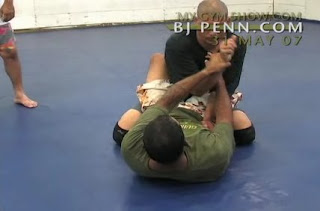 The tip is how to draw out and isolate the arm in preparation for an armlock from the guard. Charuto's point is that if you just grab the arm and stretch it, you make two mistakes: (1) if the arm is straight, then it is easier for the guy to just pull it out of your grip and (2) if you just grab the arm and try to pin it, then you will give away the fact that you are going for the armlock.
Charuto has you bring the wrist straight forward toward you, while pulling with your legs to help break posture. Then swing the arm across your body. But as you do so, come across with your other arm and bring it down across the inside of the guy's elbow. This will create the kind of bend in the arm that is necessary to keep it trapped as well as to hold off telegraphing the armlock until the last minute.
At least I'm pretty sure it's Charuto.
Charuto--real name Renato Verissimo--is one of BJ Penn's top jiu jitsu instructors. I've been looking for this video for days after first stumbling across it over at BJ Penn.com.
 The tip is how to draw out and isolate the arm in preparation for an armlock from the guard. Charuto's point is that if you just grab the arm and stretch it, you make two mistakes: (1) if the arm is straight, then it is easier for the guy to just pull it out of your grip and (2) if you just grab the arm and try to pin it, then you will give away the fact that you are going for the armlock.
Charuto has you bring the wrist straight forward toward you, while pulling with your legs to help break posture. Then swing the arm across your body. But as you do so, come across with your other arm and bring it down across the inside of the guy's elbow. This will create the kind of bend in the arm that is necessary to keep it trapped as well as to hold off telegraphing the armlock until the last minute.
Saturday, August 04, 2007


Half Guard Sweep
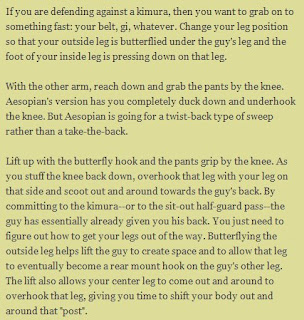
I need a name for this sweep. It's effective against the kimura from the half-guard. But it is also nice just when the guy crosses your body and puts his head on your far shoulder. This position is prerequisite for arm attacks on that side like the kimura. It also makes it impossible to do the tackle, twist or "inside" take the back moves.
So this sweep is one worth practicing.
So this sweep is one worth practicing.

Friday, August 03, 2007
De La Riva Sweep Counter to Combat Base/Jayhawk
De La Riva Sweep Counter to Combat Base
 The combat base, or Jayhawk as I code it, is a tricky thing to deal with. You'll find yourself up against it when somebody opens your closed guard and drops a knee in the middle. You also find it a lot when starting off sparring sessions from the knees. Rodrigo, Cindy and Stephan--two black belts and a high-level brown--have all started recent sparring sessions with me by adopting the Jayhawk.
There are a couple of different ways to fight it. I like this one in part because it uses the De La Riva style of guard work that Rodrigo teaches a lot of. I read somewhere on the forum that Gracie Barra guys are known for their De La Riva (along with Rickson guys allegedly). For what it is worth ...
Basically to start this sweep off, you want to put a foot in the hip and De La Riva your other foot through the knee-up leg. Your feet should come together, so that they are really locked in. Grab the knee-up side elbow and the guy's head. First pull him TOWARD you to get him off his base. Then kick him to the side with your De La Riva hook and move to block with side control.
 The combat base, or Jayhawk as I code it, is a tricky thing to deal with. You'll find yourself up against it when somebody opens your closed guard and drops a knee in the middle. You also find it a lot when starting off sparring sessions from the knees. Rodrigo, Cindy and Stephan--two black belts and a high-level brown--have all started recent sparring sessions with me by adopting the Jayhawk.
There are a couple of different ways to fight it. I like this one in part because it uses the De La Riva style of guard work that Rodrigo teaches a lot of. I read somewhere on the forum that Gracie Barra guys are known for their De La Riva (along with Rickson guys allegedly). For what it is worth ...
Basically to start this sweep off, you want to put a foot in the hip and De La Riva your other foot through the knee-up leg. Your feet should come together, so that they are really locked in. Grab the knee-up side elbow and the guy's head. First pull him TOWARD you to get him off his base. Then kick him to the side with your De La Riva hook and move to block with side control.
Thursday, August 02, 2007
Half Guard Sweep with Twist
Here's a nice quick instructional on the "twist" sweep out of the half guard. It's the compliment to Old School that I'd been talking about, and I think it is the same sweep that Tommy was talking about this spring.
In any event, this guy makes it seem very easy--more so that Bravo's Twist Back, which seems to require more leg/foot dexterity than I've got these days ...
A couple of details worth noting.
This is no gi, but is perfectly applicable to the gi. I can grab the pants at the knee instead of underhooking the knee, for example.
Also, the guy makes a good point of not just driving the guy across your hips, but diagonally. To do this, you lift as you roll, rather than just trying to haul the guy over your body.
The guy doesn't make too much noise about keeping the one leg trapped, which has been a problem for me. I suspect I'm just opening up my legs when I go to pivot, instead of just scooting my hips in, goshi-style. It also wouldn't hurt for me to get small instead of remaining stretched out ...
A last detail. Whereas with Old School you backstep to avoid winding in the other guy's guard, with this sweep--which still needs a good name ... "New School"?--you actually do a sort of sitout with the sweep side leg, bringing back under you, so that you don't just roll into the other guy's half guard.
A nice find. I'm very much looking forward to an improved half-guard game over the next few weeks.
In any event, this guy makes it seem very easy--more so that Bravo's Twist Back, which seems to require more leg/foot dexterity than I've got these days ...
A couple of details worth noting.
This is no gi, but is perfectly applicable to the gi. I can grab the pants at the knee instead of underhooking the knee, for example.
Also, the guy makes a good point of not just driving the guy across your hips, but diagonally. To do this, you lift as you roll, rather than just trying to haul the guy over your body.
The guy doesn't make too much noise about keeping the one leg trapped, which has been a problem for me. I suspect I'm just opening up my legs when I go to pivot, instead of just scooting my hips in, goshi-style. It also wouldn't hurt for me to get small instead of remaining stretched out ...
A last detail. Whereas with Old School you backstep to avoid winding in the other guy's guard, with this sweep--which still needs a good name ... "New School"?--you actually do a sort of sitout with the sweep side leg, bringing back under you, so that you don't just roll into the other guy's half guard.
A nice find. I'm very much looking forward to an improved half-guard game over the next few weeks.
Wednesday, August 01, 2007
Half Guard Hang Ups
Some resolutions and stray thoughts following Tuesday night’s training …
I’ve got three seconds from the moment I get into half guard to start executing a sweep—and to continue executing sweeps until I am (a) in a dominant position, (b) back to neutral after scramble or, (c) with the guy in full guard—closed or open.
I need to treat being on the bottom in half guard like being on the bottom in side control or something. There aren’t very many good submissions from the half, and I’m tired of being on the bottom in half guard and just defending the pass. I’ve got to focus on specifically what I want to do from the bottom in half guard. Underhook? Old School or take the back. Overhook? Tommy Sweep or the Slip.
I should also consider putting in the butterfly hook and trying the Rickson sweep, also. But the point is that I need an “agenda” when I’m on the bottom in half guard, the same way that I built “agendas” for closed guard (i.e., King Crimson, The Widow, Scissorhands, H. Rap Brown, etc.)
I should break it down into specific actions, like the unplugged. Even though I’m not hitting the arm drag like I’d like, for example, drawing up the unplugged version means that when I don’t hit the arm drag, it is NOT because I don’t know what to do. I’m just too fazy (my neologism of fatigue and lazy) to get it down.
The old school sweep is a good example. I know that sweep like the back of my hand. Yet I’ve not been coming up on the inside elbow. If I don’t do that, then I’m just wasting time—and more importantly, wasting energy. Old school. Get the underhook. Come up on the elbow. Come up on the knee. Grab the far foot. Pull and tackle. Backstep to avoid his guard and move into side control.
It’s that fucking simple. Yet I might do it properly once a week, if that.
Tommy Sweep—which needs to be renamed. Get the overhook. Dip your shoulder down and inside to get small. Hook the guy’s inside leg with your inside leg. Reach down and grab his outside leg pants at the knee. With your inside foot planted, pivot your hips inside like a hip throw/goshi and lift the guy’s outside knee up and over. Backstep to avoid his guard and move into side control.
I’ve been missing the Tommy Sweep in large part because I’ve been so committed to trapping the guy’s inside leg with my outside leg. Then, when I go to pivot, I inevitably release that trap as I pivot on my hip. That allows the guy to pull his leg out and hop right into side control. It happened again last night.
Looking for some details on the Tommy Sweep, I came across some notes from Eric Dalhberg about taking the back from half-guard that I want to look at. Those notes were based on the underhook. I’ve also got some notes for taking the back when you’ve got the overhook.
And of course there’s that great functional half-guard tutorial I’ve got on Google Video, the one that showed how to regain the underhook from the “double paw” position. The paw has been working wonderfully. But again, I’ve been using it mostly as a defensive tool, not as a tool to help me set up a sweep. That has got to change.
Bottom line: I like the half guard. But I need to make it an offensive weapon and not just a defensive one. I can use the lockdown to freeze a guy when either first getting into half guard or after a failed sweep attempt. But three seconds is all I’m giving myself after I’ve clamped that lockdown. Time to go. Time to move. Time to sweep.
I’ve got three seconds from the moment I get into half guard to start executing a sweep—and to continue executing sweeps until I am (a) in a dominant position, (b) back to neutral after scramble or, (c) with the guy in full guard—closed or open.
I need to treat being on the bottom in half guard like being on the bottom in side control or something. There aren’t very many good submissions from the half, and I’m tired of being on the bottom in half guard and just defending the pass. I’ve got to focus on specifically what I want to do from the bottom in half guard. Underhook? Old School or take the back. Overhook? Tommy Sweep or the Slip.
I should also consider putting in the butterfly hook and trying the Rickson sweep, also. But the point is that I need an “agenda” when I’m on the bottom in half guard, the same way that I built “agendas” for closed guard (i.e., King Crimson, The Widow, Scissorhands, H. Rap Brown, etc.)
I should break it down into specific actions, like the unplugged. Even though I’m not hitting the arm drag like I’d like, for example, drawing up the unplugged version means that when I don’t hit the arm drag, it is NOT because I don’t know what to do. I’m just too fazy (my neologism of fatigue and lazy) to get it down.
The old school sweep is a good example. I know that sweep like the back of my hand. Yet I’ve not been coming up on the inside elbow. If I don’t do that, then I’m just wasting time—and more importantly, wasting energy. Old school. Get the underhook. Come up on the elbow. Come up on the knee. Grab the far foot. Pull and tackle. Backstep to avoid his guard and move into side control.
It’s that fucking simple. Yet I might do it properly once a week, if that.
Tommy Sweep—which needs to be renamed. Get the overhook. Dip your shoulder down and inside to get small. Hook the guy’s inside leg with your inside leg. Reach down and grab his outside leg pants at the knee. With your inside foot planted, pivot your hips inside like a hip throw/goshi and lift the guy’s outside knee up and over. Backstep to avoid his guard and move into side control.
I’ve been missing the Tommy Sweep in large part because I’ve been so committed to trapping the guy’s inside leg with my outside leg. Then, when I go to pivot, I inevitably release that trap as I pivot on my hip. That allows the guy to pull his leg out and hop right into side control. It happened again last night.
Looking for some details on the Tommy Sweep, I came across some notes from Eric Dalhberg about taking the back from half-guard that I want to look at. Those notes were based on the underhook. I’ve also got some notes for taking the back when you’ve got the overhook.
And of course there’s that great functional half-guard tutorial I’ve got on Google Video, the one that showed how to regain the underhook from the “double paw” position. The paw has been working wonderfully. But again, I’ve been using it mostly as a defensive tool, not as a tool to help me set up a sweep. That has got to change.
Bottom line: I like the half guard. But I need to make it an offensive weapon and not just a defensive one. I can use the lockdown to freeze a guy when either first getting into half guard or after a failed sweep attempt. But three seconds is all I’m giving myself after I’ve clamped that lockdown. Time to go. Time to move. Time to sweep.
Tuesday, July 31, 2007
Gospel
From what I remember, "gospel" actually means "good news", not "rules you must follow" or "great advice." So it is in the spirit of receiving good news that I treat this entry in Roy Harris' essay, "Progression in Brazilian Jiu Jitsu."
Dan Inosanto was right: "When you're tired, you're not strong, you're not fast, you don't have good technique. When you're tired you're not even smart." I'm trying very hard to parse between situations when I know what to do, but feel I can't do it for one reason or another (read: fatigue), from those situations where I don't have any idea what to do next. Five days into the third week of post-layoff "pre-training", there are an annoyingly high number of situations in the former category relative to the latter.
The conditioning will come--I'd like things to happen sooner. But I don't see myself competing until September at the earliest. That gives me at least five weeks to get my act together, conditioning-wise. Next week I'm looking to get back to three times a week, taking Stephan's class on Wednesday's. That should help.
But there's no denying that fatigue makes you stupid. It's like your brain becomes a house with rooms you forget existed.
Fatigue also makes you cowardly. You start settling for half guard because it is better than being in guard. You settle for side control because it is better than half-guard.
I've been thinking about it for a few days now. I want to make it a point of trying to get dominant position at every opportunity. Obviously some opportunities are going to work out better than others. And those opportunities, per Harris, will be all about escaping, not merely defending. It's better to get submitted trying to complete an escape than to avoid a submission simply by not trying.
And that goes double for passing the guard.
Spider guard sweeps were the instructional. I'll do the write-up in a separate post.
Tonight, I spent more time on top trying to pass half-guard than I would have liked. Passing the half guard should be something that I can do with some consistency--if for no other reason than I spend so much time defending it.
Blue Belt
This is the belt of survival. It is the belt where the focus of your training must be on escaping from most of the inferior positions (the mount, the guard, the side mount, the wrestler's cradle and headlocks). Having the ability to escape from most inferior positions is paramount to having the ability to get on top of a person, positionally dominate them and making them tap. I know that there are a number of submissions from inferior positions (not necessarily the guard), but these submissions require a high level of speed, power and explosiveness. The reason why these submissions require speed, power and explosiveness is because your body, when placed in an inferior position, can not effectively apply leverage. To compensate for the inability to apply leverage, you substitute it with speed, power and explosiveness to effect the lock. (Anyone who tells you any different is either purposely misleading you or very unknowledgeable with grappling! I know that some may argue this point, but I stand by this point.) Not only do you have an inability to apply leverage from an inferior position, you also do not have control of your opponent's body! So now do you see why escapes are so important to building a firm foundation in grappling?
When you can easily escape the tightest pin (from just about anyone), you will find yourself on top more often. When you find yourself on top, you have more chances for submission. However, you should not jump right into submission just yet because you have not developed the skill to hold someone down with finesses and ease. I have seen too many blue belts begin their journey into submission too soon and often become frustrated because they just can't finish their opponent. They get so close, but they often fail at finishing their opponent. This usually leads the blue belt to seeking out more and more submission techniques. He thinks that the "new" and "sneaky" techniques will make him more skilled at submissions. However, what he doesn't realize is that his inability to finish his opponent is directly related to his inability to positionally dominate him. The blue belt feels good when he has escaped a hold down and has landed on top. However, he also feels like he has ONE SHOT at sinking in the submission. He knows if he fails, he will end up on his back and have to fight for the top position again. So, he usually stalls, waiting for his opponent to make a mistake so he can hopefully capitalize on it.
Once the blue belt has a firm grip on positional escapes, he should then move on to positional dominance: which is "the ability to control an opponent." When the blue belt can readily escape from most of the bottom positions, he should focus his training on learning how to control his opponent with greater ease and finesse. Although anyone can control their opponent if they can use all of their strength for short periods of time. It will take some time before a person can effortlessly hold down their opponent.
Once the blue belt has a good grip on these two aspects, he should then begin to develop a few good submissions. Still, he should not be consumed with them because there are still a few more areas to train before a lengthy period of time should be spent on submissions. (Yes, yes, yes, I know that submissions are the more enjoyable part of Brazilian Jiu Jitsu. I am not saying that you should not train them at all. However, all I am saying is this, "Don't focus on them quite yet. Wait until you are a high purple belt!")
The blue belt should have a large repertoire of positional and submission techniques. However, his depth of knowledge of these techniques is very limited because of his experience level. And because of his limited experience, he will still require a good amount of speed, power and explosiveness to effect most of his techniques. This is to be expected.
Another interesting thing happens at the blue belt level: the bar of performance raises itself to highly competitive levels. I remember when I was a white belt, it felt OK to tap to everyone because hey, I was a white belt. However, once I was promoted to blue belt, many of the bigger, stronger and more talented white belts began to set their cross-hair on me. What once was a shared journey of joy and frustration suddenly became field of itchy trigger fingered snipers. Many of the white belts who were once fellow sojourners now wanted the privilege of being able to say, "I made a blue belt tap!" It seemed like overnight the game of Jiu Jitsu suddenly became very competitive. Well, if you think the game was interesting at the blue belt level, wait until you hear about the highly regarded purple belt!
Dan Inosanto was right: "When you're tired, you're not strong, you're not fast, you don't have good technique. When you're tired you're not even smart." I'm trying very hard to parse between situations when I know what to do, but feel I can't do it for one reason or another (read: fatigue), from those situations where I don't have any idea what to do next. Five days into the third week of post-layoff "pre-training", there are an annoyingly high number of situations in the former category relative to the latter.
The conditioning will come--I'd like things to happen sooner. But I don't see myself competing until September at the earliest. That gives me at least five weeks to get my act together, conditioning-wise. Next week I'm looking to get back to three times a week, taking Stephan's class on Wednesday's. That should help.
But there's no denying that fatigue makes you stupid. It's like your brain becomes a house with rooms you forget existed.
Fatigue also makes you cowardly. You start settling for half guard because it is better than being in guard. You settle for side control because it is better than half-guard.
I've been thinking about it for a few days now. I want to make it a point of trying to get dominant position at every opportunity. Obviously some opportunities are going to work out better than others. And those opportunities, per Harris, will be all about escaping, not merely defending. It's better to get submitted trying to complete an escape than to avoid a submission simply by not trying.
And that goes double for passing the guard.
Spider guard sweeps were the instructional. I'll do the write-up in a separate post.
Sunday, July 29, 2007
Saturday, July 28, 2007
"Don't Let Him Pass Your Guard"
One of the downsides of the Cobra guard is that if the guy stands to pass and starts running around, I'm in trouble if I don't catch him with either the armdrag or the hook.
This guard pass defense move is one alternative for when I'm late. The key is that the guy's head needs to be down. He has to be about to put his weight on you. I suspect that if the guy comes in with very upright posture, as if he is going to go just for the knee on belly, this guard pass defense might not be as effective.
This guard pass defense move is one alternative for when I'm late. The key is that the guy's head needs to be down. He has to be about to put his weight on you. I suspect that if the guy comes in with very upright posture, as if he is going to go just for the knee on belly, this guard pass defense might not be as effective.
Friday, July 27, 2007
Stop Me If You've Heard This One Before ...
Two weeks back from the 3-month layoff and one thing that hasn’t changed is my difficulty in maintaining posture in the guard.
While this is obviously something I need to work on, it also makes sense that—if maintaining posture is a problem—I come up with another way of dealing with the guard that makes the posture problem irrelevant.
The solution? You guessed it: STAND.
There’s really only one good reason why I don’t try and stand to pass the guard—and I’ve said it before: laziness. I don’t mean moral laziness. Just a feeling that the effort required to stand, open and pass the guard is “too much” at any given point in time (i.e., almost always). Part of that is a mental block. But part of it is indeed a physical one: I need to get my legs in better condition so that I always “feel” strong enough to stand and pass.
In no gi, this has been especially tricky. Last night, rolling with one of the newer guys, I got caught in his guard and my posture was completely broken. He had a good armwrap on my right arm and though I never felt threatened by it, I was having a hard time staying out of the armwrap when I did manage to pull my arm free.
 It’s been said a thousand times: standing up in the guard eliminates much if not most of the submissions you can get caught by. Every single loss I’ve had in a tournament came from a submission from the guard (three armlocks and a triangle).
Again, I’ve had some difficulty with standing passes in general. But whereas I feel confident about being able to improve my standing passes in the gi, I still feel a little lost when trying to do so in no gi.
 With that in mind, here are the steps to a no gi standing pass from BJ Penn’s MyGym:
In posture, reach out and put your right hand on the mat near the guy’s hips.
Step up deep with the left leg. Your foot should be by the guy’s shoulder.
Put your left hand on the guy’s throat/collarbone, Jacare-style. You don’t want to choke him. Just to make it hard for him to sit up without choking himself.
Turn your left leg in so that your knee is pressing down on the guy’s ribs. You should be virtually perpendicular to the guy’s body. Come up to stand on both legs.
Continue turning your body (similar to the CC Grinder triangle choke escape) into him, putting pressure on with your knee. With your right hand, push down on the near knee to open the guard.
Step back once the guard opens. Bring your knee forward to that you are staggered (not front) and ready to pass the guard.
While this is obviously something I need to work on, it also makes sense that—if maintaining posture is a problem—I come up with another way of dealing with the guard that makes the posture problem irrelevant.
The solution? You guessed it: STAND.
There’s really only one good reason why I don’t try and stand to pass the guard—and I’ve said it before: laziness. I don’t mean moral laziness. Just a feeling that the effort required to stand, open and pass the guard is “too much” at any given point in time (i.e., almost always). Part of that is a mental block. But part of it is indeed a physical one: I need to get my legs in better condition so that I always “feel” strong enough to stand and pass.
In no gi, this has been especially tricky. Last night, rolling with one of the newer guys, I got caught in his guard and my posture was completely broken. He had a good armwrap on my right arm and though I never felt threatened by it, I was having a hard time staying out of the armwrap when I did manage to pull my arm free.
 It’s been said a thousand times: standing up in the guard eliminates much if not most of the submissions you can get caught by. Every single loss I’ve had in a tournament came from a submission from the guard (three armlocks and a triangle).
 Again, I’ve had some difficulty with standing passes in general. But whereas I feel confident about being able to improve my standing passes in the gi, I still feel a little lost when trying to do so in no gi.
 With that in mind, here are the steps to a no gi standing pass from BJ Penn’s MyGym:
Thursday, July 26, 2007
Take Downs and Drag Arounds
No gi tonight. A smallish class with two new brand new big guys, and a couple of guys who are just starting out also. Angela, Jason (Garcia), Steven, Lance ... Andrew showed up a little later ...
A good rough warm-up, though not as tough as last Thursdays. My conditioning is slowly coming back. But I definitely need to get back to it on Saturday and Sunday I'm thinking The 39 on Saturday and a LSD on Sunday.
We worked hip throws and then arm drag takedowns. For the hip throw, in addition to making the right inside pivot, Rodrigo emphasized bringing both hands together--almost like a wedge--and sliding your outstretched arms around the neck and over the arm to grip the tricep.
Another way of doing the move is to underhook the arm instead of wrapping the head. I didn't practice a lot of those--in part I think because I was working with a taller guy and I just didn't feel like I had much control. We drilled this standing and walking.
The arm drag was standard. The emphasis here was not letting go of the arm after you've dragged it. It will be part of the takedown eventually. Another detail was how Rodrigo had us to a short of inside leg chuck or sweep on the leg that is on the same side as the arm you are dragging. I actually remember a takedown drill where one person had to takedown everyone in class one after the other in a line. Tommy did just this armdrag takedown on everybody. I've also seen Marcelo Garcia hit it in highlight videos.
Getting a little ahead of myself ... Rodrigo showed us what the next move would be, which was to drop down and hook the drag-side leg with your leg. The move was very similar to the one Rodrigo had us do a few days ago. It's a great, great move and one that I really have to perfect since the arm drag is something I'm trying to make a big part of my game.
Sparring was pretty good. I think I rolled five or six times. In some ways it was pretty crazy; the mat seemed like a water slide and it was impossible sometimes to get a base. I did manage to get my first ever rear naked choke submission. I actually had the neck perfectly for a few seconds before I realized all I had to do was the "good to go" move and slide my other hand behind the neck. Squeeze the elbows and ta-da.
I'm not going to say that I want to pattern my game after Marcelo Garcia's. But maybe a combination of Garcia's and Rodrigo's wouldn't be so bad (with a little Leo Viera thrown in for good measure). I like Rodrigo's guard a lot: excellent use of hooks and very little inverted guard type stuff. With Garcia, the armdrag and the RNC are just gold as far as I'm concerned.
Interestingly, the afterschool special was Rodrigo showing a bunch of us how Marcelo sets up his x-guard or cross guard. Rodrigo doesn't use a whole lot of cross guard himself. But the philosophy of the hooks is very, very similar. The more I looked at it, even though I don't think Rodrigo's game and Marcelo's game are all that simiiar, both have a similar appreciation of the well-placed hook behind the knee.
The afterschool special was similar to the move from spider guard that Rodrigo showed us the other day. From Cobra guard with one knee up and one knee down, you shoot your down leg through and underhook the guy's leg. The knee up leg hooks under the guy's knee.
The underhook needs to be deep. Get that guy's leg up on your shoulder not just on your arm. Saulo makes this point about the guard pass: use your shoulder, which is stronger than just your arm.
Push out with the knee hook and straighten your body to extend the leg-on-shoulder. Take the shoot-through leg and hook it higher up on the leg compared to the knee hook. You are now in cross guard.
You can shoulder the guy over. You can stand. And if the guy tries to lower his weight on you by sitting, you roll in the direction of your leg-on-shoulder, pulling with the inside hook to take him backwards.
Rodrigo also showed a great counter. When the guy rocks back into the cross guard, Rodrigo just walked forward and then did a sort of sit out with the leg that was being double hooked. Straight into side control.
It was pretty funny having Rodrigo go over and over and over on all the variations of the cross guard, everybody's eyes like saucers, then he goes, "Okay, and here is how I would counter that."
Good stuff. During sparring, Jason (Garcia) caught me in a crazy scissor neck crank armbar for my last tap of the week. I remember Cindy catching me in a similar scissor neck crank twice in a row. So when Jason hit it, I thought I knew what was going on. But then he caught my arm. I tried to slide my arm back. But he had me perfectly, right at the elbow.
A good rough warm-up, though not as tough as last Thursdays. My conditioning is slowly coming back. But I definitely need to get back to it on Saturday and Sunday I'm thinking The 39 on Saturday and a LSD on Sunday.
We worked hip throws and then arm drag takedowns. For the hip throw, in addition to making the right inside pivot, Rodrigo emphasized bringing both hands together--almost like a wedge--and sliding your outstretched arms around the neck and over the arm to grip the tricep.
Another way of doing the move is to underhook the arm instead of wrapping the head. I didn't practice a lot of those--in part I think because I was working with a taller guy and I just didn't feel like I had much control. We drilled this standing and walking.
The arm drag was standard. The emphasis here was not letting go of the arm after you've dragged it. It will be part of the takedown eventually. Another detail was how Rodrigo had us to a short of inside leg chuck or sweep on the leg that is on the same side as the arm you are dragging. I actually remember a takedown drill where one person had to takedown everyone in class one after the other in a line. Tommy did just this armdrag takedown on everybody. I've also seen Marcelo Garcia hit it in highlight videos.
Getting a little ahead of myself ... Rodrigo showed us what the next move would be, which was to drop down and hook the drag-side leg with your leg. The move was very similar to the one Rodrigo had us do a few days ago. It's a great, great move and one that I really have to perfect since the arm drag is something I'm trying to make a big part of my game.
Sparring was pretty good. I think I rolled five or six times. In some ways it was pretty crazy; the mat seemed like a water slide and it was impossible sometimes to get a base. I did manage to get my first ever rear naked choke submission. I actually had the neck perfectly for a few seconds before I realized all I had to do was the "good to go" move and slide my other hand behind the neck. Squeeze the elbows and ta-da.
I'm not going to say that I want to pattern my game after Marcelo Garcia's. But maybe a combination of Garcia's and Rodrigo's wouldn't be so bad (with a little Leo Viera thrown in for good measure). I like Rodrigo's guard a lot: excellent use of hooks and very little inverted guard type stuff. With Garcia, the armdrag and the RNC are just gold as far as I'm concerned.
Interestingly, the afterschool special was Rodrigo showing a bunch of us how Marcelo sets up his x-guard or cross guard. Rodrigo doesn't use a whole lot of cross guard himself. But the philosophy of the hooks is very, very similar. The more I looked at it, even though I don't think Rodrigo's game and Marcelo's game are all that simiiar, both have a similar appreciation of the well-placed hook behind the knee.
The afterschool special was similar to the move from spider guard that Rodrigo showed us the other day. From Cobra guard with one knee up and one knee down, you shoot your down leg through and underhook the guy's leg. The knee up leg hooks under the guy's knee.
The underhook needs to be deep. Get that guy's leg up on your shoulder not just on your arm. Saulo makes this point about the guard pass: use your shoulder, which is stronger than just your arm.
Push out with the knee hook and straighten your body to extend the leg-on-shoulder. Take the shoot-through leg and hook it higher up on the leg compared to the knee hook. You are now in cross guard.
You can shoulder the guy over. You can stand. And if the guy tries to lower his weight on you by sitting, you roll in the direction of your leg-on-shoulder, pulling with the inside hook to take him backwards.
Rodrigo also showed a great counter. When the guy rocks back into the cross guard, Rodrigo just walked forward and then did a sort of sit out with the leg that was being double hooked. Straight into side control.
It was pretty funny having Rodrigo go over and over and over on all the variations of the cross guard, everybody's eyes like saucers, then he goes, "Okay, and here is how I would counter that."
Good stuff. During sparring, Jason (Garcia) caught me in a crazy scissor neck crank armbar for my last tap of the week. I remember Cindy catching me in a similar scissor neck crank twice in a row. So when Jason hit it, I thought I knew what was going on. But then he caught my arm. I tried to slide my arm back. But he had me perfectly, right at the elbow.
Hilo Guard
With no-gi training tonight (Thu 7/26), I’m looking at my three top closed guard sequences—King Crimson, The Widow and H. Rap Brown—as something to focus on, as well as the half guard and Cobra guard sequences.
I’m also looking at some of the tips over at BJ Penn’s My Gym. One interesting tip has to do with what I called the “Hilo Guard” sometime ago. Basically it is an open guard for no gi that involves putting both feet on the hips at the same time. This obviously gives you a lot of control over the guy’s ability to move forward. But I never really worked the Hilo guard thoroughly and BJ’s talk about open guard for no gi gave me some things to think about.
 For one, BJ says to keep your shins on the guy’s biceps and your hands around his triceps to help hold him in place. You don’t want him to get too high on your knees or too low by your ankles—both of which would make it easier for him to pass your guard. And we all know what BJ Penn’s attitude is toward letting guys pass your guard … So keep the guy on the top of your shins.
The Hilo guard works by pushing with your legs on the hips and pulling on his triceps with your hands.
BJ says that the guy will try to trap your hips by either overhooking or underhooking your leg. If he tries to go over, then just block his arm with your arm on that side. If he tries to go under, then just circle your leg at the knee counterclockwise and replace the guard.
If the guy does manage to get over your knees, then do the following: (1) raise your hips up, (2) put both hands on his shoulders and lock them out, forming a double stiff arm, (3) elbow escape to one side and replace the Hilo guard, (4) elbow escape to the other side and replace the Hilo guard.
I’m also looking at some of the tips over at BJ Penn’s My Gym. One interesting tip has to do with what I called the “Hilo Guard” sometime ago. Basically it is an open guard for no gi that involves putting both feet on the hips at the same time. This obviously gives you a lot of control over the guy’s ability to move forward. But I never really worked the Hilo guard thoroughly and BJ’s talk about open guard for no gi gave me some things to think about.
 For one, BJ says to keep your shins on the guy’s biceps and your hands around his triceps to help hold him in place. You don’t want him to get too high on your knees or too low by your ankles—both of which would make it easier for him to pass your guard. And we all know what BJ Penn’s attitude is toward letting guys pass your guard … So keep the guy on the top of your shins.
 The Hilo guard works by pushing with your legs on the hips and pulling on his triceps with your hands.
BJ says that the guy will try to trap your hips by either overhooking or underhooking your leg. If he tries to go over, then just block his arm with your arm on that side. If he tries to go under, then just circle your leg at the knee counterclockwise and replace the guard.
If the guy does manage to get over your knees, then do the following: (1) raise your hips up, (2) put both hands on his shoulders and lock them out, forming a double stiff arm, (3) elbow escape to one side and replace the Hilo guard, (4) elbow escape to the other side and replace the Hilo guard.
Wednesday, July 25, 2007
H. Rap Brown
I'm working on a new attack sequence to go along with King Crimson and The Widow. It's based in part off some success a Lake Stevens blue belt had against me earlier this spring, as well as some success I've had recently with training partners here at GB Seattle.
 If you happen to have Kid Peligro and Rodrigo Medeiros' excellent book, The Essential Guard, then you can find some of the techniques I'm putting into H. Rap Brown on pages 163, 166-167, 170, and 170-171. Four techniques total--all equally gi and no gi friendly--plus the obligatory transition to half guard and transition to Cobra guard.
We'll see how it works next week.
Peace!
 If you happen to have Kid Peligro and Rodrigo Medeiros' excellent book, The Essential Guard, then you can find some of the techniques I'm putting into H. Rap Brown on pages 163, 166-167, 170, and 170-171. Four techniques total--all equally gi and no gi friendly--plus the obligatory transition to half guard and transition to Cobra guard.
 We'll see how it works next week.
Peace!
Tuesday, July 24, 2007
Arm Drags!
How do I know I was meant to train jiu jitsu? Just last night I was working on an "armdrag unplugged" idea, trying to break down the steps of the armdrag counter to the foot grab while in Cobra guard. I pretty much figured one out, and figured I'd get around to posting it a little later.
Tonight in training what does Rodrigo have us do? Arm drags.
This has happened before. I remember a weekend trying to figure out if there were any chokes from side control that I could start working on. At the time, I was finding myself on top in side control and know really knowing how to attack with a choke threat that might bring the arms into play. I come into class on the following Monday, and Mamazinho shows us three chokes from side control.
It may not be instant karma, but it's pretty damn close.
After a blistering warm-up (the regular running with jump sprawls and froggers, which I think are swiftly becoming part of the new "regular), we started on the arm drag. Rodrigo first had us just work on the drag from the guy standing and holding your knees. He emphasized kicking the drag side foot out and gripping behind the elbow. Another key point--one that runs through so much of jiu jitsu--is to keep the grip on the arm.
The next step was the move to the back. Here, as you drag the arm, you want to use that leverage to spin around the leg on that side, hooking it with your trailing leg. The emphasis in this step was to make sure you get behind the leg, and not to the side. If you stay to the side and don't commit your body to a full spin, then you make it easier for the guy to press down on you with his knee and put you in a bad position. And with that arm grip, you want to switch hands, pinning that arm to the leg, using your inside arm to wrap them both up and your outside arm to keep you propped up.
The last part of this arm drag series was the reversal. Once you get behind the leg in step two, in order to complete the reversal you need to press forward with your inside shoulder against the guy's thigh and bring your trapping knee from the inside to the outside.
The special bonus technique was a De La Riva esque sweep from the spider guard. There were at least three variations on this: a basic reversal takedown, a standing reversal takedown, and another reversal that I can't remember. There's also a bicep slicer in there, for the record. Rodrigo encouraged us not to use it.
Here's the move: from spider guard move one foot to the belly and kick the other foot wide to the side. Take your outside leg and hook it over the trapped arm on that side (remember we're in spider guard) and under the guy's leg on that side and hook it behind his knee.
From here, release the far side/inside grip. Bring your foot-in-belly leg back and shoot it between the guy's legs. You are going to dive and underhook the far side/inside leg as in X-guard or cross guard.
Pull on the sleeve, kick out with the hook and drive forward to complete the sweep. In order to keep from hitting the bicep slicer, let go of the sleeve as you come up on top in the reversal. If you do everything else right, you won't miss it.
Tonight in training what does Rodrigo have us do? Arm drags.
This has happened before. I remember a weekend trying to figure out if there were any chokes from side control that I could start working on. At the time, I was finding myself on top in side control and know really knowing how to attack with a choke threat that might bring the arms into play. I come into class on the following Monday, and Mamazinho shows us three chokes from side control.
It may not be instant karma, but it's pretty damn close.
After a blistering warm-up (the regular running with jump sprawls and froggers, which I think are swiftly becoming part of the new "regular), we started on the arm drag. Rodrigo first had us just work on the drag from the guy standing and holding your knees. He emphasized kicking the drag side foot out and gripping behind the elbow. Another key point--one that runs through so much of jiu jitsu--is to keep the grip on the arm.
The next step was the move to the back. Here, as you drag the arm, you want to use that leverage to spin around the leg on that side, hooking it with your trailing leg. The emphasis in this step was to make sure you get behind the leg, and not to the side. If you stay to the side and don't commit your body to a full spin, then you make it easier for the guy to press down on you with his knee and put you in a bad position. And with that arm grip, you want to switch hands, pinning that arm to the leg, using your inside arm to wrap them both up and your outside arm to keep you propped up.
The last part of this arm drag series was the reversal. Once you get behind the leg in step two, in order to complete the reversal you need to press forward with your inside shoulder against the guy's thigh and bring your trapping knee from the inside to the outside.
The special bonus technique was a De La Riva esque sweep from the spider guard. There were at least three variations on this: a basic reversal takedown, a standing reversal takedown, and another reversal that I can't remember. There's also a bicep slicer in there, for the record. Rodrigo encouraged us not to use it.
Here's the move: from spider guard move one foot to the belly and kick the other foot wide to the side. Take your outside leg and hook it over the trapped arm on that side (remember we're in spider guard) and under the guy's leg on that side and hook it behind his knee.
From here, release the far side/inside grip. Bring your foot-in-belly leg back and shoot it between the guy's legs. You are going to dive and underhook the far side/inside leg as in X-guard or cross guard.
Pull on the sleeve, kick out with the hook and drive forward to complete the sweep. In order to keep from hitting the bicep slicer, let go of the sleeve as you come up on top in the reversal. If you do everything else right, you won't miss it.
Subscribe to:
Posts (Atom)