160.7 …Dressed no shoes
Thursday morning and I’m right on target. Subtracting a few pounds for the clothes, that puts me at somewhere between 159 and 157. I’ll probably have some black beans for lunch, but those should be the last carbs of the day today. There’s still some question about whether the weigh-in will be Friday night or Saturday morning. Obviously, I’d prefer the former so that I can have a somewhat normal Friday night. But I’ll deal either way.
This is why I said that I’d like to drop to a walking around weight of about 150-155, and then just eat conscientiously, but otherwise normally. I hate restricting my water intake the most, and if I could get down to 150-155, that would make some of the pre weigh-in water restriction more or less unnecessary.
Nothing fancy last night in class. Mamazinho took it relatively light on us given the tournament Saturday—though I think there were only three of us (Tommy, Griff and myself) out of the ten-odd people who showed up. I did some specific mount/escape mount work with Vinny the Blue. I could barely get my knees to the ground when I was on top, and he reversed me pretty handily each time (I got a little better toward the end.) Like me, he seems to prefer the upa to the elbow escape from mount. I then worked some specific rear mount/escape rear mount with Tommy, as well as specific side control and half guard. Tommy’s pretty good at combining the upa and elbow escape to get back to full guard or to knees. I had a typically hard time keeping him under control.
One thing I did try to do was focus on the upper body game when trying to establish and keep rear mount. After class, Chris (the purple belt from my “Risk of Ruin” evening) and I talked about how he emphasized the over/under grip more than the hooks, because the over/under will keep the guy from turning into you and you can always fight to replace the hooks—or to use your legs even without hooks to control the guy’s lower body.
Starting next week, I want to put an emphasis on taking the back. Chris also showed me some of the arm drag types of things he likes to do—an idea that echoes Tommy’s frequent use of the arm drag to set up different attacks. The great thing about the arm drag is that is crosses over pretty seamlessly from gi to no gi. Like taking the back, it’s a nice skill to have.
One thing to be wary of going forward. While I did a better job of extending the outside leg during my triangle escape against Tommy, Tommy has adjusted by moving to take my back. I think I can avoid that, but I need to think about how to tweak the triangle escape to avoid that situation. For one, I know I need to keep the pressure on the down/pinned leg and to work to pass—not just to avoid getting choked. Otherwise I give him too much time to adjust his position. I also need to be more aware of what the other guy is doing, instead of just being focused on the choking leg.
Tommy’s the only one I’ve rolled with who has made this adjustment, so there’s no reason for me to start freaking out. But now that I know that there is that vulnerability, it is something I should make sure I work to fix.
Another Tommy note: He showed us a variation on the clock choke that looks pretty fancy but is really pretty straightforward and really brings the choking pressure. You start out in the clock choke position. You want to bring your inside leg up and lay your ankle on the wrist of the choking arm. It doesn’t have to be pretty—flexibility helps, but the important thing is to get the leg in place. Your inside leg will be “butterflied” with your knee on his back and your ankle on your wrist/lower forearm. Reach over with the other hand and grab the guy’s leg on the far side. Then roll/hop over the guy’s shoulder while pulling with the choke arm and keeping the leg in place. The choke can come quickly. Trying the move with Griff, he tapped before I made it to the mat on the other side.
Not a lot of direct takeaway from Wednesday night's class for the tournament. I still am feeling strangely fatigued early on in class. I've been pretty consistent with my 3 p.m. meal, so I know it's not a fuel issue. There's a possibility that I'm fighting off the flu that Rebecca had a few weeks ago. Ironically, I've had the feeling that I "peaked" about two weeks ago when I was catching people left and right with that keylock from cross-side. I haven't been able to hit it since.
If I did "peak", then that "peak" would coincide with when Rebecca was feeling very sluggish and achy the week going into the Saturday before the last UFC (the 16th). Mamazinho reminded me to take it easy Thursday and Friday; I've got to go to class Thursday night just to keep my riddum (as GSP would say). But there's no reason to blow myself out. Then again, even if I do work hard Thursday night, I should have plenty of recovery time before Saturday morning.
I think I've figured out my goal for Saturday: a submission victory--or, failing that, an overwhelming double-digit win on points. I've won matches on points (2-0 twice, 5-0, 3-2), and I've lost by submission (two armbars and a triangle). But I haven't won a match by submission yet. Whatever else happens, that's what I want to accomplish on Saturday. And if I can't win, at least I want to lose on points, not by submission. I've got to remember that my submission losses have come from not being aggressive enough in passing the guard. If worse comes to worse, establish that rock-solid posture (having Tommy in my guard and seeing him hit that posture was instructive ...) and get set for the next pass attempt.
Thursday, September 28, 2006
Tuesday, September 26, 2006
"Coming Down the Mountain ..."
I’ve got plenty of stuff to do, but I haven’t posted since my Waterloo Moment of last week. Suffice to say that Thursday went better—nothing groundbreaking, just a good solid practice. It was no gi, so some of the specific things I’d wanted to work out weren’t going to happen. I did drills with Jim, then specific work with Shaka if I remember correctly. I actually didn’t do half-bad with Shaka in terms of escaping side control. Mostly I managed to roll him over once or twice a la my fight at the Yesler tournament this spring. Not the textbook escape, but an escape worth being able to do.
Last night I worked drills with Michelle the brown belt. Clock choke attack and defense, and a lot of rear mount attack and rear mount defense from a variety of positions. I certainly didn’t mind this work—my rear mount game is still pretty miserable. I think we finished off with specific guard attack/guard pass work. I’ve been working two passes of late: the handcuff pass and the body underhook, both of which work pretty well together.
Free sparred with Tommy, then Bruce and Joe. Tommy was hard to handle, as always, but one mistake I’m making is in my triangle choke defense and escape. Once I get ahold of the choking leg with both hands, I’ve had the tendency to stay crouched down and to try and “walk” the leg open. That might work with guys my size or skill-level, but against Tommy-caliber guys and up, that won’t be nearly enough.
What I need to do is to push down on the choking leg, pinning it to the mat, while simultaneously pushing my body into the other guy. I’m trying to create space to bring a knee through, so I can’t stay crouched down like I have been doing. Even—or especially—if the guy tries to pull your head toward him, that will only help the escape by making it easier to wedge your body between his body and that choking leg.
I knew something was missing after I’d managed to work the escape a few times without doing it properly. Getting stuck a few times lately when rolling with higher belts like Tommy and that purple belt from my “Risk of Ruin” evening was a big-tip off. Mamazinho was yelling at me last night, trying to get me to complete the escape, but I was lost. I’ve got two more sessions—Wednesday and Thursday—to try and get that right before the tournament. Tommy sounded confident that the escape will work—he’d made some adjustments to defeat it that somebody who hadn’t dealt with that escape often might not. So I’ll take his word for it.
Rolling with Bruce and, to a lesser degree Joe, showed some weaknesses in my top game—particularly when guys are effective at turning on their sides. This is where I’ve got a couple of options I should work on. One is the S-mount that Saulo talks about. The others are the brabo/d’arce choke options. A last option is the Kron choke, the winding guillotine. If there’s a common denominator, then it appears that denominator is the choke as a way of dealing with the guy who has turned on his side.
I tried that keylock with my hand behind the head on Joe once or twice, but there really was no leverage whatsoever. I half-remember Waterman trying to submit Overeem that way in a Pride event awhile back. H20 couldn’t get it either until he moved his arms back into the traditional keylock position. There may be a way of entering the proper positioning if I catch the wrist from behind the head—it seems like a nice way to sneak up on the submission. But I don’t think I can get the finish unless my arms are in front.
That’s it for now. My weight is okay for Tuesday. Wednesday morning will be the big test. I’d love to get down around 155 by Thursday night, and then glide into the weigh-in Friday evening. I think I’m around 158-159 right now. A few tentative butterflies have already found some space in my gut, but nothing too traumatic. I just want to represent well and let the chips fall where they may.
Last night I worked drills with Michelle the brown belt. Clock choke attack and defense, and a lot of rear mount attack and rear mount defense from a variety of positions. I certainly didn’t mind this work—my rear mount game is still pretty miserable. I think we finished off with specific guard attack/guard pass work. I’ve been working two passes of late: the handcuff pass and the body underhook, both of which work pretty well together.
Free sparred with Tommy, then Bruce and Joe. Tommy was hard to handle, as always, but one mistake I’m making is in my triangle choke defense and escape. Once I get ahold of the choking leg with both hands, I’ve had the tendency to stay crouched down and to try and “walk” the leg open. That might work with guys my size or skill-level, but against Tommy-caliber guys and up, that won’t be nearly enough.
What I need to do is to push down on the choking leg, pinning it to the mat, while simultaneously pushing my body into the other guy. I’m trying to create space to bring a knee through, so I can’t stay crouched down like I have been doing. Even—or especially—if the guy tries to pull your head toward him, that will only help the escape by making it easier to wedge your body between his body and that choking leg.
I knew something was missing after I’d managed to work the escape a few times without doing it properly. Getting stuck a few times lately when rolling with higher belts like Tommy and that purple belt from my “Risk of Ruin” evening was a big-tip off. Mamazinho was yelling at me last night, trying to get me to complete the escape, but I was lost. I’ve got two more sessions—Wednesday and Thursday—to try and get that right before the tournament. Tommy sounded confident that the escape will work—he’d made some adjustments to defeat it that somebody who hadn’t dealt with that escape often might not. So I’ll take his word for it.
Rolling with Bruce and, to a lesser degree Joe, showed some weaknesses in my top game—particularly when guys are effective at turning on their sides. This is where I’ve got a couple of options I should work on. One is the S-mount that Saulo talks about. The others are the brabo/d’arce choke options. A last option is the Kron choke, the winding guillotine. If there’s a common denominator, then it appears that denominator is the choke as a way of dealing with the guy who has turned on his side.
I tried that keylock with my hand behind the head on Joe once or twice, but there really was no leverage whatsoever. I half-remember Waterman trying to submit Overeem that way in a Pride event awhile back. H20 couldn’t get it either until he moved his arms back into the traditional keylock position. There may be a way of entering the proper positioning if I catch the wrist from behind the head—it seems like a nice way to sneak up on the submission. But I don’t think I can get the finish unless my arms are in front.
That’s it for now. My weight is okay for Tuesday. Wednesday morning will be the big test. I’d love to get down around 155 by Thursday night, and then glide into the weigh-in Friday evening. I think I’m around 158-159 right now. A few tentative butterflies have already found some space in my gut, but nothing too traumatic. I just want to represent well and let the chips fall where they may.

Wednesday, September 20, 2006
Risk of Ruin
There's a concept in speculation--whether you are trading options or playing poker--called "risk of ruin". It's basically a mathematical formula that determines how likely you are to go broke given a certain amount of starting capital (or bankroll, for gamblers) and a certain risk level. The bottom line of risk of ruin analysis is that if you want to speculate, you better have enough of a cushion to be able to take the inevitable losses before you start winning with any regularity. In other words, if you go to the horsetrack with $100 and decide to gamble big all day long, your risk of ruin is pretty damn high. On the other hand, if you hit the casino with $1,000 and play nickel slots, then there's a pretty good chance you'll leave the building with something other than your clenched fists in your pockets. You might not get rich. You might not make a dime. But you probably won't be ruined.
So if somebody had told me on the drive over to training tonight, that I'd spend ten minutes doing specific drills with a 185 pound purple belt, another five or six minutes in free sparring with that same purple belt, and then asked me how I think I'd do "working on my top game" in preparation for next week's tournament, well, you wouldn't need to be a math whiz to calculate my risk of ruin for the evening.
I'm not going to dwell on it. I've had lousy training sessions before and I'll have plenty more before I'm finally carried off the mat kicking, screaming and bleeding. And, as Rebecca reminded me when I got home, I don't need to carry a negative attitude into a tournament less than two weeks from now that I desperately want to win first place at. But my lousy performance tonight is more than a little hard to choke down, and I'm pretty sure my voice cracked more than once before I figured I better get the hell out of the academy before I embarassed myself.
There are a lot of specific things to mention. Tommy as usual had some constructive and positive things to say--some of which he's tried to tell me before. But I don't have the presence to get into it right now. There's an argument that Mamazinho is putting me with tough guys because he thinks I'm good enough to not be matched up with, well, not so tough guys. Sort of like how he got on my case a little bit after my last tournament loss: if he didn't give a damn, then he wouldn't have bothered getting upset.
But if I'm not going to start punching holes in walls, I'm not going to waste time making lemonade out of lemons, either. It was what it was. A week of good training, a couple of submission victories on the 30th and, except for this post, tonight won't even be a memory.
So if somebody had told me on the drive over to training tonight, that I'd spend ten minutes doing specific drills with a 185 pound purple belt, another five or six minutes in free sparring with that same purple belt, and then asked me how I think I'd do "working on my top game" in preparation for next week's tournament, well, you wouldn't need to be a math whiz to calculate my risk of ruin for the evening.
I'm not going to dwell on it. I've had lousy training sessions before and I'll have plenty more before I'm finally carried off the mat kicking, screaming and bleeding. And, as Rebecca reminded me when I got home, I don't need to carry a negative attitude into a tournament less than two weeks from now that I desperately want to win first place at. But my lousy performance tonight is more than a little hard to choke down, and I'm pretty sure my voice cracked more than once before I figured I better get the hell out of the academy before I embarassed myself.
There are a lot of specific things to mention. Tommy as usual had some constructive and positive things to say--some of which he's tried to tell me before. But I don't have the presence to get into it right now. There's an argument that Mamazinho is putting me with tough guys because he thinks I'm good enough to not be matched up with, well, not so tough guys. Sort of like how he got on my case a little bit after my last tournament loss: if he didn't give a damn, then he wouldn't have bothered getting upset.
But if I'm not going to start punching holes in walls, I'm not going to waste time making lemonade out of lemons, either. It was what it was. A week of good training, a couple of submission victories on the 30th and, except for this post, tonight won't even be a memory.
Tuesday, September 19, 2006
Two Weeks 'Til
Two weeks out from the tournament ... last night, Monday, was a C+ performance in training. I gassed a lot quicker than I'd thought I would while sparring with Clint, who is an especially important guy for me to roll with insofar as he is a quality blue belt in my weight class. He caught me with an omoplata after a scramble. I'd managed to reverse out of his side control into my side control, but my side control game is still too prehistoric to catch advanced belts.
Rolling with Tommy during the specific drill that had us starting from side control was certainly testament to that. He got out of my side control repeatedly and I think I might have managed one escape to knees when he was on top, but that would have been it. I need to remember Ray's dictum in terms of getting out of side control, that I've boiled down to: THROAT, SWIM, WALK, FLAT, PULL, BOOM! Just for practice/preparation sake, I need to find myself in side control tomorrow night at least a few times to try and get this escape ingrained in body memory.
A little more active from the top Monday night, but still not where I want to be. If I'm not getting a submission, then I need to rack up the points. I liked my movement back and forth from side control to north/south--though I did a lousy job of working either of Mamazinho's armbar or kimura from north/south. For some reason I completely neglected the south-facing side control, which would have helped a lot against Mike the white belt, who is pretty good at replacing the guard.
I mentioned Mamazinho's armbar and kimura from north/south. One key to remember is that you want to put your knee deep in the side of the arm you are attacking. In a way, it is similar to what you are trying to do when attacking the arm from the guard. By wedging your leg in there, you trap the arm and make it easier to isolate and exploit. I need to remember that.
That reminds me of something else I've been thinking: after the tournament on the 30th, I think I'm going to exclusively practice armbars from the guard--it has truly become my worst technique. But that's what I thought about the triangle choke also ...
And THAT reminds me of something else. I was trying to work the arm wrap choke against Clint. I got farther along this time, but still couldn't pull it off. I want to keep working that as one of my key techniques from the guard. But I also need to open things up with the Tommy's Spider Guard Triangle/Omoplata combo. I haven't been playing much open guard, at all. I may not wind up with somebody in my guard on the 30th or not. But I don't want to be paralyzed if it happens. I've got plenty of things to do from the guard--and that open guard triangle/omoplata is one of them.
Rolling with Tommy during the specific drill that had us starting from side control was certainly testament to that. He got out of my side control repeatedly and I think I might have managed one escape to knees when he was on top, but that would have been it. I need to remember Ray's dictum in terms of getting out of side control, that I've boiled down to: THROAT, SWIM, WALK, FLAT, PULL, BOOM! Just for practice/preparation sake, I need to find myself in side control tomorrow night at least a few times to try and get this escape ingrained in body memory.
A little more active from the top Monday night, but still not where I want to be. If I'm not getting a submission, then I need to rack up the points. I liked my movement back and forth from side control to north/south--though I did a lousy job of working either of Mamazinho's armbar or kimura from north/south. For some reason I completely neglected the south-facing side control, which would have helped a lot against Mike the white belt, who is pretty good at replacing the guard.
I mentioned Mamazinho's armbar and kimura from north/south. One key to remember is that you want to put your knee deep in the side of the arm you are attacking. In a way, it is similar to what you are trying to do when attacking the arm from the guard. By wedging your leg in there, you trap the arm and make it easier to isolate and exploit. I need to remember that.
That reminds me of something else I've been thinking: after the tournament on the 30th, I think I'm going to exclusively practice armbars from the guard--it has truly become my worst technique. But that's what I thought about the triangle choke also ...
And THAT reminds me of something else. I was trying to work the arm wrap choke against Clint. I got farther along this time, but still couldn't pull it off. I want to keep working that as one of my key techniques from the guard. But I also need to open things up with the Tommy's Spider Guard Triangle/Omoplata combo. I haven't been playing much open guard, at all. I may not wind up with somebody in my guard on the 30th or not. But I don't want to be paralyzed if it happens. I've got plenty of things to do from the guard--and that open guard triangle/omoplata is one of them.
Monday, September 18, 2006
Response from Ryan Hall
How about that? I posted a comment at the blog of Lloyd Irvin purple belt, Ryan Hall and, as he's done with many other commenters, he answered back.
Nothing earth-shattering to report, but it was good of him to respond and his comments to get at something I've suspected about developing your skills and talents to the maximum.
Here's what I wrote:
And here's Ryan's response:
A lot of that was my suspicion. If you develop a technique or two (a submission technique) and become very, very good at it, then that allows you to hang with others whose all-around game might be much better. Not only that, but it also allows you to have a gameplan to rely on, while working on other areas of your game that (a) aren't as strong and (b) aren't what your opponent is looking for. In Ryan's case, his triangle choke attack keeps him in just about every match he's going to be in, even if he ends up winning the fight with another submission (i.e., the heel hook in his last open weight match as a blue belt.)
Since I'm such a big Ryan Hall fan and an even bigger fan of Lloyd Irvin's "project" to show us how Ryan Hall progresses, I want to post his note on his blog that talks about his recent earning of his purple belt. I like reading this kind of thing from time to time. So this will have it here at the ready the next time I'm in a mood for inspiration.
Ryan Hall Comments on Getting the Purple Belt
Nothing earth-shattering to report, but it was good of him to respond and his comments to get at something I've suspected about developing your skills and talents to the maximum.
Here's what I wrote:
Excellent work on the latest video. Keep ‘em coming as fast as you can put them up. I find it incredibly helpful as I study BJJ (about 14 months now) to listen to you describe what you are trying to do in the moment. I’ve done okay in local tournaments (4-3 with one first place finish in four events), but my biggest problem is “getting lost” in the middle of a match. Listening to you narrate your matches helps show me how to “think through” what I want to do when I’m competing. I even modelled a gameplan after one of the sample ones of yours that Master Lloyd provided in a e-mail.
Here’s my question. Your gameplan seems long and very detailed. It is possible–especially at my level–to use a much smaller, more truncated gameplan focusing on a few techniques and still be effective?
Keep up the great work. You’ve got a fan in Seattle.
And here's Ryan's response:
Thanks for posting, and I’m glad that you’re finding the blog helpful.
In terms of using a more truncated gameplan successfully, I would say with 100% confidence that it will work for you. The gameplan that was initially sent out via the e-mail list was not my first crack at a gameplan, and that one is nowhere near as detailed as my current one. Each incarnation of your gameplan will be increasingly detailed and specific. That said, nothing starts out complex, and even a basic outline of how you will structure your training and competition is extremely useful. One thing to keep in mind is that, even once your gameplan becomes more flesched out, you don’t need 15 techniques from every position. You need only a couple that you can successfully use on almost anyone. It doesn’t matter if I think you only have a loop choke from your open guard as long as you can set it up in a variety of ways and you catch me with it anyway. Mariano Rivera (Yankees closer, and greatest postseaon closer in baseball history) has two pitches, and everyone knows about them. Hit them if you can.
If you can develp a true “A-game” that can be used on anyone, you will be immediately successful in competition. You will always have a goal from each position and situation (even if that goal is only to get back to a position from which you can begin to launch your “A-game” offense again), and you will not be prone to freezing in pressure situation. If you can triangle black belts as a blue belt, you can triangle anyone that you might match up against. Everyone except the very best will have to be so paranoid about your #1 attacks, that all of your follow-ups will come more easily.
Hope that helps. Thanks again for posting.
A lot of that was my suspicion. If you develop a technique or two (a submission technique) and become very, very good at it, then that allows you to hang with others whose all-around game might be much better. Not only that, but it also allows you to have a gameplan to rely on, while working on other areas of your game that (a) aren't as strong and (b) aren't what your opponent is looking for. In Ryan's case, his triangle choke attack keeps him in just about every match he's going to be in, even if he ends up winning the fight with another submission (i.e., the heel hook in his last open weight match as a blue belt.)
Since I'm such a big Ryan Hall fan and an even bigger fan of Lloyd Irvin's "project" to show us how Ryan Hall progresses, I want to post his note on his blog that talks about his recent earning of his purple belt. I like reading this kind of thing from time to time. So this will have it here at the ready the next time I'm in a mood for inspiration.
Ryan Hall Comments on Getting the Purple Belt
Saturday, September 16, 2006
B.J. Penn and Northwest FightScene
Here's a nice write-up on a B.J. Penn grappling seminar held in Oregon back in July. Two of the techniques, which are shown pretty well in this write-up, are especially interesting to me: the guard pass--or more accurately the opening of the guard before the pass, and a way of going from stacking to take-the-back.
There's a nice twist on the standing guard pass that BJ uses. Not only does he use the L-stance (north leg parallel to body, south leg perpendicular) pretty much as Saulo emphasizes. But also he keeps the north leg tight against the guy's hip, driving his knee down and into the thigh on the one side as he turns toward the opposite leg's knee.

It's like a stand and twist movement, pushing down against that knee on the one side and twisting against the leg on the other side. B.J. put his down hand (north side hand) on the bottom guy's throat, which is something I'm not so comfortable with even though I've seen more and more jiu jitsu guys using the throat to hold the guy's upper body down (i.e., Jacare's second fight in the 2005 ADCC).
In any event, I want to try that stand and twist, as opposed to the "walking around" motion that Saulo talks about. The solution is probably a hybrid of the two. But in addition to the Knee Drop and the Wrist Cuff, this would be a nice "opening the guard" technique to have at my disposal.
There's a nice twist on the standing guard pass that BJ uses. Not only does he use the L-stance (north leg parallel to body, south leg perpendicular) pretty much as Saulo emphasizes. But also he keeps the north leg tight against the guy's hip, driving his knee down and into the thigh on the one side as he turns toward the opposite leg's knee.
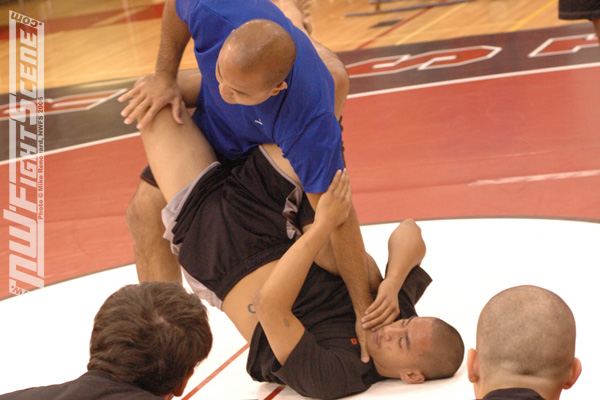
It's like a stand and twist movement, pushing down against that knee on the one side and twisting against the leg on the other side. B.J. put his down hand (north side hand) on the bottom guy's throat, which is something I'm not so comfortable with even though I've seen more and more jiu jitsu guys using the throat to hold the guy's upper body down (i.e., Jacare's second fight in the 2005 ADCC).
In any event, I want to try that stand and twist, as opposed to the "walking around" motion that Saulo talks about. The solution is probably a hybrid of the two. But in addition to the Knee Drop and the Wrist Cuff, this would be a nice "opening the guard" technique to have at my disposal.
Wednesday, September 13, 2006
Planning for Wednesday Night
I had a pretty good training session on Monday. My work from on top is getting more consistent. There are still a couple of specific things I want to tighten up, though.
Passing the guard: A little better here. There are really two steps: opening the guard and then actually passing the guard. I haven’t been working the Saulo pass like I should. But I have done better with the Knee drop pass. In fact I managed to open Joe’s guard using it—though it took a little bit of extending my knee and pushing back to finally pop the latch. The Knee drop is a big no-gi pass, so I’m liking the fact that I was able to get it to work with the gi. Tonight I should put more emphasis on the Gracie Barra and Cesar Gracie standing passes.
In terms of passing the knees, shortly after working the Knee drop on Joe I managed to hit Bravo’s Staple Gun pass to get to side control. That was pretty amazing insofar as I’d never practiced that one, or even looked at it much in the book. It also involves that backstep that Rodrigo loves, but that I don’t see a lot of guys using. Bravo talks about alternating between the Staple Gun and the Underpass—the Underpass being that one pass I remember Leo Viera working against someone (Rob Di Censo?) with a very good butterfly type guard with sick hip flexibility.
Tommy showed us a few other passes, some of them with definite Cindy influences (“the Cindy Hop”), and some of them reminiscent of what Mamazinho taught us recently in terms of stepping between the knees and underhooking the far arm, and some that reminded me of the pass that Rodrigo showed us awhile back where you step to the outside of the leg near the hip and sort of backstep to the north, winding up in south-facing/Twister side control type position.
Tommy’s were all standing passes, compared to Bravo’s Underpass and Staple Gun. Ideally, I’ll get all of these down. For now, I want to focus on the Underpass and the Staple Gun.
From the bottom: Two main issues here: escaping rear mount and sweeping from the half guard.
As much as I like the Saulo escape from rear mount, I want to work the more standard, Mamazinho version for the next few sessions. Let’s remember the basics:
Escaping rear mount
1. Defend the neck and follow the fingers: Use the choke side arm to defend the neck
2. Put your head on the mat: Shift your body and put your head (and shoulders if possible) on the mat AWAY from the choke.
3. Block the far leg and elbow escape back in: Use the far hand to block or grab the guys’ far leg so he won’t roll over and take the mount. Take the inside arm—the one that was defending the neck—and drop that elbow to the mat as you turn into the guy, rolling him over into side control.
The other thing I want to work on is sweeping from the half guard. In addition to the two that Mamazinho showed us a little while back, one where you replace the full guard and one where you take the back, I’ve got three from Bravo: Old School, Plan B and Twist Back. What is most important right now is that I get my half guard set up properly. The trick is to have your inside leg straight down the middle between the guy’s legs. The outside leg wraps over the guy’s outside leg.
To actually close the half guard, you hook the foot of the outside leg under the calf of the inside leg.
There are other things I should work on tonight, of course. My work from the guard has gotten a little weaker, and I haven’t hit the Shaka sweep in several classes. I also haven’t been working Tommy’s Spider Triangle/Omoplata like I should. I should probably start more sparring sessions by pulling guard, trying to get the sweep or submission, and then working my top game if I don’t get the sub from the bottom. Last class, I took down all three guys with throws from the knees. That doesn’t replicate anything that’s likely to happen in a tournament, so I shouldn’t get accustomed to doing this too often.
Passing the guard: A little better here. There are really two steps: opening the guard and then actually passing the guard. I haven’t been working the Saulo pass like I should. But I have done better with the Knee drop pass. In fact I managed to open Joe’s guard using it—though it took a little bit of extending my knee and pushing back to finally pop the latch. The Knee drop is a big no-gi pass, so I’m liking the fact that I was able to get it to work with the gi. Tonight I should put more emphasis on the Gracie Barra and Cesar Gracie standing passes.
In terms of passing the knees, shortly after working the Knee drop on Joe I managed to hit Bravo’s Staple Gun pass to get to side control. That was pretty amazing insofar as I’d never practiced that one, or even looked at it much in the book. It also involves that backstep that Rodrigo loves, but that I don’t see a lot of guys using. Bravo talks about alternating between the Staple Gun and the Underpass—the Underpass being that one pass I remember Leo Viera working against someone (Rob Di Censo?) with a very good butterfly type guard with sick hip flexibility.
Tommy showed us a few other passes, some of them with definite Cindy influences (“the Cindy Hop”), and some of them reminiscent of what Mamazinho taught us recently in terms of stepping between the knees and underhooking the far arm, and some that reminded me of the pass that Rodrigo showed us awhile back where you step to the outside of the leg near the hip and sort of backstep to the north, winding up in south-facing/Twister side control type position.
Tommy’s were all standing passes, compared to Bravo’s Underpass and Staple Gun. Ideally, I’ll get all of these down. For now, I want to focus on the Underpass and the Staple Gun.
From the bottom: Two main issues here: escaping rear mount and sweeping from the half guard.
As much as I like the Saulo escape from rear mount, I want to work the more standard, Mamazinho version for the next few sessions. Let’s remember the basics:
Escaping rear mount
1. Defend the neck and follow the fingers: Use the choke side arm to defend the neck
2. Put your head on the mat: Shift your body and put your head (and shoulders if possible) on the mat AWAY from the choke.
3. Block the far leg and elbow escape back in: Use the far hand to block or grab the guys’ far leg so he won’t roll over and take the mount. Take the inside arm—the one that was defending the neck—and drop that elbow to the mat as you turn into the guy, rolling him over into side control.
The other thing I want to work on is sweeping from the half guard. In addition to the two that Mamazinho showed us a little while back, one where you replace the full guard and one where you take the back, I’ve got three from Bravo: Old School, Plan B and Twist Back. What is most important right now is that I get my half guard set up properly. The trick is to have your inside leg straight down the middle between the guy’s legs. The outside leg wraps over the guy’s outside leg.
To actually close the half guard, you hook the foot of the outside leg under the calf of the inside leg.
There are other things I should work on tonight, of course. My work from the guard has gotten a little weaker, and I haven’t hit the Shaka sweep in several classes. I also haven’t been working Tommy’s Spider Triangle/Omoplata like I should. I should probably start more sparring sessions by pulling guard, trying to get the sweep or submission, and then working my top game if I don’t get the sub from the bottom. Last class, I took down all three guys with throws from the knees. That doesn’t replicate anything that’s likely to happen in a tournament, so I shouldn’t get accustomed to doing this too often.
Tuesday, September 12, 2006
Keylock Nation Meets the Staple Gun
A good night on the mat: laps, several sets of 50 crunches, four sets of 25 pushups and line throws for warmup. Then some work against the turtle defense. Mamazinho showed us a shoulder roll to transition the guy from turtle to rear-mounted that requires reaching under both arms and getting a tight grip on the collars. That, and watching your head when you go into the roll.
He also showed us the basic wrestler’s sit-out for when you are in the turtle defense and the guy on top has you around the waist. You want to grab the wrist to trap the arm on one side and, on that same side, post a leg out. Grab the pants by the knee on the other side. Now, sit out by shooting your pants-grab-side leg between your posted leg and the guy. As you do this, keep your head tucked tight against his body as you shoot under and around to move to the back.
We did a lot of specific work. I worked with Joe in the drills and Clint in the specific sparring. One minute mount, one minute side control, one minute half-guard, one minute rear mount, one minute passing the guard—I was pretty whipped after twelve minutes of that.
Sparring went pretty well. I rolled with Clint first and actually caught him in a keylock, which is obviously my best submission hold at this point. I was in the best position for the arm-wrap choke that I’d ever been in against Clint also, but wasn’t able to close the deal. I think the problem was that I didn’t push off on the arm-wrap side hip to get a better angle for the choke with the other hand.
I rolled with a new white belt (relatively new, at least). He had a few pounds on me, but that was about it. I caught him in a keylock also, and he tapped as I was trying to put him in a katagatame twice. I need to remember to go to guard against guys like this and work my bottom game, especially sweeps and arm-wrap combinations.
Last I rolled with Joe. I couldn’t catch him in anything. But I did do a pretty good guard pass, Eddie Bravo’s “staple gun,” that involves underhooking one leg and pinning the other (preferably to the mat, but stuffing it in a butterfly hook is okay). Basically, you want to pin the guy’s pass side leg with your non-pass side leg (or just jam it) and move your pass side to the outside a bit. Then, backstep with your non-pass side leg while keeping the other leg underhooked to prevent him from turning into you and blocking the pass.
I was surprised that I got it. Very few folks use the backstep consistently—it is one of Rodrigo’s favorite ways to get around a guy’s defenses. I want to try and integrate it more into what I do. Bravo talks about going back and forth between the underpass and the staple gun. I might try that combo for the next few weeks and see if it sticks.
After class, Tommy showed us a couple of moves. He’s got a Cindy-style guard pass where he just hops over the guy’s knees and then turns around and drops into side control. It’s a little risky because for a moment you’re back is turned to the guy. But the hop over is often surprising enough that you can make the move work. Tommy’s big on improve. I’m less comfortable with that and feel like I need to have more of my game mapped out. But that could just be a matter of familiarity with the various positions in jiu jitsu. Rickson is big on improv also (“you must allow yourself to be at a zero point … connected with the variations”).
More importantly, though, Tommy reminded me/us of those "passing the knees" moves that Rodrigo was showing us months and months ago. There's the variation where you step around the knees and put your knee down on the stomach and drop into south-facing side control. And there's the variation where you step in between the knees, underhook against the non-pass side arm and bring the between-the-knees knee across the pass side knee. I need to bring these guard pass variations into the mix, also.
He also showed us the basic wrestler’s sit-out for when you are in the turtle defense and the guy on top has you around the waist. You want to grab the wrist to trap the arm on one side and, on that same side, post a leg out. Grab the pants by the knee on the other side. Now, sit out by shooting your pants-grab-side leg between your posted leg and the guy. As you do this, keep your head tucked tight against his body as you shoot under and around to move to the back.
We did a lot of specific work. I worked with Joe in the drills and Clint in the specific sparring. One minute mount, one minute side control, one minute half-guard, one minute rear mount, one minute passing the guard—I was pretty whipped after twelve minutes of that.
Sparring went pretty well. I rolled with Clint first and actually caught him in a keylock, which is obviously my best submission hold at this point. I was in the best position for the arm-wrap choke that I’d ever been in against Clint also, but wasn’t able to close the deal. I think the problem was that I didn’t push off on the arm-wrap side hip to get a better angle for the choke with the other hand.
I rolled with a new white belt (relatively new, at least). He had a few pounds on me, but that was about it. I caught him in a keylock also, and he tapped as I was trying to put him in a katagatame twice. I need to remember to go to guard against guys like this and work my bottom game, especially sweeps and arm-wrap combinations.
Last I rolled with Joe. I couldn’t catch him in anything. But I did do a pretty good guard pass, Eddie Bravo’s “staple gun,” that involves underhooking one leg and pinning the other (preferably to the mat, but stuffing it in a butterfly hook is okay). Basically, you want to pin the guy’s pass side leg with your non-pass side leg (or just jam it) and move your pass side to the outside a bit. Then, backstep with your non-pass side leg while keeping the other leg underhooked to prevent him from turning into you and blocking the pass.
I was surprised that I got it. Very few folks use the backstep consistently—it is one of Rodrigo’s favorite ways to get around a guy’s defenses. I want to try and integrate it more into what I do. Bravo talks about going back and forth between the underpass and the staple gun. I might try that combo for the next few weeks and see if it sticks.
After class, Tommy showed us a couple of moves. He’s got a Cindy-style guard pass where he just hops over the guy’s knees and then turns around and drops into side control. It’s a little risky because for a moment you’re back is turned to the guy. But the hop over is often surprising enough that you can make the move work. Tommy’s big on improve. I’m less comfortable with that and feel like I need to have more of my game mapped out. But that could just be a matter of familiarity with the various positions in jiu jitsu. Rickson is big on improv also (“you must allow yourself to be at a zero point … connected with the variations”).
More importantly, though, Tommy reminded me/us of those "passing the knees" moves that Rodrigo was showing us months and months ago. There's the variation where you step around the knees and put your knee down on the stomach and drop into south-facing side control. And there's the variation where you step in between the knees, underhook against the non-pass side arm and bring the between-the-knees knee across the pass side knee. I need to bring these guard pass variations into the mix, also.
Friday, September 08, 2006
Humble Pie
Last night’s time on the mats in a lot of ways mirrored yesterday’s experience in the market. I lost money on bullish bets across the board, slow-moving big caps like Budweiser, speculative nonsense like Sun Microsystems and a field bet on the Nasdaq 100.
They were timely exits. I owned September calls, which meant that my positions in those three beasts had to reach a certain point by next Friday or I’d lose it all. Budweiser got whacked first and hardest, and after a few minutes of anxiety I decided to do the right thing and dump the position. Sun Micro looked like it was moving too vertically so that one had to go also. And the Nasdaq position hit a mandatory exit point, so bye bye QQQQ.
So I did the right thing, but lost money. Trading is like that much of the time.
I spent most of my time last night with higher belts about my size: Shaka with Greco takedown drills, later “king of the guard” with Tommy, Alex the Purple and Clint. Though I did okay in the general takedown work, I couldn’t do anything against Shaka when we started with double underhooks. He pretty much took me down at will—a good reminder not to let somebody get double underhooks.
“King of the Guard” was another exercise in humility. I don’t think I was ever in Clint’s guard. But I worked a few times against Tommy and Alex, mostly trying to work the wrist pin pass that worked on Clint back on Tuesday night. No dice. Tommy showed me a guard pass that is similar to the Saulo no-gi guard pass only where Saulo pinches his knees in to pop the guard open, Tommy uses his elbows to push out. I wonder how those two would work as a combo. I wouldn’t mind seeing Tommy work that pass again—I feel as if there is a detail I’m missing. But it was working for him last night.
Sparring was with Shaka, then Tommy, then Mike (the tall Asian white belt). As I said to Griff later, I’m still getting schooled by the guy’s who are supposed to school me. Shaka was typically hard to deal with and caught me in a couple of different submissions. Tommy was little different, catching me in body triangles twice I think and making me work hard to avoid some triangles. My time with Mike was a change of pace in that regard as I was able to work two keylocks against him in about six minutes.
There are two techniques I want to get some clarification on, both of which are ones that Mamazinho showed us. Tommy pointed out the idea of underhooking the far arm during a guard pass, which is what reminded me of the pass that Mamazinho showed us. There was also a way of dealing with the knees that I remember Mamazinho showing Lindsey weeks ago. I remember the general points, but know that I’m leaving out some crucial details.
Three training sessions in a row … it will be nice to get a break and digest some of what we’ve worked on and I’m trying to work through. Next week I’ll get back to two gi nights and one no-gi and try to get my “tournament” game a little tighter. I’m still convinced that the difference between placing and not placing will be my ability to pass the guard. That’s been the case in all seven tournament matches I’ve had over the past year. I don’t want to make it sound like it’s all cake after that. But I pass the guard—or even maintain a solid base and posture in the guard—and two of my three losses become wins.
They were timely exits. I owned September calls, which meant that my positions in those three beasts had to reach a certain point by next Friday or I’d lose it all. Budweiser got whacked first and hardest, and after a few minutes of anxiety I decided to do the right thing and dump the position. Sun Micro looked like it was moving too vertically so that one had to go also. And the Nasdaq position hit a mandatory exit point, so bye bye QQQQ.
So I did the right thing, but lost money. Trading is like that much of the time.
I spent most of my time last night with higher belts about my size: Shaka with Greco takedown drills, later “king of the guard” with Tommy, Alex the Purple and Clint. Though I did okay in the general takedown work, I couldn’t do anything against Shaka when we started with double underhooks. He pretty much took me down at will—a good reminder not to let somebody get double underhooks.
“King of the Guard” was another exercise in humility. I don’t think I was ever in Clint’s guard. But I worked a few times against Tommy and Alex, mostly trying to work the wrist pin pass that worked on Clint back on Tuesday night. No dice. Tommy showed me a guard pass that is similar to the Saulo no-gi guard pass only where Saulo pinches his knees in to pop the guard open, Tommy uses his elbows to push out. I wonder how those two would work as a combo. I wouldn’t mind seeing Tommy work that pass again—I feel as if there is a detail I’m missing. But it was working for him last night.
Sparring was with Shaka, then Tommy, then Mike (the tall Asian white belt). As I said to Griff later, I’m still getting schooled by the guy’s who are supposed to school me. Shaka was typically hard to deal with and caught me in a couple of different submissions. Tommy was little different, catching me in body triangles twice I think and making me work hard to avoid some triangles. My time with Mike was a change of pace in that regard as I was able to work two keylocks against him in about six minutes.
There are two techniques I want to get some clarification on, both of which are ones that Mamazinho showed us. Tommy pointed out the idea of underhooking the far arm during a guard pass, which is what reminded me of the pass that Mamazinho showed us. There was also a way of dealing with the knees that I remember Mamazinho showing Lindsey weeks ago. I remember the general points, but know that I’m leaving out some crucial details.
Three training sessions in a row … it will be nice to get a break and digest some of what we’ve worked on and I’m trying to work through. Next week I’ll get back to two gi nights and one no-gi and try to get my “tournament” game a little tighter. I’m still convinced that the difference between placing and not placing will be my ability to pass the guard. That’s been the case in all seven tournament matches I’ve had over the past year. I don’t want to make it sound like it’s all cake after that. But I pass the guard—or even maintain a solid base and posture in the guard—and two of my three losses become wins.
Thursday, September 07, 2006
Running on Empty
I almost feel as if some of the gains I’ve made in the past few weeks were undone last night. It was Wednesday, so we were back in the gi I love so much. And maybe it was because we’d just done no gi the night before, maybe it was because I’m not taking in enough carbs to keep me fueled until 7 or 8 at night, but I felt like I gassed way too hard and way too quickly last night.
Mamazinho showed us a couple of variations out dealing with the turtle position. First, he showed us how to move from facing the turtle to taking the back. This is a standard move where you reach across the turtle’s back with your opposite hand while doing a backstep with the leg on the other side. For example, you would reach over his back with your right hand and do the backstep with your left leg. You want to control the inside elbow as you backstep and then slide your inside knee between his arm and his body for superior control. With that far hand, reach under and control the wrist.
From this position, Mamazinho showed us the infamous clock choke. You reach under the neck and get a good choking grip. Then walk forward around and toward the head with your outside leg. From here, you want to step through with your inside leg while putting all your weight on the turtle’s inside shoulder. Pull up to get the choke—though most of the work will come from your weight bearing down on the shoulder.
Last there was a counter to the clock choke. Mamazinho reminded us to NEVER, NEVER, NEVER turn away from a choke—ALWAYS look to turn into it somehow. In this counter, the turtle grabs the choking arm/hand with his outside hand. Then you (as the turtle) want to sit in with your inside leg while snaking your inside arm preferably around the waist—though I was only able to get my arm around the top guy’s inside leg. Then, turning into the top guy, roll him over your hips, turning your inside shoulder up first.
I was able to do it fairly well in drills. But when Mamazinho had us do it as a specific sparring drill, I was more of a mixed bag. I was able to hit it against the tall Asian white belt I’ve been sparring with a lot lately, but not once against Tommy.
From there we went into some more specific sparring: side control, mount and take the back. Like I said, maybe there were a hundred reasons why I just didn’t have the juice last night, but by the time we got to the take the back work, I was spent.
As for sparring, I still managed to get three rolls in. That’s pretty much my standard—I don’t want to go too many sessions where I don’t get at least that many “free rolls”. I rolled with that new guy that Rebecca met, then with Tommy and then with Stephan. As you can see the night didn’t get any easier. I managed to get a forearm choke on the new guy, a white belt who’s probably a little heavier than I am but not much. But by the time I got to Tommy I was starting to fade.
What’s worse about fading like that is that while my body is tired, it is my ability to think clearly that is really what gets hit. I feel like I have to stop and crank up my brain like an old Model T just to get it in gear and plotting what my next move should be. One example was that Tommy was working his spider guard at one point. I know that it is easiest to deal with the spider guard when you stand up and extend the guy’s guard. But I didn’t do it. On the other hand, there are still things that I am godawful at, like escaping from the mount with anything other than an upa. I see so many guys being able to elbow escape out of the mount—even white belts like Adam were pretty good at that. But I feel completely hapless trying to elbow escape out of the mount. This is a major area of weakness, because once guys figure out that the upa is my only escape from the mount, it will be that much easier for them to defend themselves against it. Maybe I’ll see if I can get somebody to work on that before class—just the basic movement. There’s also always the Abaya stuff on Google Video.
A couple of points from last night’s rolling in general.
If you get a triangle on a guy and he stands up stacking you, then don’t allow him to back you up on your neck. Go for either the double heel push sweep, the elbow overhead sweep or even release the triangle and go for a seated double leg takedown. Whatever you do, don’t just be there upside down trying to secure the triangle at all costs. Ideally, you should give up the triangle BEFORE the guy realizes that he doesn’t have to keep fighting it because it is gone.
If you don’t want to take the back, then you’ve got to secure the clock choke position. A guy giving you his back is either giving you four points or the submission. If you don’t want the points, at least take the submission.
Having a good triangle choke escape is good, very good. But not getting caught in the triangle is even better.
Don’t leave your arms dangling around when you are on top. A lot of guys might miss it, but both Rodrigo and Stephan have managed to tap me with keylocks from the bottom in half guard. Neither of those submissions “had” to happen.
When guys are standing against your Marcelo guard, consider shooting between their legs into X-guard or all the way into taking the back. They should be put on the defensive, instead of being able to stand there and plot their next move.
Mamazinho showed us a couple of variations out dealing with the turtle position. First, he showed us how to move from facing the turtle to taking the back. This is a standard move where you reach across the turtle’s back with your opposite hand while doing a backstep with the leg on the other side. For example, you would reach over his back with your right hand and do the backstep with your left leg. You want to control the inside elbow as you backstep and then slide your inside knee between his arm and his body for superior control. With that far hand, reach under and control the wrist.
From this position, Mamazinho showed us the infamous clock choke. You reach under the neck and get a good choking grip. Then walk forward around and toward the head with your outside leg. From here, you want to step through with your inside leg while putting all your weight on the turtle’s inside shoulder. Pull up to get the choke—though most of the work will come from your weight bearing down on the shoulder.
Last there was a counter to the clock choke. Mamazinho reminded us to NEVER, NEVER, NEVER turn away from a choke—ALWAYS look to turn into it somehow. In this counter, the turtle grabs the choking arm/hand with his outside hand. Then you (as the turtle) want to sit in with your inside leg while snaking your inside arm preferably around the waist—though I was only able to get my arm around the top guy’s inside leg. Then, turning into the top guy, roll him over your hips, turning your inside shoulder up first.
I was able to do it fairly well in drills. But when Mamazinho had us do it as a specific sparring drill, I was more of a mixed bag. I was able to hit it against the tall Asian white belt I’ve been sparring with a lot lately, but not once against Tommy.
From there we went into some more specific sparring: side control, mount and take the back. Like I said, maybe there were a hundred reasons why I just didn’t have the juice last night, but by the time we got to the take the back work, I was spent.
As for sparring, I still managed to get three rolls in. That’s pretty much my standard—I don’t want to go too many sessions where I don’t get at least that many “free rolls”. I rolled with that new guy that Rebecca met, then with Tommy and then with Stephan. As you can see the night didn’t get any easier. I managed to get a forearm choke on the new guy, a white belt who’s probably a little heavier than I am but not much. But by the time I got to Tommy I was starting to fade.
What’s worse about fading like that is that while my body is tired, it is my ability to think clearly that is really what gets hit. I feel like I have to stop and crank up my brain like an old Model T just to get it in gear and plotting what my next move should be. One example was that Tommy was working his spider guard at one point. I know that it is easiest to deal with the spider guard when you stand up and extend the guy’s guard. But I didn’t do it. On the other hand, there are still things that I am godawful at, like escaping from the mount with anything other than an upa. I see so many guys being able to elbow escape out of the mount—even white belts like Adam were pretty good at that. But I feel completely hapless trying to elbow escape out of the mount. This is a major area of weakness, because once guys figure out that the upa is my only escape from the mount, it will be that much easier for them to defend themselves against it. Maybe I’ll see if I can get somebody to work on that before class—just the basic movement. There’s also always the Abaya stuff on Google Video.
A couple of points from last night’s rolling in general.
If you get a triangle on a guy and he stands up stacking you, then don’t allow him to back you up on your neck. Go for either the double heel push sweep, the elbow overhead sweep or even release the triangle and go for a seated double leg takedown. Whatever you do, don’t just be there upside down trying to secure the triangle at all costs. Ideally, you should give up the triangle BEFORE the guy realizes that he doesn’t have to keep fighting it because it is gone.
If you don’t want to take the back, then you’ve got to secure the clock choke position. A guy giving you his back is either giving you four points or the submission. If you don’t want the points, at least take the submission.
Having a good triangle choke escape is good, very good. But not getting caught in the triangle is even better.
Don’t leave your arms dangling around when you are on top. A lot of guys might miss it, but both Rodrigo and Stephan have managed to tap me with keylocks from the bottom in half guard. Neither of those submissions “had” to happen.
When guys are standing against your Marcelo guard, consider shooting between their legs into X-guard or all the way into taking the back. They should be put on the defensive, instead of being able to stand there and plot their next move.
Tuesday, September 05, 2006
Armbar Counter to Can Opener
During the king of the guard drill, I managed to pass the guard of a guy who'd already had a sesion or two on the bottom. The first guy I get is this huge new guy who's been coming pretty regular over the past few weeks. It will be interesting to see how good he gets if he sticks around.
Anyway, he enters my guard and immediately throws a can opener on me. I decide to try and defend it rather than tell him that can openers are not a technique he should be practicing for a variety of reasons. Probably not so smart because this guy might outweight me by seventy or more pounds.
Anyway, Rodrigo tells him to drop the can-opener and we continue for a little while. I'm not going to bother trying to sweep him, I managed to scramble to my feet and away he goes.
The next guy was a new guy who was pretty tough. He eventually managed to pass my guard after I'd tried a lot of different sweep attempts. I was mostly going for "knee pick" sweeps, and couldn't get enough momentum to take him over. I've really got to think about my grips and hooks with no gi. I like the fact that I tried to be aggressive from the guard with sweeps and then attacking with the triangle when I get the opportunity. I threw a triangle on that new guy after awhile, but wasn't able to finish the job.
My big mistake was in not going immediately to the choke side knee to get the angle, and then zoom in on the head. My whole triangle defense (which worked twice tonight) is based on putting the choking leg on the mat. By hooking the choke side knee, you make it a lot harder for the defender to put your choking leg on the mat. You've got the angle on him.
I've got a half suspicion that getting the angle is more important for guys with relatively short legs than it is for guys with relatively long legs. If you can get your legs around the guy fairly easily, then that creates a certain amount of leverage--or potential leverage. But if your ankles are tight against the guy's back as you are attacking with a triangle, then your legs have little leverage. On their own, it's leg strength against the guy's capacity to posture up.
So hook that choke side leg. Look down your knee as if you were a sniper.
This was supposed to be a post about a counter to the can opener. Here's the counter. Courtesy of Lockflow. I don't imagine I'll get a lot of practice using it. But it's nice to know.
Now, back to searching for no gi ways to open the guard ...
Anyway, he enters my guard and immediately throws a can opener on me. I decide to try and defend it rather than tell him that can openers are not a technique he should be practicing for a variety of reasons. Probably not so smart because this guy might outweight me by seventy or more pounds.
Anyway, Rodrigo tells him to drop the can-opener and we continue for a little while. I'm not going to bother trying to sweep him, I managed to scramble to my feet and away he goes.
The next guy was a new guy who was pretty tough. He eventually managed to pass my guard after I'd tried a lot of different sweep attempts. I was mostly going for "knee pick" sweeps, and couldn't get enough momentum to take him over. I've really got to think about my grips and hooks with no gi. I like the fact that I tried to be aggressive from the guard with sweeps and then attacking with the triangle when I get the opportunity. I threw a triangle on that new guy after awhile, but wasn't able to finish the job.
My big mistake was in not going immediately to the choke side knee to get the angle, and then zoom in on the head. My whole triangle defense (which worked twice tonight) is based on putting the choking leg on the mat. By hooking the choke side knee, you make it a lot harder for the defender to put your choking leg on the mat. You've got the angle on him.
I've got a half suspicion that getting the angle is more important for guys with relatively short legs than it is for guys with relatively long legs. If you can get your legs around the guy fairly easily, then that creates a certain amount of leverage--or potential leverage. But if your ankles are tight against the guy's back as you are attacking with a triangle, then your legs have little leverage. On their own, it's leg strength against the guy's capacity to posture up.
So hook that choke side leg. Look down your knee as if you were a sniper.
This was supposed to be a post about a counter to the can opener. Here's the counter. Courtesy of Lockflow. I don't imagine I'll get a lot of practice using it. But it's nice to know.
Now, back to searching for no gi ways to open the guard ...
First and Thirty ...
First training day of the “30 Days” before Copa 8 Northwest on September 30th is tonight. It’s a Tuesday, so I’m going to assume that we’re still doing no-gi on Tuesdays and Thursdays. I wouldn’t be surprised if this changes in the fall. But for now, I’ll wear my no-gi gear and bring my gi gear just in case.
If it is no-gi tonight, then I’ll want to work on my half-guard sweeps and reversals from the bottom. From the top, I really want to concentrate on the northside crawl and southside swing crossbody armlocks from side control. I think I’ve been holding back for fear of losing the arm as I move around the head. But I need more attacks for when the guy straightens out his arm to defend against kimuras and keylocks. With the gi, I can very easily work my choke series (cross collar, winding and baseball) when the far arm is extended away. Without the gi, those same chokes are harder to get—if they can be gotten at all. In either case, those two variations on the crossbody armlock are things I should definitely work on—especially on no-gi days.
If we’re going gi tonight, then it will be chokes, more chokes and nothing but the chokes.
If it is no-gi tonight, then I’ll want to work on my half-guard sweeps and reversals from the bottom. From the top, I really want to concentrate on the northside crawl and southside swing crossbody armlocks from side control. I think I’ve been holding back for fear of losing the arm as I move around the head. But I need more attacks for when the guy straightens out his arm to defend against kimuras and keylocks. With the gi, I can very easily work my choke series (cross collar, winding and baseball) when the far arm is extended away. Without the gi, those same chokes are harder to get—if they can be gotten at all. In either case, those two variations on the crossbody armlock are things I should definitely work on—especially on no-gi days.
If we’re going gi tonight, then it will be chokes, more chokes and nothing but the chokes.
Saturday, September 02, 2006
The Triangle Escape
Credit where credit is due ... the triangle choke counter that I picked up from Gracie Barra black belt Marcelo Pereira in the September 2006 issue of Ultimate Grappling has been working like an ancient Chinese secret. Between Wednesday and Thursday nights, I think I was caught in six triangles and used Pereira's escape to get out of five of them. Lance the Blue caught me Thursday night with the sixth one, after I'd managed to escape at least one of his triangle attacks that night.
Most importantly, it gives me something specific to do when I'm in a given situation. There's that haze that enters when you're in an unfamiliar situation, and you are scrambling your brain trying to find the file folder where a particular escape, reversal, sweeep, etc. was stored. By knowing that triangle choke attack = Pereira escape, I can better train myself to move automatically.
It will also help me with my own triangle attack. Given the escape that I've been using, it seems to me critical that the guy attacking with the triangle get perpendicular to the other guy as quickly as possible. The easiest way to do this is to underhook the leg that's on the same side as the choking leg. I've written before that when you are in the proper perpendicular position, you want to be looking at your choking knee the same way you'd look down the barrel of a rifle.
I don't want to make a habit out of escaping from triangle chokes, but this escape has been working very, very well in a pretty short period of time. I'm also still having a hard time transitioning from the escape to the guard pass that Pereira shows. Something to work on during the next "30" ...
Most importantly, it gives me something specific to do when I'm in a given situation. There's that haze that enters when you're in an unfamiliar situation, and you are scrambling your brain trying to find the file folder where a particular escape, reversal, sweeep, etc. was stored. By knowing that triangle choke attack = Pereira escape, I can better train myself to move automatically.
It will also help me with my own triangle attack. Given the escape that I've been using, it seems to me critical that the guy attacking with the triangle get perpendicular to the other guy as quickly as possible. The easiest way to do this is to underhook the leg that's on the same side as the choking leg. I've written before that when you are in the proper perpendicular position, you want to be looking at your choking knee the same way you'd look down the barrel of a rifle.
I don't want to make a habit out of escaping from triangle chokes, but this escape has been working very, very well in a pretty short period of time. I'm also still having a hard time transitioning from the escape to the guard pass that Pereira shows. Something to work on during the next "30" ...
Friday, September 01, 2006
Brabo Choke with Gi
I want to consider working this choke from the top into my "30 days" preparation for the September 30th event. Things could go differently, but in all of my past four tournaments, I have been on top. The problem has been finishing fights from the top. I've been doing much better in recent trainings at getting submissions from the top, mostly keylocks. I need to be persistent and keep attacking. Changing positions and continuing to attack.
Brabo Choke with Gi
Brabo Choke with Gi
Wednesday, August 30, 2006
Tips on Escaping from Rear Mount
Monday I spent a terrible time rear mounted by Joe, the white belt wrestler. A part of what made it terrible was the fact that he was cranking my jaw instead of working for the RNC. Mamazinho kept yelling at me to do this or that, but I was afraid that if I moved my one hand, Joe was going to dislocate my jaw.
Of course, I could have just tapped and been done with it …
But the real trick is to get the hell out of there. So tonight, my goal is to let every white belt I spar with take my back, and then force myself to escape, reverse to the top and submit with one of my top games. I’m not going to play this with any of the higher belts I roll with. But there aren’t too many white belts that’ve been around longer than me, so I figure I should be able to escape their rear mounts—or tap trying, right?
I re-watched the Saulo clip to pick up some key details of the duck/shuck/swing escape. Here are some key things that I have been forgetting/leaving out.
Protect your neck. Tuck your elbows tight against your sides. Tuck one hand in your collar to defend the one side, and use the other hand to fend off any attempts to reach around.
DUCK! You need to get your ass on the mat. Duck down as deep as you can get so that your weight is not on him where the guy can control your body more easily.
SHUCK! Here’s one thing I’ve been doing wrong about the shuck. Saulo says NEVER use your hands to try and remove a hook. A lot of popular rear mount escapes have you do that. But Saulo’s point makes sense. Not only does it expose your body when you reach for the hook, but also it’s a mismatch: your arm against his leg. Maybe you win, but you don’t win easy. So instead you just kick out the leg. Now, in order for this to work there are two things you’ve GOT to do. First, you must have ducked deep. Second, you must have your elbows in tight. Three, as you kick the leg to remove the hook, you want to push off with the elbow on the same side. By kicking your leg you straighten both your leg and his leg that was bent over yours. By pushing with the elbow, you move that straighten leg off to the side.
SWING! It helps to figure out which direction you’re going to swing before you begin the escape—though I imagine that when you get good, you can figure that out from whichever leg you manage to unhook. Generally speaking, if he’s got grips around your head or neck, then you want to swing in the direction of the fingers. If he doesn’t have that grip, then it doesn’t matter so much. The key detail here is to drop the elbow to the mat on the same side that you are swinging toward. It is basically—surprise, surprise—an elbow escape to knees. Attack the leg that is between yours by either moving into the guy’s half guard or by pinning and passing.
That’s really all there is to it. I need to remember that, occasional lapses of cardio notwithstanding, the solution to my problems is always a technical solution. It is never a matter of being too small or too slow or too weak. It is because I’m not doing the right technical thing. Go to a safe position, regain your focus, and then go for the escape.
Of course, I could have just tapped and been done with it …
But the real trick is to get the hell out of there. So tonight, my goal is to let every white belt I spar with take my back, and then force myself to escape, reverse to the top and submit with one of my top games. I’m not going to play this with any of the higher belts I roll with. But there aren’t too many white belts that’ve been around longer than me, so I figure I should be able to escape their rear mounts—or tap trying, right?
I re-watched the Saulo clip to pick up some key details of the duck/shuck/swing escape. Here are some key things that I have been forgetting/leaving out.
Protect your neck. Tuck your elbows tight against your sides. Tuck one hand in your collar to defend the one side, and use the other hand to fend off any attempts to reach around.
DUCK! You need to get your ass on the mat. Duck down as deep as you can get so that your weight is not on him where the guy can control your body more easily.
SHUCK! Here’s one thing I’ve been doing wrong about the shuck. Saulo says NEVER use your hands to try and remove a hook. A lot of popular rear mount escapes have you do that. But Saulo’s point makes sense. Not only does it expose your body when you reach for the hook, but also it’s a mismatch: your arm against his leg. Maybe you win, but you don’t win easy. So instead you just kick out the leg. Now, in order for this to work there are two things you’ve GOT to do. First, you must have ducked deep. Second, you must have your elbows in tight. Three, as you kick the leg to remove the hook, you want to push off with the elbow on the same side. By kicking your leg you straighten both your leg and his leg that was bent over yours. By pushing with the elbow, you move that straighten leg off to the side.
SWING! It helps to figure out which direction you’re going to swing before you begin the escape—though I imagine that when you get good, you can figure that out from whichever leg you manage to unhook. Generally speaking, if he’s got grips around your head or neck, then you want to swing in the direction of the fingers. If he doesn’t have that grip, then it doesn’t matter so much. The key detail here is to drop the elbow to the mat on the same side that you are swinging toward. It is basically—surprise, surprise—an elbow escape to knees. Attack the leg that is between yours by either moving into the guy’s half guard or by pinning and passing.
That’s really all there is to it. I need to remember that, occasional lapses of cardio notwithstanding, the solution to my problems is always a technical solution. It is never a matter of being too small or too slow or too weak. It is because I’m not doing the right technical thing. Go to a safe position, regain your focus, and then go for the escape.
Monday, August 28, 2006
The Worst of Times ...
It's funny when you're rolling and a guy has you in rear mount and the professor is trying to coach you out of the position, and then when you don't take the advice for one reason or another, switches to coaching the guy to finish you.
Aside from my regular tap-by-triangle with Clint, I was bugged by my performance with Joe the white belt wrestler. Especially given the fact that it was gi, I should have done much more to exploit my greater familiarity with it, by using the spider guard more. He was not at all sure what to do with my "Marcelinho" guard approach for awhile. He eventually got to my side, I reversed him eventually, then he managed to reverse me shortly afterward. He was in the dominant position for the rest of the time, including a ridiculous amount of time when I had him in half guard and just couldn't mentally process either of the moves I'd just learned. That's the most annoying set of minutes in jiu jitsu.
Rear mount was worse, I'd gotten slow and had been face-cranked a few times while on the bottom holding him in half-guard. Jesse the Purple calls "head squeezing" and I don't blame him for not being thrilled rolling with guys who use a lot of cranks. When he had me in rear mount, I never felt much danger from a choke, but I was pretty concerned that I might get my jaw knocked out of place (or, to a lesser extent, poked in the eye when he'd cross-face me in an attempt to get better grip across my head.)
If a guy is cranking you like that, you've got to attack that cranking arm at the wrist and elbow and do Saulo's duck, shuck and spin to reverse the hell out of there. Follow the fingers and plan which leg should shuck and which way you'll spin. It only takes a second or two (it takes three plus hooks in order to get four points ...), but I bet that's all it take to make that reversal work.
Cranks may not submit, but they aren't fun and can lead to some real unpleasantness. So I want to make sure I don't fool around with guys who have games based on cranks. Use that strength-overcommitment against them, as in the reversal roll against the keylock from mount.
I felt a little fatigued, but I did manage 5 sessions of sparring (6 minutes the last one) which is a lot for me. My 3 p.m. meal was subpar, as was breakfast. Hopefully I can work on that and be better Wednesday and Thursday.
Aside from my regular tap-by-triangle with Clint, I was bugged by my performance with Joe the white belt wrestler. Especially given the fact that it was gi, I should have done much more to exploit my greater familiarity with it, by using the spider guard more. He was not at all sure what to do with my "Marcelinho" guard approach for awhile. He eventually got to my side, I reversed him eventually, then he managed to reverse me shortly afterward. He was in the dominant position for the rest of the time, including a ridiculous amount of time when I had him in half guard and just couldn't mentally process either of the moves I'd just learned. That's the most annoying set of minutes in jiu jitsu.
Rear mount was worse, I'd gotten slow and had been face-cranked a few times while on the bottom holding him in half-guard. Jesse the Purple calls "head squeezing" and I don't blame him for not being thrilled rolling with guys who use a lot of cranks. When he had me in rear mount, I never felt much danger from a choke, but I was pretty concerned that I might get my jaw knocked out of place (or, to a lesser extent, poked in the eye when he'd cross-face me in an attempt to get better grip across my head.)
If a guy is cranking you like that, you've got to attack that cranking arm at the wrist and elbow and do Saulo's duck, shuck and spin to reverse the hell out of there. Follow the fingers and plan which leg should shuck and which way you'll spin. It only takes a second or two (it takes three plus hooks in order to get four points ...), but I bet that's all it take to make that reversal work.
Cranks may not submit, but they aren't fun and can lead to some real unpleasantness. So I want to make sure I don't fool around with guys who have games based on cranks. Use that strength-overcommitment against them, as in the reversal roll against the keylock from mount.
I felt a little fatigued, but I did manage 5 sessions of sparring (6 minutes the last one) which is a lot for me. My 3 p.m. meal was subpar, as was breakfast. Hopefully I can work on that and be better Wednesday and Thursday.
Best of Times ...
Okay, it was neither, really. But on the one hand I got more submissions tonight in specific and general sparring than I think I've gotten all year.
On the other hand I had an impossible time with the white belt wrestler Joe and his cranks and rear mount.
Mamazinho showed us a couple of moves from half-guard. Good, solid basic stuff. The kind of thing I've really got to put in the Book. The first was a half-guard reversal to the back, and the second was a half guard, full guard replacement. Very simple. Very straightforward. Very effective.
But I've got to make sure I practice them. The fact of the matter is that there are a lot of times you can be in half-guard, even against guys that are much better. If you have a solid threat to take the back from that position, or to get back to full guard, that's an advantage worth having.
The take-the-back move is similar to the "duck under" that I've been reading in the Martell Greco-Roman Wrestling book. Here, you want to take advantage of when the top guy moves to south-facing side control with the elbow on the far side of the bottom guy's head. You'd never do such a move from a dominant position if you were standing in Greco. You'd be giving the guy the duck under to take your back. And that's as good a position in Greco as it is in Brazilian jiu jitsu (or should be in my case.)
The move is basically the same as the going to knees from elbow escape. But you do it with the outer leg trapping the top guy's leg and a deep underhook on that side. You could probably come up to your elbow on the other side in a worst case scenario, and then work to either take the back or pummel him over. The main idea is to free your ass, and not remained pinned beneath his center of gravity.
The full guard replacement has you pin the guy's leg with your inside leg and use your outside leg to hook under that same leg higher up. You need to elbow escape out a bit to the outside (I should think of elbow escape and side control together) to get the room, depending on your flexibility. But even I was able to get my outside leg hooked fairly high up. With an underhook on the escape side, grab the pants near the knee on the other side.
Lift up, and simultaneously slide your inside leg to the outside and then up to regain full guard.
Some good stuff tonight in sparring like I said. It's been months since I got a single "top" submission like a kimura or a keylock, and I managed to get two or three tonight in five separate sparring sessions (a long Monday night!). The then-and-now, I think, was just relentlessness. If you've got a good position, then you've got to throw submissions (or new positions) at the guy constantly. Not sloppily and not "fakes"--real submission attacks.
As long as you've got the position, you've got the option to throw effective submission attacks and/or move to other more-or-less equal positions. At the same time, you don't want to be so focused on submission attacks that you forget gauging whether you are still in the optimal position. And, especially in my case, you don't want to be so focused on maintaining position--especially a single position--that you never make the guy worry about getting submitted (the BJJ equivalent of a cardinal sin).
So good for me on that score. I'd like to put the armlock by way of Bravo's Spider Web to use, the north hook crawl and south hook step armlocks ... There were a couple of times when I started after the south hook step, but I got confused and scared at making the move over the head to the other side of the guy (again, not wanting to lose the position from the side). I'm blown away at how many opportunities you have to make that attack, especially if the guy is busy fending off kimuras and keylocks (and chokes when you include the gi). I've got to work on that. I was watching Marcelinho finish Chris Brennan in the first round of the 2005 ADCC competition the other night. He uses the south hook step, and no gi at that. Good stuff.
On the other hand I had an impossible time with the white belt wrestler Joe and his cranks and rear mount.
Mamazinho showed us a couple of moves from half-guard. Good, solid basic stuff. The kind of thing I've really got to put in the Book. The first was a half-guard reversal to the back, and the second was a half guard, full guard replacement. Very simple. Very straightforward. Very effective.
But I've got to make sure I practice them. The fact of the matter is that there are a lot of times you can be in half-guard, even against guys that are much better. If you have a solid threat to take the back from that position, or to get back to full guard, that's an advantage worth having.
The take-the-back move is similar to the "duck under" that I've been reading in the Martell Greco-Roman Wrestling book. Here, you want to take advantage of when the top guy moves to south-facing side control with the elbow on the far side of the bottom guy's head. You'd never do such a move from a dominant position if you were standing in Greco. You'd be giving the guy the duck under to take your back. And that's as good a position in Greco as it is in Brazilian jiu jitsu (or should be in my case.)
The move is basically the same as the going to knees from elbow escape. But you do it with the outer leg trapping the top guy's leg and a deep underhook on that side. You could probably come up to your elbow on the other side in a worst case scenario, and then work to either take the back or pummel him over. The main idea is to free your ass, and not remained pinned beneath his center of gravity.
The full guard replacement has you pin the guy's leg with your inside leg and use your outside leg to hook under that same leg higher up. You need to elbow escape out a bit to the outside (I should think of elbow escape and side control together) to get the room, depending on your flexibility. But even I was able to get my outside leg hooked fairly high up. With an underhook on the escape side, grab the pants near the knee on the other side.
Lift up, and simultaneously slide your inside leg to the outside and then up to regain full guard.
Some good stuff tonight in sparring like I said. It's been months since I got a single "top" submission like a kimura or a keylock, and I managed to get two or three tonight in five separate sparring sessions (a long Monday night!). The then-and-now, I think, was just relentlessness. If you've got a good position, then you've got to throw submissions (or new positions) at the guy constantly. Not sloppily and not "fakes"--real submission attacks.
As long as you've got the position, you've got the option to throw effective submission attacks and/or move to other more-or-less equal positions. At the same time, you don't want to be so focused on submission attacks that you forget gauging whether you are still in the optimal position. And, especially in my case, you don't want to be so focused on maintaining position--especially a single position--that you never make the guy worry about getting submitted (the BJJ equivalent of a cardinal sin).
So good for me on that score. I'd like to put the armlock by way of Bravo's Spider Web to use, the north hook crawl and south hook step armlocks ... There were a couple of times when I started after the south hook step, but I got confused and scared at making the move over the head to the other side of the guy (again, not wanting to lose the position from the side). I'm blown away at how many opportunities you have to make that attack, especially if the guy is busy fending off kimuras and keylocks (and chokes when you include the gi). I've got to work on that. I was watching Marcelinho finish Chris Brennan in the first round of the 2005 ADCC competition the other night. He uses the south hook step, and no gi at that. Good stuff.
Friday, August 25, 2006
The 3 o'clock Meal Ticket
Great class on Thursday—and I think I owe it all to a bowl of Mongolian Beef and fried rice.
For a variety of reasons, I’d been training jiu jitsu on an empty stomach. I’d get my last meal at 12 noon, and then eat nothing or next to nothing until it was time to go train at 6 p.m. I’d do okay, after a year of training I’m in pretty good grappling shape. But over the past few months I’ve been feeling really wrecked at the end of class. I’d still put in the mat time, but when I was done I was DONE.
I know that a part of this had to do with trying to keep my weight under 160—or even under 155 for a little while. And the easiest way to do that was calorie restriction. But it seemed like those missing calories were increasingly starting to catch up with me. For example, during Wednesday night’s class I only rolled twice. My second session with the tall Asian white belt was terrible. I was in his guard and couldn’t get out. Actually, I did manage to open his guard a few times, but I could get past his legs and spent a lot of time in “half side control”. What really sucked was that we were literally rolling at Mamazinho’s feet and the thought of him looking down on me haplessly trying (and not trying) to pass this guy’s guard almost made me want to throw up. I didn’t think I could look any more pathetic.
After last night, I’m really starting to wonder if I haven’t just been training with too little fuel. I felt like I had energy to burn and was able to move a lot more than I could the night before. True, the two weeks before this I only trained twice and that maybe took the edge off of my stamina. But the difference between how I felt at the end of Wednesday’s practice and the end of Thursday’s practice was dramatic.
I’m going to do some more research on pre-workout meals. I still don’t want a lot of stuff in my stomach when I’m rolling, so there are some other options I want to look into. But it will be interesting to see how things go next week (the last week of the “Three Before 30”).
More to add later about some training stuff. Picked up a few interesting things from Tommy and Cindy. Unfortunately, being without a computer means that I’ll have to wait until Monday to get those notes down.
For a variety of reasons, I’d been training jiu jitsu on an empty stomach. I’d get my last meal at 12 noon, and then eat nothing or next to nothing until it was time to go train at 6 p.m. I’d do okay, after a year of training I’m in pretty good grappling shape. But over the past few months I’ve been feeling really wrecked at the end of class. I’d still put in the mat time, but when I was done I was DONE.
I know that a part of this had to do with trying to keep my weight under 160—or even under 155 for a little while. And the easiest way to do that was calorie restriction. But it seemed like those missing calories were increasingly starting to catch up with me. For example, during Wednesday night’s class I only rolled twice. My second session with the tall Asian white belt was terrible. I was in his guard and couldn’t get out. Actually, I did manage to open his guard a few times, but I could get past his legs and spent a lot of time in “half side control”. What really sucked was that we were literally rolling at Mamazinho’s feet and the thought of him looking down on me haplessly trying (and not trying) to pass this guy’s guard almost made me want to throw up. I didn’t think I could look any more pathetic.
After last night, I’m really starting to wonder if I haven’t just been training with too little fuel. I felt like I had energy to burn and was able to move a lot more than I could the night before. True, the two weeks before this I only trained twice and that maybe took the edge off of my stamina. But the difference between how I felt at the end of Wednesday’s practice and the end of Thursday’s practice was dramatic.
I’m going to do some more research on pre-workout meals. I still don’t want a lot of stuff in my stomach when I’m rolling, so there are some other options I want to look into. But it will be interesting to see how things go next week (the last week of the “Three Before 30”).
More to add later about some training stuff. Picked up a few interesting things from Tommy and Cindy. Unfortunately, being without a computer means that I’ll have to wait until Monday to get those notes down.
Thursday, August 24, 2006
Make Me Feel Good
Damn Jiu Jitsu Gear! I ordered a pair of HCK shorts from them so that I’d have something more appropriate to wear on no-gi Tuesdays and Thursdays. I waited six days before posting a “What’s up?” message to the message board. Props to Sam for getting back to me in a timely fashion. He says there was some screw up at HCK’s warehouse on the west coast and that they are “re-sending it.”
I should have asked how they were shipping it because it makes no sense for me to have to wait another three to five days to get my gear. Quite frankly, they should have overnighted it. Maybe they will, and Sam just didn’t mention it. Or maybe they’ll throw in a t-shirt or some other tchotsky. But Sam telling me “this isn’t typical” is irrelevant. Of course it isn’t typical! Otherwise nobody would shop there ever! As the lady said, “make me feel good.” Throw in a little something. I remember when I ordered that white Ouano gi from ssfgear. They didn’t have it in stock, so Ron sent me a platinum weave white Gameness gi. I’d have preferred a regular weave, but the platinum weave is a tougher, more expensive gi and it showed his appreciation for my business and regret at not being able to get me what I ordered. That, as far as I’m concerned, is how it’s done.
I still love the forum at jiu jitsu gear. But if those shorts don’t show up by Friday, then that will be the last time I order products from them. You’ve got to show your customers a little appreciation when things go wrong, that they don’t have to just eat your mistakes. We’ll see what happens.
I should have asked how they were shipping it because it makes no sense for me to have to wait another three to five days to get my gear. Quite frankly, they should have overnighted it. Maybe they will, and Sam just didn’t mention it. Or maybe they’ll throw in a t-shirt or some other tchotsky. But Sam telling me “this isn’t typical” is irrelevant. Of course it isn’t typical! Otherwise nobody would shop there ever! As the lady said, “make me feel good.” Throw in a little something. I remember when I ordered that white Ouano gi from ssfgear. They didn’t have it in stock, so Ron sent me a platinum weave white Gameness gi. I’d have preferred a regular weave, but the platinum weave is a tougher, more expensive gi and it showed his appreciation for my business and regret at not being able to get me what I ordered. That, as far as I’m concerned, is how it’s done.
I still love the forum at jiu jitsu gear. But if those shorts don’t show up by Friday, then that will be the last time I order products from them. You’ve got to show your customers a little appreciation when things go wrong, that they don’t have to just eat your mistakes. We’ll see what happens.
Wednesday, August 23, 2006
Butterfly Guard Passes
Here’s a perfect example of what’s wrong with my training.
Monday night. We’re working on a pair of butterfly guard passes. In both, the key is to underhook the far side arm (the non-pass side) and to “tripod-up” with your head and both feet as the support points (actually I think it is more the shoulder of the underhooking arm and both feet, at least in the first pass).
Anyway, in the first version, you want to switch your base as if opening up your hips to the south or turning AWAY from the guy on the ground. As you do this, you want to slide your inside knee under the near leg. As you move back across, you pin the other leg to the ground with your inside knee and walk your other leg up so that you are stepping up near his shoulder.
Grab the arm on that far side and pull it up and toward you. Then plant the far knee on the mat. From here, all you need to do is flip your inside leg around and gain the mount position.
The second variation is in case the guy tries to block you from dropping that walk around leg. In this case, lean farther over in your tripod so that your head is on the mat (on the far side). You then lift up into a headstand, and twist your body in midair so that you land on the other side (the underhook side). Make sure you bring your knee in tight against his hips so that the guy’s movement is limited.
So those were the main moves from Monday. We do 10 minutes of guard/pass guard specific sparring. I work with that same new guy that Rebecca met, the guy whose name I can’t ever remember. I got a number of good sweeps, mostly the ankle underhook sweep when he stood to try and open my guard. I spent more time than I would have liked with my closed guard locked around his waist. I need to remember to open it up and try for one of the open guard sweeps that Rodrigo showed us awhile back. Or even a quick move to X-guard and then to the back—a move I’ve been desperate to work on.
From the top I did a pretty good job of passing his guard on the ground. I need to remember that when the guy opens up his guard to put a foot in the hip or on the mat, that I should immediately go after the pass. I should look at it as if he’s already done the “hard part” for me by opening his guard, and move as quickly and as automatically as possible into a pass.
After that we did another ten minutes of guard/pass guard. This time I was working with Clint the blue belt. Much different world here, though he didn’t have an especially easy time passing my guard. I think I even got a sweep once. Again, I spent too much time in the closed guard, instead of opening it up and trying a few different things (like the Shaka sweep). From the top, Clint caught me in a triangle and in an arm triangle that was tight but I didn’t tap because it wasn’t really there. I think the problem was that he was squeezing hard, but didn’t have any leverage because it was straight on.
Saulo makes this point in one of his instructionals when talking about the no-gi katagatame from the mount. Rather than stay in the mount, Saulo moves to a “knee-on-chest” position that allows him to just use the weight of his body to apply the necessary pressure. Clint tried pushing on BOTH hips with his feet, but I think if he had just pushed against ONE hip and tried to get an angle instead, he might have gotten the submission.
That was the class. Although tempted to watch Rodrigo and Mamazinho spar (!!!), I decided to roll with Tommy for awhile instead. And here’s the mistake I mentioned.
What techniques did we practice today? Butterfly guard passes. Who uses the butterfly guard more than ANYONE at Gracie Barra Seattle? Why, Tommy, of course. How many times did I try the butterfly guard passes we’d just learned when rolling with Tommy? Hello? Anyone? Anyone? Bueller?
It took me 24 hours to realize what I had (not) done. It’s no crisis, but it’s the habit in my game that I hate the most. It’s like there’s some post-learning, cooling off period in which I’m not supposed to try the techniques I JUST SPENT AN HOUR LEARNING!!! It’s not like I won’t get another chance to try these passes against the guy who’s got the best butterfly guard at the academy. But it annoys me that I don’t realize these opportunities when they present themselves. The same thing happens in tournaments, and keeps me from performing much better than I have.
Anyway, that’s that. Back at class tonight and Thursday now that my Eastlake errands are done for now. The diet is working nicely; I’m staying under 160 without too much trouble. Hopefully I can have some good training tonight and tomorrow, and then another good three sessions next week before getting going with the “30 days” part of the pre-tournament program …
Quick note: I was talking with Tommy about the triangle. I’m impressed that I’ve been throwing triangles at guys every chance I get—even if I haven’t tapped anybody with one in months. I’m having a hard time breaking the posture, and Tommy recommended focusing on pulling down on the head earlier in the attack as opposed to later. He pointed out that grabbing the leg and trying to break the posture that way can be difficult. When you think about it, if you can get a good grip on the head, then you’ve got more leverage to break his posture than if you’ve got a leg across his back or the back of his shoulders.
Monday night. We’re working on a pair of butterfly guard passes. In both, the key is to underhook the far side arm (the non-pass side) and to “tripod-up” with your head and both feet as the support points (actually I think it is more the shoulder of the underhooking arm and both feet, at least in the first pass).
Anyway, in the first version, you want to switch your base as if opening up your hips to the south or turning AWAY from the guy on the ground. As you do this, you want to slide your inside knee under the near leg. As you move back across, you pin the other leg to the ground with your inside knee and walk your other leg up so that you are stepping up near his shoulder.
Grab the arm on that far side and pull it up and toward you. Then plant the far knee on the mat. From here, all you need to do is flip your inside leg around and gain the mount position.
The second variation is in case the guy tries to block you from dropping that walk around leg. In this case, lean farther over in your tripod so that your head is on the mat (on the far side). You then lift up into a headstand, and twist your body in midair so that you land on the other side (the underhook side). Make sure you bring your knee in tight against his hips so that the guy’s movement is limited.
So those were the main moves from Monday. We do 10 minutes of guard/pass guard specific sparring. I work with that same new guy that Rebecca met, the guy whose name I can’t ever remember. I got a number of good sweeps, mostly the ankle underhook sweep when he stood to try and open my guard. I spent more time than I would have liked with my closed guard locked around his waist. I need to remember to open it up and try for one of the open guard sweeps that Rodrigo showed us awhile back. Or even a quick move to X-guard and then to the back—a move I’ve been desperate to work on.
From the top I did a pretty good job of passing his guard on the ground. I need to remember that when the guy opens up his guard to put a foot in the hip or on the mat, that I should immediately go after the pass. I should look at it as if he’s already done the “hard part” for me by opening his guard, and move as quickly and as automatically as possible into a pass.
After that we did another ten minutes of guard/pass guard. This time I was working with Clint the blue belt. Much different world here, though he didn’t have an especially easy time passing my guard. I think I even got a sweep once. Again, I spent too much time in the closed guard, instead of opening it up and trying a few different things (like the Shaka sweep). From the top, Clint caught me in a triangle and in an arm triangle that was tight but I didn’t tap because it wasn’t really there. I think the problem was that he was squeezing hard, but didn’t have any leverage because it was straight on.
Saulo makes this point in one of his instructionals when talking about the no-gi katagatame from the mount. Rather than stay in the mount, Saulo moves to a “knee-on-chest” position that allows him to just use the weight of his body to apply the necessary pressure. Clint tried pushing on BOTH hips with his feet, but I think if he had just pushed against ONE hip and tried to get an angle instead, he might have gotten the submission.
That was the class. Although tempted to watch Rodrigo and Mamazinho spar (!!!), I decided to roll with Tommy for awhile instead. And here’s the mistake I mentioned.
What techniques did we practice today? Butterfly guard passes. Who uses the butterfly guard more than ANYONE at Gracie Barra Seattle? Why, Tommy, of course. How many times did I try the butterfly guard passes we’d just learned when rolling with Tommy? Hello? Anyone? Anyone? Bueller?
It took me 24 hours to realize what I had (not) done. It’s no crisis, but it’s the habit in my game that I hate the most. It’s like there’s some post-learning, cooling off period in which I’m not supposed to try the techniques I JUST SPENT AN HOUR LEARNING!!! It’s not like I won’t get another chance to try these passes against the guy who’s got the best butterfly guard at the academy. But it annoys me that I don’t realize these opportunities when they present themselves. The same thing happens in tournaments, and keeps me from performing much better than I have.
Anyway, that’s that. Back at class tonight and Thursday now that my Eastlake errands are done for now. The diet is working nicely; I’m staying under 160 without too much trouble. Hopefully I can have some good training tonight and tomorrow, and then another good three sessions next week before getting going with the “30 days” part of the pre-tournament program …
Quick note: I was talking with Tommy about the triangle. I’m impressed that I’ve been throwing triangles at guys every chance I get—even if I haven’t tapped anybody with one in months. I’m having a hard time breaking the posture, and Tommy recommended focusing on pulling down on the head earlier in the attack as opposed to later. He pointed out that grabbing the leg and trying to break the posture that way can be difficult. When you think about it, if you can get a good grip on the head, then you’ve got more leverage to break his posture than if you’ve got a leg across his back or the back of his shoulders.
Sunday, August 20, 2006
Sunday Watching Monday
I'm looking forward to next week. I fell off the wagon as last week ended--no class Thursday night and no resistance work Friday morning--which makes for a C+ training week, at best. I like the idea of having another two weeks to work on a bunch of things before trying to hone in on what I want to do on September 30th. The trick is to take advantage of this time.
I feel like I'm taking baby steps, slowly gaining the confidence to move consistently toward north-south out of side control, for example, as a fundamental position-to-control move as opposed to just "wrestling around" and finding myself in some relatively more advantageous position than the one before. I've put together a little warm-up/drill that I want to get accustomed to, a sort of 180 degree version of the 360 drill. I'm hoping that will help me move better from the top--and open up submission opportunities like the north and south cross body armlocks, the "Jacare" (north-south kimura to armlock) and the "Cindy" (mount keylock/Americana to armlock).
This is the time to lose the conservatism. You never know who you'll end up matched against in class. So you've got to be ready to work on whatever part of your game that you're given an opportunity to work on. It's tricky since I've never been on my back in a single fight out of seven in the past year. So, do I continue to work on my back game in order to do better against the guys I train with? Or do I work on the top game at every chance in order to do better against the competition at the local tournaments?
So I've just got to be able to do whatever the situation calls for. I've been so impressed by the notion of gameplanning that I've been discounting the Ricksonesque "flow with the go" Jedi Knight Tao Warrior caca that happens to be where we'd all like to end up. I remember reading Ken Shamrock's semi-autobiography, and his critical reference to Brazilian jiu jitsu as a martial art that built on "waiting for mistakes". Shamrock's point of view misses the point that there are a hundred litle mistakes, any one of which can be leveraged into something otherwise unexpected. I guess you could play a jiu jitsu fighter like Shamrock played Royce in Gracie v. Shamrock II, but that would be more making the point than contradicting it.
I feel like I'm taking baby steps, slowly gaining the confidence to move consistently toward north-south out of side control, for example, as a fundamental position-to-control move as opposed to just "wrestling around" and finding myself in some relatively more advantageous position than the one before. I've put together a little warm-up/drill that I want to get accustomed to, a sort of 180 degree version of the 360 drill. I'm hoping that will help me move better from the top--and open up submission opportunities like the north and south cross body armlocks, the "Jacare" (north-south kimura to armlock) and the "Cindy" (mount keylock/Americana to armlock).
This is the time to lose the conservatism. You never know who you'll end up matched against in class. So you've got to be ready to work on whatever part of your game that you're given an opportunity to work on. It's tricky since I've never been on my back in a single fight out of seven in the past year. So, do I continue to work on my back game in order to do better against the guys I train with? Or do I work on the top game at every chance in order to do better against the competition at the local tournaments?
So I've just got to be able to do whatever the situation calls for. I've been so impressed by the notion of gameplanning that I've been discounting the Ricksonesque "flow with the go" Jedi Knight Tao Warrior caca that happens to be where we'd all like to end up. I remember reading Ken Shamrock's semi-autobiography, and his critical reference to Brazilian jiu jitsu as a martial art that built on "waiting for mistakes". Shamrock's point of view misses the point that there are a hundred litle mistakes, any one of which can be leveraged into something otherwise unexpected. I guess you could play a jiu jitsu fighter like Shamrock played Royce in Gracie v. Shamrock II, but that would be more making the point than contradicting it.
Ultimate (?!) Grappling Magazine
Picked up a nice copy of (Ultimate) Grappling magazine this afternoon. I'm trying to get the 7-11 across from the office to pick up the magazine (they had stocked it once before) and I'd subscribe if it weren't for their notoriously sub-par subscription service. But the absence of both makes for a nice excuse to roll down to the Border at SouthCenter on a nice summer day like today ...
A LOT of mixed martial arts coverage, which I suspect pays the bills. Most worthwhile in this issue were the escapes from Marcelo Pereira and the "common mistakes" article by Stephen Kesting and Eric Paulson. Camarillo's piece on osoto gari and his idea of "impact control" probably rounds out the top three. I'd argue that if you get three articles in a magazine that you will read more than a few times, then you've got your hands on a pretty decent edition. Props to (Ultimate) Grappling for producing solid Brazilian jiu jitsu articles even as their mixed martial arts coverage expands.
A LOT of mixed martial arts coverage, which I suspect pays the bills. Most worthwhile in this issue were the escapes from Marcelo Pereira and the "common mistakes" article by Stephen Kesting and Eric Paulson. Camarillo's piece on osoto gari and his idea of "impact control" probably rounds out the top three. I'd argue that if you get three articles in a magazine that you will read more than a few times, then you've got your hands on a pretty decent edition. Props to (Ultimate) Grappling for producing solid Brazilian jiu jitsu articles even as their mixed martial arts coverage expands.
Friday, August 18, 2006
One Week into Three Weeks
Not a bad week of training, not a great week of training.
Mornings have been good. The 2-day split resistance work is fitting in nicely if I'm up by 6 am. I've just been doing crunches to warm up. I'll probably add some more ab work next week, maybe some of the things Michelle had us do in Wednesday night's class. More about them later.
Missing training on Thursday. That and not lifting this morning (chest/2xback) are my chief demerits. I don't plan on missing any more scheduled classes (3xMWR through August 31, then 4xMTWR through September 28) between now and the tournament on September 30.
Wednesday night Mamazinho had us doing some different things. He had us working on basic side control escapes, emphasixing the hand positioning in particular: one hand to block the hip against a move to north/south, one hand between your body and his that is working to swim under the far arm.
Another key detail is that in order to turn to your knees, you will have to walk your body toward north/south in the OTHER direction. This is to give your swim arm room AND to give your body the space in order to get to your knees.
You want to get your head tight against his body and come up with the knee on that same side to drive him over.
It is basically the same elements in the sequence that I'd been shown by that one (Filipino?) brown belt with the serious ink: THROAT, SWIM, WALK, FLAT, PULL, BOOM. I'd more than half-forgotten that when we were actually doing the drill ...
We also did an interesting drill where we tucked our hands in our belts and the top guy tried to stay on top while the bottom guy tried to work his escape. The emphasis here was to move your body and to get in the right body position for the escape (or the control, if you're on top.) Good stuff.
I was able to use the upa pretty effectively in my drill to dislodge the guy I was working with (a white belt with a few months of training at most, more or less my size). I'm much better at using the upa than I am at moves involving twisting my body when I'm on the bottom. During this "Three Weeks" period, I really need to work on non-upa escapes.
We learned some other things also. There was a series Mamazinho showed us for dealing with a guy once he does make it to all fours. It involves reaching under and grabbing his far arm with both hands, and then pulling his arms toward you as you bump his body over and away from you.
You want to wind up in the scarf hold, kesagatame position. If the guy tries to prevent being rolled by posting a leg out, then you want to attack higher up his body closer to his head. I had a harder time getting this one correct, so I might want to ask Mamazinho on Monday to show me that detail again.
I've been working a lot on my triangle choke in sparring when I get a chance. This is a perfect time to work on it--even though I haven't once been on my back in any of the four tournaments. I've been trying the spider version Tommy showed me, as well as the stuff I'm picking up with the triangle from following Ryan Hall. Hall does a great job of commentating on some of his matches, and I already think I've picked up a few basics that will help me attack with a choke I'd pretty much given up on.
I'd love to model my submission game around chokes. I think I remember reading somewhere that Rickson got a majority of his submission victories by choke, and I definitely remember Rodrigo pointing out that the choke is the most efficient submission. Adrenaline might help a guy fight off a joint hyperextension in a heated moment during a competition. But when it comes to a choke, blood is either flowing to the brain or it's not.
Mornings have been good. The 2-day split resistance work is fitting in nicely if I'm up by 6 am. I've just been doing crunches to warm up. I'll probably add some more ab work next week, maybe some of the things Michelle had us do in Wednesday night's class. More about them later.
Missing training on Thursday. That and not lifting this morning (chest/2xback) are my chief demerits. I don't plan on missing any more scheduled classes (3xMWR through August 31, then 4xMTWR through September 28) between now and the tournament on September 30.
Wednesday night Mamazinho had us doing some different things. He had us working on basic side control escapes, emphasixing the hand positioning in particular: one hand to block the hip against a move to north/south, one hand between your body and his that is working to swim under the far arm.
Another key detail is that in order to turn to your knees, you will have to walk your body toward north/south in the OTHER direction. This is to give your swim arm room AND to give your body the space in order to get to your knees.
You want to get your head tight against his body and come up with the knee on that same side to drive him over.
It is basically the same elements in the sequence that I'd been shown by that one (Filipino?) brown belt with the serious ink: THROAT, SWIM, WALK, FLAT, PULL, BOOM. I'd more than half-forgotten that when we were actually doing the drill ...
We also did an interesting drill where we tucked our hands in our belts and the top guy tried to stay on top while the bottom guy tried to work his escape. The emphasis here was to move your body and to get in the right body position for the escape (or the control, if you're on top.) Good stuff.
I was able to use the upa pretty effectively in my drill to dislodge the guy I was working with (a white belt with a few months of training at most, more or less my size). I'm much better at using the upa than I am at moves involving twisting my body when I'm on the bottom. During this "Three Weeks" period, I really need to work on non-upa escapes.
We learned some other things also. There was a series Mamazinho showed us for dealing with a guy once he does make it to all fours. It involves reaching under and grabbing his far arm with both hands, and then pulling his arms toward you as you bump his body over and away from you.
You want to wind up in the scarf hold, kesagatame position. If the guy tries to prevent being rolled by posting a leg out, then you want to attack higher up his body closer to his head. I had a harder time getting this one correct, so I might want to ask Mamazinho on Monday to show me that detail again.
I've been working a lot on my triangle choke in sparring when I get a chance. This is a perfect time to work on it--even though I haven't once been on my back in any of the four tournaments. I've been trying the spider version Tommy showed me, as well as the stuff I'm picking up with the triangle from following Ryan Hall. Hall does a great job of commentating on some of his matches, and I already think I've picked up a few basics that will help me attack with a choke I'd pretty much given up on.
I'd love to model my submission game around chokes. I think I remember reading somewhere that Rickson got a majority of his submission victories by choke, and I definitely remember Rodrigo pointing out that the choke is the most efficient submission. Adrenaline might help a guy fight off a joint hyperextension in a heated moment during a competition. But when it comes to a choke, blood is either flowing to the brain or it's not.
Tuesday, August 15, 2006
Knee-on-Belly
Last night we worked on some knee-on-belly moves. Apparently, this was some work that Mamazinho did with the afternoon class, as well.
First he had us work on hopping from side control to knee-on-belly. A couple of points about side control. You want to control the head and control the hips. I notice that he grabs the far pants leg underneath like a lot of the higher belts do. That does a great job of controling the elbow escape. Mamazinho made the point also that if you don't have control over the hips with an arm, then you need to move your knee up higher to block the hip.
For the side control to knee-on-belly transition, you want your north hand to grab the collar behind the neck (first half of the baseball choke, by the way), and your south hand to grab the far pants leg underneath. Move your south hand to grab the belt and slide your south knee against the near hip. In one move, hop up to put your south knee on the guy's belly right where your south hand was. At the same time, slide your north leg 45 degree out for stability and base. Your north leg should be around the same level as the guy's head or shoulder.
Mamazinho showed us a simple armlock from the knee-on-belly. Basically, it is an attack you can use if the guy makes a mistake and tries to push you away, extending his arm and pushing against your chest. If the guy does this, grab his arm near the wrist or forearm and swing your north leg down and over his face. Tuck your south leg under his armpit and squeeze your knees together. He's now in "The Web". Drop back carefully to complete the armlock.

He also showed us a better way of escaping knee-on-belly than trying to push against the guy's chest and inviting an armlock. It is better to take your outside hand and push against his belt or midsection. This will extend the leg that is dropping the knee and make it more vulnerable to attack (just like an extended arm is easier to attack than one that is tightly bent). At the same time, grab the foot with the inside hand and continue straightening out the leg somewhat. Elbow escape your hips away from the top man, but as you do this come up on your inside knee. It sounds more complicated than it is. Essentially you want to end up with your inside knee on the ground and your outside leg posted out--as if you were doing knee-on-belly with the mat. Use this leverage to push the guy back, using his leg as a rudder to drive him over.
Lastly, Mamazinho had us work on hopping from one side to the other with alternating knee-on-belly positions. This is what gave the afternoon guys a hard time and those of us in the evening were little different. I worked with Andy from New York (who got his blue belt last night just before heading back to the east coast) for most of the drills, but eventually switched over to Bruce (the barkeep). He'd been in the afternoon session the other day and helped me figure out some details about how to make the switch work.
Basically, as the guy turns into you to elbow escape or go to knees, you want to replace the knee on the belly with the knee of the leg that is posting. It should be as much a simultaneous process as possible. You then sink the armlock from (almost) behind the guy as he is turned away.
I think this is one of those moves that is very simple, but looks very impressive when pulled off. In most instances you won't have to switch back and forth 50 million times. One switch, maybe two and either you've got the armlock attack or you don't.
First he had us work on hopping from side control to knee-on-belly. A couple of points about side control. You want to control the head and control the hips. I notice that he grabs the far pants leg underneath like a lot of the higher belts do. That does a great job of controling the elbow escape. Mamazinho made the point also that if you don't have control over the hips with an arm, then you need to move your knee up higher to block the hip.
For the side control to knee-on-belly transition, you want your north hand to grab the collar behind the neck (first half of the baseball choke, by the way), and your south hand to grab the far pants leg underneath. Move your south hand to grab the belt and slide your south knee against the near hip. In one move, hop up to put your south knee on the guy's belly right where your south hand was. At the same time, slide your north leg 45 degree out for stability and base. Your north leg should be around the same level as the guy's head or shoulder.
Mamazinho showed us a simple armlock from the knee-on-belly. Basically, it is an attack you can use if the guy makes a mistake and tries to push you away, extending his arm and pushing against your chest. If the guy does this, grab his arm near the wrist or forearm and swing your north leg down and over his face. Tuck your south leg under his armpit and squeeze your knees together. He's now in "The Web". Drop back carefully to complete the armlock.

He also showed us a better way of escaping knee-on-belly than trying to push against the guy's chest and inviting an armlock. It is better to take your outside hand and push against his belt or midsection. This will extend the leg that is dropping the knee and make it more vulnerable to attack (just like an extended arm is easier to attack than one that is tightly bent). At the same time, grab the foot with the inside hand and continue straightening out the leg somewhat. Elbow escape your hips away from the top man, but as you do this come up on your inside knee. It sounds more complicated than it is. Essentially you want to end up with your inside knee on the ground and your outside leg posted out--as if you were doing knee-on-belly with the mat. Use this leverage to push the guy back, using his leg as a rudder to drive him over.
Lastly, Mamazinho had us work on hopping from one side to the other with alternating knee-on-belly positions. This is what gave the afternoon guys a hard time and those of us in the evening were little different. I worked with Andy from New York (who got his blue belt last night just before heading back to the east coast) for most of the drills, but eventually switched over to Bruce (the barkeep). He'd been in the afternoon session the other day and helped me figure out some details about how to make the switch work.
Basically, as the guy turns into you to elbow escape or go to knees, you want to replace the knee on the belly with the knee of the leg that is posting. It should be as much a simultaneous process as possible. You then sink the armlock from (almost) behind the guy as he is turned away.
I think this is one of those moves that is very simple, but looks very impressive when pulled off. In most instances you won't have to switch back and forth 50 million times. One switch, maybe two and either you've got the armlock attack or you don't.
Monday, August 14, 2006
Three Weeks to Thirty Days
This is my latest tournament pre-program. I'm even starting early enough to have a pre-prep period ("three weeks") before the real, pre-tournament training gets going ("thirty days"). I'm taking the "thirty days out" line from Lloyd Irvin's training strategy, which has his folks buckling down hard for the last thirty days going into a tournament. I'm spotting up the 2nd Annual Pacific Northwest Jiu Jitsu tournament sponsored by BJJ Spokane as my next event. It's September 30th, so my time window is nicely sized.
Here's the dealio for the Three Weeks: BJJ training Monday, Wednesday and Thursday. That gets me three weeks of two gi/one no gi a week. Monday, Tuesday, Thursday and Friday mornings I'll be doing a basic resistance program, ostensibly to get my body "toughed up" for the Thirty Days part of the program.
The resistance program is a 2-day split. Monday and Thursday I'll do legs and shoulders. Tuesday and Friday I'll do chest and back. No specific arm work; I'll get enough of that from the basic core workout I'm following.
Monday will be heavy legs (meaning two work sets instead of one). Tuesday will be heavy chest. Thursday will be heavy shoulders. Friday will be heavy back.
Legs: squats, Romanian deadlift, good mornings
Shoulders: Arnolds, uprights, Cubans
Chest: incline, flat and decline benches
Back: one-armed DB rows, pullovers, BUDRs
That's for the Three Weeks. On Saturdays, I'll do "The Widow" cardio routine. This is definitely a core, power-oriented resistance program, which is what I want before shutting down the weight room for the month leading into the tourny.
As for the Thirty Days, I'll switch to four nights a week bjj training (Monday, Tuesday, Wednesday, Thursday), and four mornings a week cardio. The cardio program will probably be the short one, "Beaster" with the emphasis on the inclines for the hot mile.
I've set myself on programs before, with mixed success. This one I like because it is focused and doesn't ask too much of myself in the am. I'll report on Friday evening how my discipline is going.
Here's the dealio for the Three Weeks: BJJ training Monday, Wednesday and Thursday. That gets me three weeks of two gi/one no gi a week. Monday, Tuesday, Thursday and Friday mornings I'll be doing a basic resistance program, ostensibly to get my body "toughed up" for the Thirty Days part of the program.
The resistance program is a 2-day split. Monday and Thursday I'll do legs and shoulders. Tuesday and Friday I'll do chest and back. No specific arm work; I'll get enough of that from the basic core workout I'm following.
Monday will be heavy legs (meaning two work sets instead of one). Tuesday will be heavy chest. Thursday will be heavy shoulders. Friday will be heavy back.
Legs: squats, Romanian deadlift, good mornings
Shoulders: Arnolds, uprights, Cubans
Chest: incline, flat and decline benches
Back: one-armed DB rows, pullovers, BUDRs
That's for the Three Weeks. On Saturdays, I'll do "The Widow" cardio routine. This is definitely a core, power-oriented resistance program, which is what I want before shutting down the weight room for the month leading into the tourny.
As for the Thirty Days, I'll switch to four nights a week bjj training (Monday, Tuesday, Wednesday, Thursday), and four mornings a week cardio. The cardio program will probably be the short one, "Beaster" with the emphasis on the inclines for the hot mile.
I've set myself on programs before, with mixed success. This one I like because it is focused and doesn't ask too much of myself in the am. I'll report on Friday evening how my discipline is going.
Wednesday, August 09, 2006
My Life as a Bug
Well, last Thursday I took some sort of shot to the eye while rolling with Angela the Blue. The end result was a scratched cornea, which was the diagnosis provided by GroupHealth physician's assistant, Dr. Goldworm Friday morning. I spent the rest of the day--and the rest of the weekend--nursing my very sore eyeball. I ducked out of class on Monday to give myself another day to recover and was back in class for no gi Tuesday.
Rodrigo lit us up with a warm-up of laps, sprints, pushups, squats, leg scissors, the whole thing. I tell you, it's a lot different doing that stuff in a rash guard as opposed to a gi jacket. We went over some of the same things we learned last time we were doing no gi: counter to the escape from side control that gets you to the guy's back, Rodrigo's Cradle Sweep, and a arm-drag like stand-up technique when you are down and the guy is standing above you trying to pass. We prepared for sparring with some "King of the Guard" work--in which I oddly was paired with blue belt Casey three different times and then hit the mats for some "randori" as the judo folks say. I rolled with Tommy, who tapped me about four or five times in the first three minutes, then with that one new guy that Rebecca met at the Yesler tournament (Pacific NW JJ Championships, by another name), and finished up with a short session with Clint the Blue.
Observations? No gi jiu jitsu for me still doesn't feel like jiu jitsu. I am the poster boy for Eddie Bravo's complaint that gi guys are lost without their handles when the gi comes off. On the "good" side, I slipped out of more armbars last night than I ever would have if we'd been wearing gi jackets. But on the "bad" side, I had a hard time getting going in the sparring--to say nothing of attacking from the guard.
I rolled with the new guy who pretty much overpowered me and put me on the defensive for most of the session. He was pretty determined to catch me in a keylock, so it was a pretty good time to practice escaping from the attack by rolling in the direction of the shoulder under attack. I think that keylock from the side, half-guard or mount must be THE signature move of most white belts when they are on top--especially if they are rolling with someone smaller/weaker than they are. I haven't submitted anybody with that keylock in months--though I'm fond of the keylock-to-armbar variation that I've called "The Cindy."
I'll still try and work for side control when doing no gi. But I need to force myself to take the back. That new guy gave me his back two or three times and I just didn't feel confident enough to jump on, sink in the hooks and go for the finish. I'm always reticent about taking the back of guys larger than me because I feel like I can never get the hooks in well. That said, it certainly isn't going to get any better if I keep avoiding the position ...
Tonight is back to the gi. I'll try to get some extra sparring in during the open mat session if I can to make up for the fact that my Tuesday-Wednesday-Thursday schedule means that I'm doing no gi twice a week and gi once. That's the opposite of what I'd rather be doing, but the only other options are to go Monday-Tuesday-Wednesday and then have four days in a row off (not good), or to break it up and go Monday-Wednesday-Thursday, which wouldn't be the worst thing in the world, I suppose.
I'm still not sure about three days a week versus four. I'm feeling a little desperate to improve--which is probably a common anxiety when you are (a) tracking your improvement or lack thereof every day and (b) rolling consistently with better guys. And I know the temptation to train four days a week is wrapped up in that desperation. I'm not doing anything particularly well right now, and it feels as if adding the no gi to the mix, in a way, has made things a little more difficult--at least in the short-term which with I am preoccupied ...
One thing I am trying work on as a "staple" submission is the far side armbar from side control or knee-on-belly. There is the southside version, the one Marcelo Garcia subbed Chris Brennan with in the first round of ADCC 2005. And there is a northside version, the Abhaya one that has you crawl into north-south after you've trapped the arm and then move into the armbar position--a position Bravo calls "the spider web."
That reminds me of a last point. I want to work more at getting into the "web" position, not necessarily all the way through to the completed armbar. I think there are times when I avoid going for that far side armbar because I think I have to do the move in one fell swoop. That is definitely not the case. I've seen plenty of more experienced belts stop when they get to "the web", readjust their position and THEN methodically work for the sub.
Rodrigo lit us up with a warm-up of laps, sprints, pushups, squats, leg scissors, the whole thing. I tell you, it's a lot different doing that stuff in a rash guard as opposed to a gi jacket. We went over some of the same things we learned last time we were doing no gi: counter to the escape from side control that gets you to the guy's back, Rodrigo's Cradle Sweep, and a arm-drag like stand-up technique when you are down and the guy is standing above you trying to pass. We prepared for sparring with some "King of the Guard" work--in which I oddly was paired with blue belt Casey three different times and then hit the mats for some "randori" as the judo folks say. I rolled with Tommy, who tapped me about four or five times in the first three minutes, then with that one new guy that Rebecca met at the Yesler tournament (Pacific NW JJ Championships, by another name), and finished up with a short session with Clint the Blue.
Observations? No gi jiu jitsu for me still doesn't feel like jiu jitsu. I am the poster boy for Eddie Bravo's complaint that gi guys are lost without their handles when the gi comes off. On the "good" side, I slipped out of more armbars last night than I ever would have if we'd been wearing gi jackets. But on the "bad" side, I had a hard time getting going in the sparring--to say nothing of attacking from the guard.
I rolled with the new guy who pretty much overpowered me and put me on the defensive for most of the session. He was pretty determined to catch me in a keylock, so it was a pretty good time to practice escaping from the attack by rolling in the direction of the shoulder under attack. I think that keylock from the side, half-guard or mount must be THE signature move of most white belts when they are on top--especially if they are rolling with someone smaller/weaker than they are. I haven't submitted anybody with that keylock in months--though I'm fond of the keylock-to-armbar variation that I've called "The Cindy."
I'll still try and work for side control when doing no gi. But I need to force myself to take the back. That new guy gave me his back two or three times and I just didn't feel confident enough to jump on, sink in the hooks and go for the finish. I'm always reticent about taking the back of guys larger than me because I feel like I can never get the hooks in well. That said, it certainly isn't going to get any better if I keep avoiding the position ...
Tonight is back to the gi. I'll try to get some extra sparring in during the open mat session if I can to make up for the fact that my Tuesday-Wednesday-Thursday schedule means that I'm doing no gi twice a week and gi once. That's the opposite of what I'd rather be doing, but the only other options are to go Monday-Tuesday-Wednesday and then have four days in a row off (not good), or to break it up and go Monday-Wednesday-Thursday, which wouldn't be the worst thing in the world, I suppose.
I'm still not sure about three days a week versus four. I'm feeling a little desperate to improve--which is probably a common anxiety when you are (a) tracking your improvement or lack thereof every day and (b) rolling consistently with better guys. And I know the temptation to train four days a week is wrapped up in that desperation. I'm not doing anything particularly well right now, and it feels as if adding the no gi to the mix, in a way, has made things a little more difficult--at least in the short-term which with I am preoccupied ...
One thing I am trying work on as a "staple" submission is the far side armbar from side control or knee-on-belly. There is the southside version, the one Marcelo Garcia subbed Chris Brennan with in the first round of ADCC 2005. And there is a northside version, the Abhaya one that has you crawl into north-south after you've trapped the arm and then move into the armbar position--a position Bravo calls "the spider web."
That reminds me of a last point. I want to work more at getting into the "web" position, not necessarily all the way through to the completed armbar. I think there are times when I avoid going for that far side armbar because I think I have to do the move in one fell swoop. That is definitely not the case. I've seen plenty of more experienced belts stop when they get to "the web", readjust their position and THEN methodically work for the sub.
Thursday, August 03, 2006
Weekly Update
Skipped class on Monday for a post-tournament holiday. It look like we’re going to be doing no-gi on Tuesdays and Thursdays for a while. I wonder if the popularity of the no-gi absolute (or semi-absolute, there was a “heavyweight division” and a “lightweight division”) had something to do with it.
I liked that format a lot. Rather than have 50 million no-gi categories and skill levels, let’s save the nuance for the gi competition and just throw all those no-gi guys on the mat together. Two divisions should be plenty.
I like what I’ve been doing so far this week. Definitely a renewed motivation after my disappointing 1-1 last Saturday at Copa 7. Tuesday I rolled about four times no gi and tried to focus on standing against the guard, which I finally was able to get myself to do consistently. I think I might have even passed Shaka’s guard once during a drill. Came close to passing Tommy’s but no dice. Still, I felt good, didn’t feel “lost” … It’s so much easier when you’ve got a plan …
By the way, Rodrigo taught the no gi class. He had us work the dueling underhook drill, then showed us a way to grapple for the underhook when the guy has got both underhooks on you. You step back and pivot, forcing your shoulder into the guy’s head and turning your torso almost perpendicular to his body. From there you should have enough space to swim your arm under and get the underhook on the one side.
He also showed us an ankle pick from that same position. When you pivot and twist, drop to the inside knee and grab the guy’s forward ankle. I’m not sure if it is two moves or one. I found it easier to do the pivot and drop at pretty much the same time.
Last he showed us a sweep from the closed guard. It is one that he’s showed us before. It’s a version of Rodrigo’s cradle where you overhook and wrap one arm, then pivot your hips in that direction to underhook the leg on the other side. Rodrigo pointed out that you almost want to put your head on the knee of the leg you are underhooking. You then rock back to get his weight on you and, scissoring your legs, roll him over. You should wind up in mount position at the end. Make sure you keep that arm wrapped all the way through the sweep so that he doesn’t base out at the last minute.
One basic mechanical point about scissoring your legs: all you really need to do is to kick your bottom leg out and then bring it back as you start to roll. Like so much jiu jitsu, what seems almost like magic can really be broken down into basic parts. Let it look like magic to the rest of the world. To the wizard it’s just more work.
Last night, Wednesday, was back to the gi. Mamazinho showed us some sweeps for when the guy stands in your guard. They involve grabbing a sleeve and then underhooking the leg on that same side at the ankle. You then twist your body so that your butt is on the inside of his knee. Pull up on the hook, pull on the sleeve and push into him with your hip.
Trying this technique with Tommy, it seems that if you don’t get the leg to turn, you’ve got a sort of kneebar setup or something. I think the trick is to put the pressure on the inside of the knee so you end up turning the leg out, almost sideways. That makes the leg easier to bend and the guy easier to sweep. Mamazinho showed us a variation for when you can’t get the sleeve. Instead, reach behind your head with that hand and push against the mat as if you were bridging up. Pull with the hook on the ankle and you should get the same sweep.
Did some guard/guard pass work with Jeff the White. I was a little underwhelmed with my performance. I think Jeff passed my guard three times and I passed his once. A strong guy, I’ll tell you that. I tried some of the other sweeps Mamazinho showed us for when a guy stands in your guard, but Jeff sprawled out and kept his weight on me. My big mistake was not going aggressively to spider guard. I’d get my knees up, but then not make the next key move to put a foot in the bicep. I can’t really control him with just my knees; I need to get that foot in the bicep.
Rolled many, many times last night: Andy from the East Coast, Jeff the White, Angela, Stefan, Jeff from Demon and Rodrigo. Not bad in general, good standing attacks on the guard so I’m happy with that. I played too much of the smash game with Jeff from Demon, and I don’t like that. I’ve got to remember to play more from the bottom with smaller guys—even if they are just one division smaller. Funny that I remember Jeff from Demon being harder to handle back in March, when Arnell was around. Don’t tell me that I’ve gotten THAT much better since …
Rodrigo caught me in what seemed to be an intricate gi choke. I felt wrapped up like the mummy before he got the tap. I did an okay job of moving my body to take the pressure off, but he stepped over my head to get more leverage and that pretty much did it. He also caught me in the fastest keylock known to man. I joked afterward that it wasn’t so much a keylock. In fact, it didn’t feel like he needed a key or a lock. He just pushed the door open.
Good stuff. Looking forward to tonight’s training. I want to work on more standing to attack the guard, and to try and integrate the sweeps we’ve been learning. Also, try and play more from the bottom, especially against smaller guys (Bruce, Jeff from Demon, etc.) I still haven’t put my top game together. What I need to do is try it once with everybody—especially the Jacare (north/south kimura with armbar option), which I’d like to make my signature arm/shoulder attack because it works well with and without the gi. But since we’re about six weeks away from the next tournament, I should spend this early time working on my bottom game and my standing attack/pass of the guard.
I liked that format a lot. Rather than have 50 million no-gi categories and skill levels, let’s save the nuance for the gi competition and just throw all those no-gi guys on the mat together. Two divisions should be plenty.
I like what I’ve been doing so far this week. Definitely a renewed motivation after my disappointing 1-1 last Saturday at Copa 7. Tuesday I rolled about four times no gi and tried to focus on standing against the guard, which I finally was able to get myself to do consistently. I think I might have even passed Shaka’s guard once during a drill. Came close to passing Tommy’s but no dice. Still, I felt good, didn’t feel “lost” … It’s so much easier when you’ve got a plan …
By the way, Rodrigo taught the no gi class. He had us work the dueling underhook drill, then showed us a way to grapple for the underhook when the guy has got both underhooks on you. You step back and pivot, forcing your shoulder into the guy’s head and turning your torso almost perpendicular to his body. From there you should have enough space to swim your arm under and get the underhook on the one side.
He also showed us an ankle pick from that same position. When you pivot and twist, drop to the inside knee and grab the guy’s forward ankle. I’m not sure if it is two moves or one. I found it easier to do the pivot and drop at pretty much the same time.
Last he showed us a sweep from the closed guard. It is one that he’s showed us before. It’s a version of Rodrigo’s cradle where you overhook and wrap one arm, then pivot your hips in that direction to underhook the leg on the other side. Rodrigo pointed out that you almost want to put your head on the knee of the leg you are underhooking. You then rock back to get his weight on you and, scissoring your legs, roll him over. You should wind up in mount position at the end. Make sure you keep that arm wrapped all the way through the sweep so that he doesn’t base out at the last minute.
One basic mechanical point about scissoring your legs: all you really need to do is to kick your bottom leg out and then bring it back as you start to roll. Like so much jiu jitsu, what seems almost like magic can really be broken down into basic parts. Let it look like magic to the rest of the world. To the wizard it’s just more work.
Last night, Wednesday, was back to the gi. Mamazinho showed us some sweeps for when the guy stands in your guard. They involve grabbing a sleeve and then underhooking the leg on that same side at the ankle. You then twist your body so that your butt is on the inside of his knee. Pull up on the hook, pull on the sleeve and push into him with your hip.
Trying this technique with Tommy, it seems that if you don’t get the leg to turn, you’ve got a sort of kneebar setup or something. I think the trick is to put the pressure on the inside of the knee so you end up turning the leg out, almost sideways. That makes the leg easier to bend and the guy easier to sweep. Mamazinho showed us a variation for when you can’t get the sleeve. Instead, reach behind your head with that hand and push against the mat as if you were bridging up. Pull with the hook on the ankle and you should get the same sweep.
Did some guard/guard pass work with Jeff the White. I was a little underwhelmed with my performance. I think Jeff passed my guard three times and I passed his once. A strong guy, I’ll tell you that. I tried some of the other sweeps Mamazinho showed us for when a guy stands in your guard, but Jeff sprawled out and kept his weight on me. My big mistake was not going aggressively to spider guard. I’d get my knees up, but then not make the next key move to put a foot in the bicep. I can’t really control him with just my knees; I need to get that foot in the bicep.
Rolled many, many times last night: Andy from the East Coast, Jeff the White, Angela, Stefan, Jeff from Demon and Rodrigo. Not bad in general, good standing attacks on the guard so I’m happy with that. I played too much of the smash game with Jeff from Demon, and I don’t like that. I’ve got to remember to play more from the bottom with smaller guys—even if they are just one division smaller. Funny that I remember Jeff from Demon being harder to handle back in March, when Arnell was around. Don’t tell me that I’ve gotten THAT much better since …
Rodrigo caught me in what seemed to be an intricate gi choke. I felt wrapped up like the mummy before he got the tap. I did an okay job of moving my body to take the pressure off, but he stepped over my head to get more leverage and that pretty much did it. He also caught me in the fastest keylock known to man. I joked afterward that it wasn’t so much a keylock. In fact, it didn’t feel like he needed a key or a lock. He just pushed the door open.
Good stuff. Looking forward to tonight’s training. I want to work on more standing to attack the guard, and to try and integrate the sweeps we’ve been learning. Also, try and play more from the bottom, especially against smaller guys (Bruce, Jeff from Demon, etc.) I still haven’t put my top game together. What I need to do is try it once with everybody—especially the Jacare (north/south kimura with armbar option), which I’d like to make my signature arm/shoulder attack because it works well with and without the gi. But since we’re about six weeks away from the next tournament, I should spend this early time working on my bottom game and my standing attack/pass of the guard.
Wednesday, August 02, 2006
Tuesday, August 01, 2006
Text Map for the Top
Okay, back to the repair job. To fix my top problem, I’ve mapped out all of my basic top positions, the main choke attack from that position, the main arm/shoulder attacks from that position, and the transition out of that position into another top position.
It looks a lot prettier on paper. But here is the “text map” from the top:
MOUNT
Cross collar choke
Armbar
Keylock with armbar option
Transition to side control
Transition to S-mount
SIDE CONTROL
Baseball choke
Far side kimura
Far side armbar 1 & 2
Transition to mount
Transition to north-south
NORTH-SOUTH
North/south guillotine
Kimura with armbar option
Transition to rear mount
Transition to side control
Transition to S-mount
REAR MOUNT
Rear naked choke
Winding choke
Conversion armbar
Transition to mount
HALF GUARD
Kron choke
Kimura
Pass to side control
It looks a lot prettier on paper. But here is the “text map” from the top:
MOUNT
Cross collar choke
Armbar
Keylock with armbar option
Transition to side control
Transition to S-mount
SIDE CONTROL
Baseball choke
Far side kimura
Far side armbar 1 & 2
Transition to mount
Transition to north-south
NORTH-SOUTH
North/south guillotine
Kimura with armbar option
Transition to rear mount
Transition to side control
Transition to S-mount
REAR MOUNT
Rear naked choke
Winding choke
Conversion armbar
Transition to mount
HALF GUARD
Kron choke
Kimura
Pass to side control
Ruminations, Odds & Ends
I should be doing some other writing that doesn’t have anything to do with jiu jitsu. Hell, my puts on Starbucks are actually making some nice money and my calls on Comcast haven’t collapsed!
But my mind is all about the jiu jitsu right now. I’m eager to get back on the mat and show (who? Myself?) that there’s more to me than what I showed last Saturday at Copa 7 NW.
A basic breakdown of what ails me is pretty easy to do. On top, I’m too immobile, too unwilling to risk control or position for a submission. Consequently, I pin guys (“smash” them, to be charitable), but don’t finish them.
On bottom, I don’t commit to passing the guard. I wrestle around a little, and half-assedly try a ground pass. But I rarely stand up and, if I do and it doesn’t work, I usually won’t try to stand and pass for the duration of that match.
If I can fix these two things, then I’ll be pretty much at the top of where I need to be after one year of training. The good news is that both of these problems are fixable. I know exactly what I need to do. The question is whether or not I will implement the fixes, and work them until they are second nature in advance of the September tournament—which should be huge.
It looks like the next tournament is September 30, 2006. The second Pacific Northwest Jiu Jitsu Championships sponsored by Machado Spokane—Bartinho’s guys. It will be at Yesler Community College again. Two of my three losses have come to Bartinho’s guys—including my loss last week. This tournament is also the one where I got my first place back in April.
I’m guessing that the next Copa will be in December, since this tournament is so late in September. Maybe Marcelo Alonso or somebody will try to slip in a late October tournament or something. But right now I’m betting on late September and early December for the next two events. I need to go out and win first place in my division in both of them.
But my mind is all about the jiu jitsu right now. I’m eager to get back on the mat and show (who? Myself?) that there’s more to me than what I showed last Saturday at Copa 7 NW.
A basic breakdown of what ails me is pretty easy to do. On top, I’m too immobile, too unwilling to risk control or position for a submission. Consequently, I pin guys (“smash” them, to be charitable), but don’t finish them.
On bottom, I don’t commit to passing the guard. I wrestle around a little, and half-assedly try a ground pass. But I rarely stand up and, if I do and it doesn’t work, I usually won’t try to stand and pass for the duration of that match.
If I can fix these two things, then I’ll be pretty much at the top of where I need to be after one year of training. The good news is that both of these problems are fixable. I know exactly what I need to do. The question is whether or not I will implement the fixes, and work them until they are second nature in advance of the September tournament—which should be huge.
It looks like the next tournament is September 30, 2006. The second Pacific Northwest Jiu Jitsu Championships sponsored by Machado Spokane—Bartinho’s guys. It will be at Yesler Community College again. Two of my three losses have come to Bartinho’s guys—including my loss last week. This tournament is also the one where I got my first place back in April.
I’m guessing that the next Copa will be in December, since this tournament is so late in September. Maybe Marcelo Alonso or somebody will try to slip in a late October tournament or something. But right now I’m betting on late September and early December for the next two events. I need to go out and win first place in my division in both of them.
Subscribe to:
Posts (Atom)