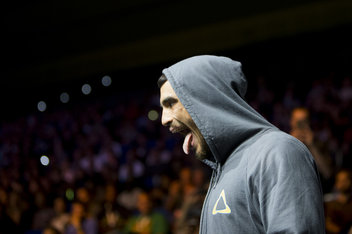
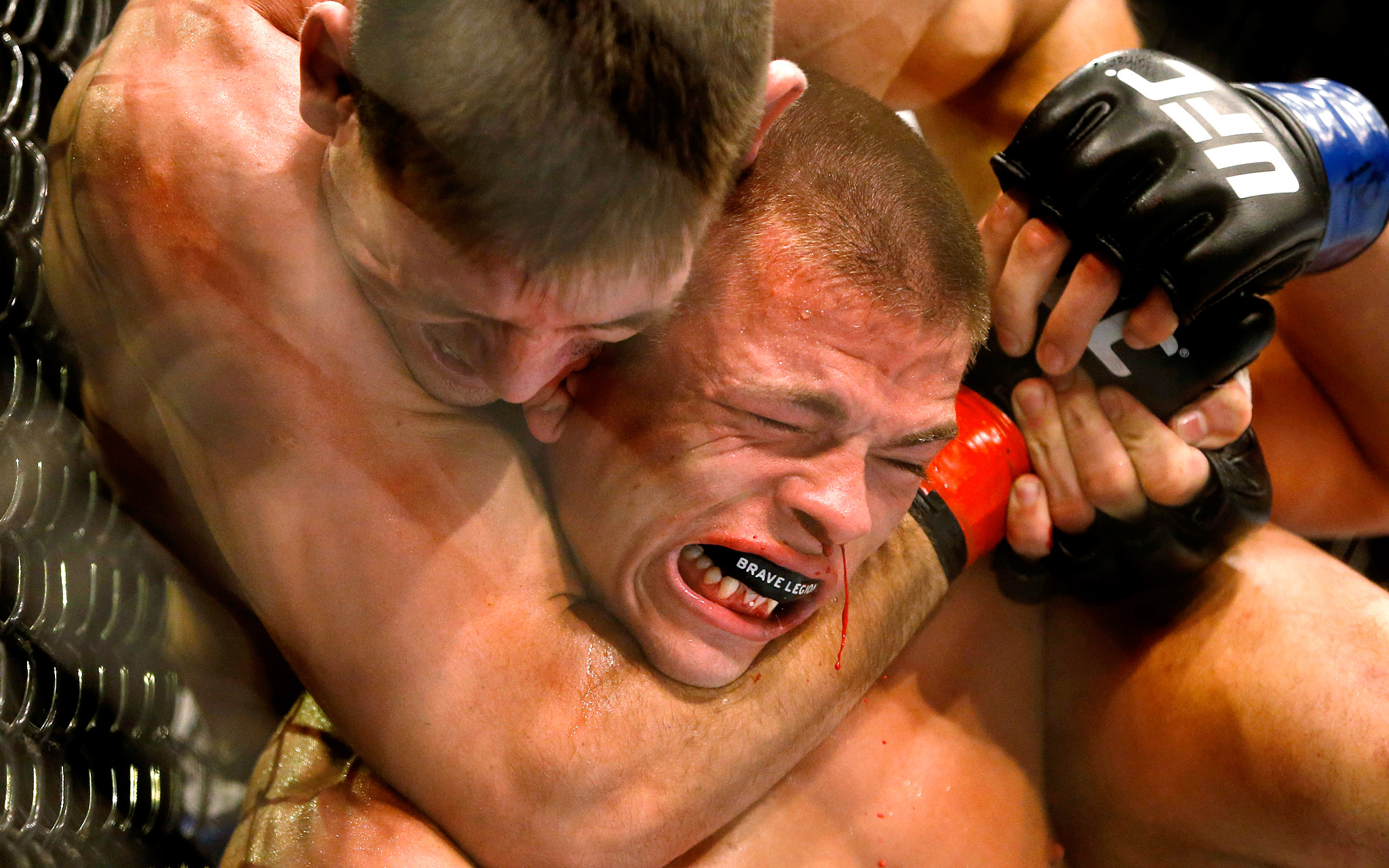
If we go to the ground and I need to use my guard, I don't foresee any problems. I see when fighters lack confidence in the guard and want to stand up fast, giving their back to the opponent. The technical get-up is one of the first things we learn in jiu-jitsu, and we have to do it well in MMA. This is important. If there's no way to do it, use the guard, sweep, try a submission.
one man's journey into a world of chokes, guards, locks, bars, sweeps, passes and strangles.
Tuesday, October 22, 2013
Werdum: What a Jiu-Jitsu Fighter Must Do Well in MMA
There's a reason why fundamentals are fundamental. Awhile back, Demian Maia talked about how his jiu-jitsu self-defense training helped his preparation for mixed martial arts. Now The Man Who Submitted Fedor has a similar thought when it comes to the basics of grappling in MMA:
Labels:
bjj philosophy,
guard work,
MMA,
quotes,
The Art of Jiu Jitsu,
UFC,
werdum
Sunday, October 20, 2013
On Kron
There is one thing more impressive to me than Kron Gracie's run of four submission victories in this year's ADCC.
The fact that there isn't a single leglock among them.
My sentiments toward leg locks are no secret. And your mileage may vary - especially when it comes to no gi competition. But peer beyond Kron's immaculate quartet and, to steal a line, it's heel hooks all the way down.
As much as I respect the performances of Galvao, Cobrinha, Romulo and old warriors like Sperry and Gurgel whose age approximates my own, Cyborg's upset victory over Buchecha in the Absolute ... it is easy to find inspiration in Kron Gracie's performances in China this weekend. His jiu-jitsu is a kind of solution.
" ...of course the techniques are great – but the sensibility of the opponent, the sense of touch, the weight, the momentum, the transition from one move to another ..."
Labels:
ADCC,
bjj philosophy,
competition,
Kron,
quotes,
Rickson,
The Art of Jiu Jitsu
Monday, October 14, 2013
Saturday, October 12, 2013
When He Hollers ... A Look at the Palhares Heel Hook
Ever since they turned vale tudo into mixed martial arts, I've lamented that there is no jiu-jitsu-grappling analogue to the massive advantage of gloved hands for strikers. If there is one thing that favors striking over jiu-jitsu in MMA, this is it.
There was one way of restoring at least some balance. And no one made the case better than Frank Mir, whose tap or snap attitude - a talk walked in brutal submission victories over Pete Williams, Tim Sylvia, and the legendary Minotaro Nogueira - made jiu-jitsu scary again. You punch my face. I snap your arm. You kick my head. I pop your knee.
You can see this in the beauty of Royce Gracie's performances in the vale tudo-era UFC. The armlocks on DeLucia, Kimo, and Hackney. Those submissions weren't "just getting caught" as so many have dismissively referred to submission losses in MMA in the past few years. Those armlocks were for keeps.
Which brings me to Palhares. The heel hook is the ultimate tap or snap technique. Worse than a two-step snake or a poison that paralyzes before it kills, the heel hook is capable of destroying almost before it hurts. In the hands of naive defender, the results can be inadvertently disastrous. In the hands of an aggressive (to say nothing of overly-aggressive) attacker, the results can be just as ruinous.
I've seen armlocks and kneebars held longer than Palhares' heel hook while referees tugged mistakenly at the most hyperextended part of the trapped limb as they called a stop to a fight. And to put it bluntly, the last person in the universe who should be convinced of the success of a submission hold should be the one applying it - at least when it comes to mixed martial arts.
In a world in which tapping to a submission is really no big deal, but tapping to strikes is a character deficit of the highest martial order, I'll admit to being willing to give a victorious grappler a second to untangle himself - and for the opponent to learn to concede (and concede quickly) even if as much out of fear of the submission as the submission itself. This isn't amateur sport jiu-jitsu. This is how they've decided to change vale tudo into MMA. I urge jiu-jitsu fighters to adjust accordingly.
And if you aren't ready forgive Palhares' heel hook or Babalu's choke, maybe wondering what the world would have been like with Vitor Belfort regaining the UFC Light Heavyweight belt will help.
"I've always had great respect for Jon Jones and know he is a great champion. When I felt his arm snap, I decreased the pressure, and he got out. Simple as that. During the bout, he managed to work his elbows well (from the top), but I was never afraid. But he was very good in the fight."
Labels:
bjj philosophy,
diary,
heel hook,
leg locks,
MMA,
submissions,
UFC,
vale tudo,
videos
Friday, October 11, 2013
An Opposing Take on the Leglock Debate
Guest Post courtesy of Professor Griff Sombke, Gracie Barra black belt, No Gi World Champion at brown belt
*
In which I disagree with Burientopteam on the importance of Leglocks to your Jiu-Jitsu game...
(H/T to Brad DeLong)
"Those who live by the sword will end up getting shot by those who don't" - Keenan Cornelius
I've been meaning to write this for months. Seriously. However, life is complicated when you're an adult. Things get shelved, and philosophical debates about grappling are one of the first to go when you're running an academy, raising a kid, training for tournaments, etc. However, I need the writing practice, and I now have an extra hour in the AM, so I am knocking this out between PT sets for my shoulder.
For me, at the core, competitive Jiu-Jitsu will always be about figuring out what your opponent wants to see LEAST, and making sure they see it as often as possible. Applying that logic to other BJJ players, I would try to exploit my opponent's (stereotypical) lack of both takedown awareness and leg attack defenses. BJJ's answer to the takedown question seems to be the guard jump/pull, which works well in a sport BJJ context, and, per the data compiled by the fine folks at www.bishopbjj.com, seems to be a very high-percentage option at the elite level. Obviously, this strategy is a bit of a problem if you compete in other grappling disciplines, relatively wide-open rulesets such as ADCC, or in MMA/Vale Tudo. However, in the "Truman Show" environment of a BJJ tournament, you're probably okay, as long as you're Medio or smaller. Kind of how the idea of diving belly down to stop a double-leg attempt would be suicidal against a BJJ player, but was an acceptable defense in a Judo context.
Leglocks, on the other hand, are a different animal. Part of the reason is because they are actually pretty versatile. You can use them as a submission, sure. But, now you have guys like Buchecha, who use them as sweeps. You can catch an opponent not defending, or with a foot/leg in a compromised position, lock a toehold, and ride that to the top or to a victory. If you're savvy enough, you can apply them from almost anywhere. I remember something Trevin Raak said to me years ago about how his guard passing got a lot better once he added footlocks to his game. You put that possibility into your opponent's mind, and that's one more thing they have to consider when sparring/competing against you. Folks who train primarily non-BJJ based grappling know this, trust me. That's an advantage for them right from the jump, and kneebar defense isn't something you want to try and figure out on the fly.
It's also not a monolithic category. "Leg locks" can mean attacks that target the large joints, such as the knee, small joints like your Achilles' tendons and ankles, and a wide range of "cutter/slicer" attacks that work great as a "second option". This means that you've laid out a minefield for an opponent to cross to try and defend while trying to maintain position at the same time. Add that to the fact that most times, the correct defense is to roll/move in a direction that tends to be favorable to the person applying the leglock, and you have a powerful weapon, which becomes a market inefficiency if you have them and your opponent doesn't. Couple that with a BJJ player's overall awareness of "where you really want to be while rolling" and you have a really nasty combination. In fact, due to the preceding factor, I would speculate that in the hands of a skilled BJJ player, leg locks become an even more dangerous weapon than they are when deployed by a less position-savvy grappler. The old jazz saying about "it's about the notes you DON'T play" comes to mind here.
Personally, I don't use them as a main option. However, I will take one if I see it. And having to reinvent a lot of what you use for a guard game at Purple belt because you are getting leglocked by folks who understand that side of things way better than you will make you a believer. This may or may not have happened to me .
It's the same as how you would play a different game if striking was legal. These are not easy habits to break. And the way to break them usually involves getting tapped a whole bunch of times. What, in my opinion, is the wrong approach, is to do what Judo has done, and ban anything that allows folks from other disciplines to come into a sport and dominate. Don't ban leg attack takedowns, for example. Learn to sprawl better. The problem isn't usually solved with more rules.
Hole in your Jiu-Jitsu soul? Probably not. Hole in your "complete grappler" soul? Absolutely. We, as high-level BJJ players, need to be familiar with these concepts, as we are expected to be walking encyclopedias of grappling. Fair stereotype or not, that's the bed we made, and it's a lot more comfortable to lie in it if you know what to do when someone grabs your foot.
(And the same goes for wrist locks. Ask anyone who's gotten tapped by one. Luckily, that's relatively simple to defend, as long as you are aware of what they are and how they happen. Everyone who's trained at GB Edmonds for any length of time knows that you always have to be aware of where/what your elbows are resting against, and be conscious of not getting them trapped there.)
*
In which I disagree with Burientopteam on the importance of Leglocks to your Jiu-Jitsu game...
(H/T to Brad DeLong)
"Those who live by the sword will end up getting shot by those who don't" - Keenan Cornelius
I've been meaning to write this for months. Seriously. However, life is complicated when you're an adult. Things get shelved, and philosophical debates about grappling are one of the first to go when you're running an academy, raising a kid, training for tournaments, etc. However, I need the writing practice, and I now have an extra hour in the AM, so I am knocking this out between PT sets for my shoulder.
For me, at the core, competitive Jiu-Jitsu will always be about figuring out what your opponent wants to see LEAST, and making sure they see it as often as possible. Applying that logic to other BJJ players, I would try to exploit my opponent's (stereotypical) lack of both takedown awareness and leg attack defenses. BJJ's answer to the takedown question seems to be the guard jump/pull, which works well in a sport BJJ context, and, per the data compiled by the fine folks at www.bishopbjj.com, seems to be a very high-percentage option at the elite level. Obviously, this strategy is a bit of a problem if you compete in other grappling disciplines, relatively wide-open rulesets such as ADCC, or in MMA/Vale Tudo. However, in the "Truman Show" environment of a BJJ tournament, you're probably okay, as long as you're Medio or smaller. Kind of how the idea of diving belly down to stop a double-leg attempt would be suicidal against a BJJ player, but was an acceptable defense in a Judo context.
Leglocks, on the other hand, are a different animal. Part of the reason is because they are actually pretty versatile. You can use them as a submission, sure. But, now you have guys like Buchecha, who use them as sweeps. You can catch an opponent not defending, or with a foot/leg in a compromised position, lock a toehold, and ride that to the top or to a victory. If you're savvy enough, you can apply them from almost anywhere. I remember something Trevin Raak said to me years ago about how his guard passing got a lot better once he added footlocks to his game. You put that possibility into your opponent's mind, and that's one more thing they have to consider when sparring/competing against you. Folks who train primarily non-BJJ based grappling know this, trust me. That's an advantage for them right from the jump, and kneebar defense isn't something you want to try and figure out on the fly.
It's also not a monolithic category. "Leg locks" can mean attacks that target the large joints, such as the knee, small joints like your Achilles' tendons and ankles, and a wide range of "cutter/slicer" attacks that work great as a "second option". This means that you've laid out a minefield for an opponent to cross to try and defend while trying to maintain position at the same time. Add that to the fact that most times, the correct defense is to roll/move in a direction that tends to be favorable to the person applying the leglock, and you have a powerful weapon, which becomes a market inefficiency if you have them and your opponent doesn't. Couple that with a BJJ player's overall awareness of "where you really want to be while rolling" and you have a really nasty combination. In fact, due to the preceding factor, I would speculate that in the hands of a skilled BJJ player, leg locks become an even more dangerous weapon than they are when deployed by a less position-savvy grappler. The old jazz saying about "it's about the notes you DON'T play" comes to mind here.
Personally, I don't use them as a main option. However, I will take one if I see it. And having to reinvent a lot of what you use for a guard game at Purple belt because you are getting leglocked by folks who understand that side of things way better than you will make you a believer. This may or may not have happened to me .
It's the same as how you would play a different game if striking was legal. These are not easy habits to break. And the way to break them usually involves getting tapped a whole bunch of times. What, in my opinion, is the wrong approach, is to do what Judo has done, and ban anything that allows folks from other disciplines to come into a sport and dominate. Don't ban leg attack takedowns, for example. Learn to sprawl better. The problem isn't usually solved with more rules.
Hole in your Jiu-Jitsu soul? Probably not. Hole in your "complete grappler" soul? Absolutely. We, as high-level BJJ players, need to be familiar with these concepts, as we are expected to be walking encyclopedias of grappling. Fair stereotype or not, that's the bed we made, and it's a lot more comfortable to lie in it if you know what to do when someone grabs your foot.
(And the same goes for wrist locks. Ask anyone who's gotten tapped by one. Luckily, that's relatively simple to defend, as long as you are aware of what they are and how they happen. Everyone who's trained at GB Edmonds for any length of time knows that you always have to be aware of where/what your elbows are resting against, and be conscious of not getting them trapped there.)
Tuesday, October 08, 2013
Top 10 Submissions in UFC History
To the extent that I have become the archangel of jiu-jitsu in mixed martial arts, here are a few favorite examples from MMA Nation of jiu-jitsu artists getting it done.
Sunday, October 06, 2013
What is a Complete Jiu-JItsu?
My guess is that many people will simultaneously agree and disagree with my five-part list. But I think it is defensible through both the "jiu-jitsu for everyone" and "competitive jiu-jitsu" lenses - the latter including jiu-jitsu's crucial crucible of mixed martial arts.
The Five Factors of a Complete Jiu-Jitsu
1. You can use jiu-jitsu to take a physical conflict to the ground in a controlled fashion.
2. You can use jiu-jitsu to move from a defensive position on the ground to a dominant position on the ground.
3. You can use jiu-jitsu to subdue an adversary from a dominant position on the ground.
4. You can use jiu-jitsu to subdue an adversary from a defensive position on the ground.
5. You can accomplish 1-4 in conflict with an adversary against whom you do not have a significant athletic (size, speed, power) advantage.
I think a lot of people confuse the techniques that can provide someone with a complete jiu-jitsu from the fundamental notion of what a complete jiu-jitsu actually means.
I think a lot of people overthink it, affected more by the innovations in sport jiu-jitsu than by either jiu-jitsu's trial by fire in mid-to-late 20th century vale tudo contests or the practical necessities of individuals seeking to protect themselves from physical harm.
I think, maybe most importantly, that all of this is still applicable to sport jiu-jitsu, that it can serve as the basis for a successful competition strategy, that it helps connect the old school jiu-jitsu that many of us love with the ever more new schools of jiu-jitsu developing right now in academies all over the world.
The Five Factors of a Complete Jiu-Jitsu
1. You can use jiu-jitsu to take a physical conflict to the ground in a controlled fashion.
2. You can use jiu-jitsu to move from a defensive position on the ground to a dominant position on the ground.
3. You can use jiu-jitsu to subdue an adversary from a dominant position on the ground.
4. You can use jiu-jitsu to subdue an adversary from a defensive position on the ground.
5. You can accomplish 1-4 in conflict with an adversary against whom you do not have a significant athletic (size, speed, power) advantage.
I think a lot of people confuse the techniques that can provide someone with a complete jiu-jitsu from the fundamental notion of what a complete jiu-jitsu actually means.
I think a lot of people overthink it, affected more by the innovations in sport jiu-jitsu than by either jiu-jitsu's trial by fire in mid-to-late 20th century vale tudo contests or the practical necessities of individuals seeking to protect themselves from physical harm.
I think, maybe most importantly, that all of this is still applicable to sport jiu-jitsu, that it can serve as the basis for a successful competition strategy, that it helps connect the old school jiu-jitsu that many of us love with the ever more new schools of jiu-jitsu developing right now in academies all over the world.
Tuesday, October 01, 2013
The Sitting Up Guard: A BJJ Scout Analysis of Rodolfo, Cobrinha, and Otavio
There have been a few "eureka" moments for me when it comes to the sitting guard. One was while watching an instructional DVD from Stephan Kesting. Another one came while watching a recent competition between Cobrinha and Rafa. But the one that is still fresh happened during the seminar by Prof Otavio Sousa just a few weeks ago here at Gracie Barra Seattle.
BJJ Scout explains why my "eurkea" reaction may be fairly common in another great analysis of a great jiu-jitsu technique.
Labels:
BJJ Scout,
cobra guard,
gi,
guard work,
sweep,
techniques,
video
Sunday, September 29, 2013
Song of Piton
Piton is the solution to movement.
Piton is the solution to speed.
Piton is the solution to flexibility.
Piton is the solution to strength.
Labels:
bjj philosophy,
choke,
diary,
goals,
guard pass,
half-guard pass,
mount,
Roger Gracie,
The Art of Jiu Jitsu
Saturday, September 28, 2013
Training Day: Saturday
A Saturday full of specific training from Prof Nate: guard/pass guard, finish from the back/defend Shark Tank style with a focus on the guard player and the finish from the back. A great way to spend the day.
Live training with a pair of tough brown belts (Steve and Pat) for eight minutes each. Almost a flashback to the days of training with Casey and Lance (and Steve and Pat, for that matter). Not the kind of training you get everyday, and it was every bit as challenging as it used to be.
161.4 on the scale post-train. WITStolo the guard replacement, the persistence, and the patience. There were more than a few Ryron Metamoris moments during today's training, and accepting that as part of my practice going forward likely will be key to arriving in one piece.
Live training with a pair of tough brown belts (Steve and Pat) for eight minutes each. Almost a flashback to the days of training with Casey and Lance (and Steve and Pat, for that matter). Not the kind of training you get everyday, and it was every bit as challenging as it used to be.
161.4 on the scale post-train. WITStolo the guard replacement, the persistence, and the patience. There were more than a few Ryron Metamoris moments during today's training, and accepting that as part of my practice going forward likely will be key to arriving in one piece.
Friday, September 27, 2013
Thursday, September 26, 2013
Wednesday, September 25, 2013
Training Day: Wednesday
Double legs from the snap down. Armbars from the "microwave" mount. Taking the back counter to upa escape from the "microwave" mount.
And Live Training. Versus half-guard. Working the lapel. Working the bicep, cross-carotid control. Working the head wedge. Working the pass.
WITStolo.
And Live Training. Versus half-guard. Working the lapel. Working the bicep, cross-carotid control. Working the head wedge. Working the pass.
WITStolo.
Labels:
armbars,
brabo,
diary,
half-guard pass,
Roger Gracie,
takedowns,
taking-the-back,
Training Day,
WITStolo
Tuesday, September 24, 2013
Monday, September 23, 2013
Does Jiu-Jitsu Need MMA?
If your initial conception of jiu-jitsu was formed while watching Royce Gracie in the early Ultimate Fighting Championship tournaments in the first half of the 1990s, the intervening years have been interesting ones.
The sport of competitive jiu-jitsu has soared in popularity - with live streams of jiu-jitsu competitions from as far away as Brazil and Abu Dhabi increasingly a regular part of the average BJJ fan's agenda, and the IBJJF expanding its tournament circuit into a new major North American city every time you turn around. As someone who began training as jiu-jitsu superstars like Roger Gracie, Ronaldo Souza, and Marcelo Garcia were dominating the sport jiu-jitsu scene, it was hard not to have an optimistic sense of where this growing emphasis on the jiu-jitsu black belt v.s. jiu-jitsu black belt notion of jiu-jitsu competition seemed to be going.
But watching the black belt debut of one of our contemporary era's up 'n' coming young superstars this evening, I felt my heart sink a bit. Certainly not as a reflection of the performance: an armbar victory is an armbar victory and all the moreso against a talented, proven opponent.
Nevertheless seeing the entrails of what has become contemporary jiu-jitsu: the emphasis on gi grips, the guard-uber-alles positioning, the endless inversions ... While a part of me enjoys and envies the technical mastery involved, I'll admit that there's another part of me wondering if what seems like an evolution in the art of jiu-jitsu is actually something else entirely.
Fighting against evolution is a dangerous thing. Judo is engaged in this Sisyphus-like labor as we speak, seeking to rid itself of any aspect of Western wrestling by banning direct attacks on the legs.
This is the same judo that was arguably crippled as a martial art (however bolstered as an Olympic sport) when the time allowed for ne-waza or ground fighting became limited.
But what is evolution? And, maybe more importantly, what is driving the evolutionary change? In sport jiu-jitsu, the driver of change is not increased exposure to new, foreign challenges from outside the art, but instead from increasingly nuanced, increasingly contrived innovations from within the art itself.
This doesn't mean that the result is inherently decadent - though there is a significant danger that this can develop. But consider the same phenomenon in other spheres of endeavor: political theory developed by political scientists, but never influenced by or tested by free citizens or voters. Economic theory developed by economists, but never tested by free markets or a business cycle. Theories of reality developed and debated by philosophers, but never tested by the real world of gravity and physics.
I spent many years studying contemporary poetry. And if there was one thing that characterized contemporary poetry in the 1980s and 1990s in particular, it was that contemporary poetry was only read by those who wrote it. That's an exaggeration. But not by much. It was a very insular world, one that had grown to embrace its own irrelevance to the broader cultural conversation.
Some may find it hard to believe that it wasn't always so with contemporary poetry. Poets, even American poets, just a generation or two ago were names that most well-read people had heard of: Robert Frost, Langston Hughes, William Carlos Williams, Syliva Plath - even if they never really read that much poetry.
All that said to say that I think I know what an art looks like when it becomes more pre-occupied with its own internal dynamics than with the sort of challenges it was originally developed to deal with. That doesn't mean that the art is on the road to obsolescence or irrelevance or decadence. But it does mean that practitioners of the art should be aware of how their art is changing, what is driving that change and, should they decide so, what to do in response.
Eddie Bravo famously said that MMA without jiu-jitsu was bad kickboxing. Of late, I've found myself wondering if jiu-jitsu without MMA - or at least the sort of sensibilities that MMA and vale tudo bring - is a similarly sub-optimal state.
Labels:
bjj philosophy,
competition,
Demian Maia,
diary,
MMA,
Rickson,
The Art of Jiu Jitsu,
vale tudo
Friday, September 20, 2013
Teaching Day: Friday
Great time teaching the 6 am, "Dawn Patrol" class this Friday. Roethke has that wonderful line "when a week of rain is a year". That's how I felt being on the teaching side of the tatame after two weeks away.
Five students is a lot for a Friday morning. And I couldn't be more grateful. I'm curious as to how attendance might change as the days get more than a little shorter and the nights more than a little longer.
We worked on the turtle headlock counter from the curriculum, and the mount reversal. I saw Coach Peter showing someone how to set up a triangle choke attack from the closed guard Thursday, and loved it so much that I decided to throw that one in to Friday's lesson, as well.
159.4 on the scale, post-train. A new injury, right elbow, has me preoccupied. But maybe not as much as usual. I've got a compression brace that seems to work well enough - though we'll see come next week. I'm probably not going to make the 12x this month - I'll be lucky to make it to nine. So being more efficient in training, and training what I need/want to train, are all the more vital.
Five students is a lot for a Friday morning. And I couldn't be more grateful. I'm curious as to how attendance might change as the days get more than a little shorter and the nights more than a little longer.
We worked on the turtle headlock counter from the curriculum, and the mount reversal. I saw Coach Peter showing someone how to set up a triangle choke attack from the closed guard Thursday, and loved it so much that I decided to throw that one in to Friday's lesson, as well.
159.4 on the scale, post-train. A new injury, right elbow, has me preoccupied. But maybe not as much as usual. I've got a compression brace that seems to work well enough - though we'll see come next week. I'm probably not going to make the 12x this month - I'll be lucky to make it to nine. So being more efficient in training, and training what I need/want to train, are all the more vital.
Labels:
diary,
Gracie Barra,
mount escape,
self defense,
teaching
Thursday, September 19, 2013
WITStolo: Reverse Collar Drag
First time sparring in weeks. I hadn't necessarily planned on it. But tonight's black belt class was an hour of specific training - probably my favorite kind of training. So I rolled with it for as long as I could.
Tonight's WITStolo is definitely the collar drag reversal from the closed guard. I think a basic cross collar choke will be enough to properly set it up. Scissorhands was the weakest of my closed guard set-ups, but that collar drag reversal would fit in nicely among that set.
My body is still waking back up to the matwork. I felt a few tinges in my intercostals and my leg cramped up midway through the third quarter, so to speak, and didn't let up until near the end of the fourth. It's a reminder that I'm going to have to take it easy on the way back in.
Tonight's WITStolo is definitely the collar drag reversal from the closed guard. I think a basic cross collar choke will be enough to properly set it up. Scissorhands was the weakest of my closed guard set-ups, but that collar drag reversal would fit in nicely among that set.
My body is still waking back up to the matwork. I felt a few tinges in my intercostals and my leg cramped up midway through the third quarter, so to speak, and didn't let up until near the end of the fourth. It's a reminder that I'm going to have to take it easy on the way back in.
Labels:
closed guard,
diary,
injuries,
reversal,
Scissorhands,
sweep,
WITStolo
Wednesday, September 18, 2013
Rickson: Striking is a 50/50 Bet
Since I'm on my horse (or at least, back in the stable), let me add that I think that Rickson had a great point when he said that the problem with striking as a strategy was that it was a "50-50 game."
As you might imagine, Master Hickson continues to catch all kinds of hell for this remark in ye olde MMA forums. And while a number of folks have embarked upon some major counter-argumentation on behalf of the non-randomness of victory in the striking arts, plenty others remain just plain pissed off that Mr. 400-0* was unimpressed by probabilities that made pugilism more sport than self-defense.
But I when I think of knockouts like Rashad Evans over Chuck Liddell, or Rampage's Third Time Charm against The Axe Murderer, I can't help but think that Rickson had a point. Sure, there was Matt Hughes' armbar off of GSP's failed kimura from bottom half guard in their first match up. And we all remember the 24-hour fever over the "Von Flue Choke" (reminder: avoid trying to guillotine from the bottom when in side control).
Still simultaneous submissions, moments in which two potentially finishing attacks are deployed at the same time, couldn't be rarer relative to those photogenic moments we know and love as fight fans when two sluggers have moved from locked and loaded to near-full extension with their heaviest haymakers en route ...
As you might imagine, Master Hickson continues to catch all kinds of hell for this remark in ye olde MMA forums. And while a number of folks have embarked upon some major counter-argumentation on behalf of the non-randomness of victory in the striking arts, plenty others remain just plain pissed off that Mr. 400-0* was unimpressed by probabilities that made pugilism more sport than self-defense.
Still simultaneous submissions, moments in which two potentially finishing attacks are deployed at the same time, couldn't be rarer relative to those photogenic moments we know and love as fight fans when two sluggers have moved from locked and loaded to near-full extension with their heaviest haymakers en route ...
Tuesday, September 17, 2013
Five Rules for Jiu-Jitsu Fighters in Mixed Martial Arts
A thread over at MMAFighting purports to provide commentary on Royce Gracie's take on the poor performance of his younger relatives in recent MMA contests.
I say "purports" because the comments seem to suggest that few of those opining have actually read the article.
Again, Royce's argument is an old one, one made by Rickson Gracie almost 10 years ago, and also amplified, in a way, by the man who is the best representative of BJJ-in-MMA done right, Demian Maia who said that his self-defense training was actually very applicable to his mixed martial arts training.
In any event, here are a few ways that jiu-jitsu fighters can improve their odds in the cage - using jiu-jitsu!
1. Train conditioning like a professional athlete
Top level competitive black belt matches in the IBJJF last for 10 minutes, plus overtimes. The minimum time for an MMA fight is 15 minutes, divided into three, five-minute rounds. Train accordingly
2. Stop striking
Rickson Gracie put it plainly almost ten years ago, and it is true today. If your edge lies in taking the fight to the ground, then your job is to take the fight to the ground. Everything that doesn't contribute to this ability is a distraction. Fighting isn't a lifestyle. It's a game. And the best way to win the game is to have the greatest possible edge in one aspect of the game, and then force your opponents to compete with you there.
3. Takedowns Matter
I don't care if it's a judo throw, a Greco toss, or a folkstyle power double leg. Again, if your edge lies in taking the fight to the ground, then your job is to take the fight to the ground. Pick a takedown, a counter to the most common defense to that takedown, and don't stop until the round ends or the fight does.
4. "Nao Para!"
One of the things BJJ fighters can bring from the tournament mat to the cage is one of the most overheard commands from the sidelines: Don't Stop.
Strikers are told to move their heads and keep pumping the jab. Grapplers need to continue fighting for their grips and positions as priority one at all times. A jab won't end a fight, but some of the best knockouts lie right behind a well-placed fist in the face. The same can be said for grapplers when it comes to getting their best grips and most decisive positions.
5. The Patton Rule
Famous American general, George Patton, allegedly said, "Your job is not to die for your country. Your job is to make that other poor son of a bitch die for his country." I feel the same way about playing guard and fighting from your back in MMA.
In other words, your job as a jiu-jitsu fighter in MMA is not to show the world how great your guard is. It is to find out how good that other "poor son of a bitch" is off his (or her) back. I don't have to run through the number of quality jiu-jitsu fighters who lost rounds in an MMA match because the judges preferred the top fighter's lay 'n' pray one-inch hammer fists to the bottom fighter's failed triangle, armbar and OMGaplata attacks from below.
I'm sure there are more. But these five would be a great place to start for most jiu-jitsu fighters - from Roger to Rolles - looking both to earn a winning record and showcase "the gentle art" at the same time.
I say "purports" because the comments seem to suggest that few of those opining have actually read the article.
Again, Royce's argument is an old one, one made by Rickson Gracie almost 10 years ago, and also amplified, in a way, by the man who is the best representative of BJJ-in-MMA done right, Demian Maia who said that his self-defense training was actually very applicable to his mixed martial arts training.
In any event, here are a few ways that jiu-jitsu fighters can improve their odds in the cage - using jiu-jitsu!
1. Train conditioning like a professional athlete
Top level competitive black belt matches in the IBJJF last for 10 minutes, plus overtimes. The minimum time for an MMA fight is 15 minutes, divided into three, five-minute rounds. Train accordingly
2. Stop striking
Rickson Gracie put it plainly almost ten years ago, and it is true today. If your edge lies in taking the fight to the ground, then your job is to take the fight to the ground. Everything that doesn't contribute to this ability is a distraction. Fighting isn't a lifestyle. It's a game. And the best way to win the game is to have the greatest possible edge in one aspect of the game, and then force your opponents to compete with you there.
3. Takedowns Matter
I don't care if it's a judo throw, a Greco toss, or a folkstyle power double leg. Again, if your edge lies in taking the fight to the ground, then your job is to take the fight to the ground. Pick a takedown, a counter to the most common defense to that takedown, and don't stop until the round ends or the fight does.
4. "Nao Para!"
One of the things BJJ fighters can bring from the tournament mat to the cage is one of the most overheard commands from the sidelines: Don't Stop.
Strikers are told to move their heads and keep pumping the jab. Grapplers need to continue fighting for their grips and positions as priority one at all times. A jab won't end a fight, but some of the best knockouts lie right behind a well-placed fist in the face. The same can be said for grapplers when it comes to getting their best grips and most decisive positions.
5. The Patton Rule
Famous American general, George Patton, allegedly said, "Your job is not to die for your country. Your job is to make that other poor son of a bitch die for his country." I feel the same way about playing guard and fighting from your back in MMA.
In other words, your job as a jiu-jitsu fighter in MMA is not to show the world how great your guard is. It is to find out how good that other "poor son of a bitch" is off his (or her) back. I don't have to run through the number of quality jiu-jitsu fighters who lost rounds in an MMA match because the judges preferred the top fighter's lay 'n' pray one-inch hammer fists to the bottom fighter's failed triangle, armbar and OMGaplata attacks from below.
I'm sure there are more. But these five would be a great place to start for most jiu-jitsu fighters - from Roger to Rolles - looking both to earn a winning record and showcase "the gentle art" at the same time.
Labels:
bjj philosophy,
Demian Maia,
MMA,
news,
Rickson,
Royce Gracie,
self defense,
The Art of Jiu Jitsu,
UFC
Sunday, September 15, 2013
Frank Mir Was Right
Here's another reason why, when it comes to MMA, I've always been a Frank Mir fan.
"He went up against a really good submission guy. And he got caught. So it wasn't like he got knocked out or he got dominated, you know, through the whole fight."
--Dana White, talking about a replacement fighter for his reality series, The Ultimate Fighter.
Friday, September 13, 2013
Winning is the Solution to Losing
Maybe it's a matter of semantics. I've always felt uncomfortable with the "you either win or you learn" maxim of the "jiu-jitsu for everyone" school of thinking (a school to which I am 100% devoted, by the way).
After all, you can never step into the same river twice, as my favorite philosopher put it. So assuming we're paying at least some attention, every experience is by definition a learning experience. The problem with this maxim is that it doesn't recognize how you can - or maybe even how important it is - to win "within" losing.
One of my three greatest competitive jiu-jitsu matches is a match I lost: my first match as a brown belt. I'd end up losing three out of three matches that day (think about that the next time you have a hard time on the mat), but my first match is one I'll always remember because it was, for a moment, the most winning moment I ever had in competition.
By the time I became a brown belt, I'd long prided myself on my takedowns. "Pride" is a good word for it because while I was probably better at taking the match to the mat than the average guy, that didn't necessarily apply to the average competitive guy. And that's a difference that defines.
So by the time I got to brown belt, having gone a little better than 50/50 on the 2-0 strategy of Takedown Uber Alles that had won me many of the matches I did win, I was open to alternatives.
Professor Rodrigo had been teaching something crazy all week in the evening advanced classes. Deep half guard. And not just deep half guard, but pulling deep half guard from standing. This was a few years back, before deep half had truly eclipsed the regular "Gordo" half guard that many of us had focused on,
At this point, remembering bitterly a pair of takedowns in two competitions at purple belt that I failed to earn points for , I was more than ready for a new way to get that critical 2-0 lead. And given my love for the half guard, the idea of this new kind of takedown-to-half guard, looked and felt unbeatable
I drilled that Tuesday and Thursday evening. Pull deep half and right into the sweep. Easy as a waltz - at least a hundred-odd reps later.
The morning of the Revolution (accept no substitutes), I have my game set. I don't realize that there is a chasm of darkness beyond my plan to pull deep half and get the sweep that I have carved into my consciousness. But I'm so geeked up on my move I can't see anything beyond it.
And we square off. Me and the guy who goes on to win first or second or something impressive and podium-worthy. But I'll never forget, shaking hands, getting my grips, and pulling that deep half guard and getting that first two points. I'll never forget literally (and, yes, I mean "literally" as in "a real thing that happened") hearing a gasp from someone or ones standing or sitting around watching when I pulled deep half and got that sweep because, apparently, my opponent who went on to win our match on points despite him being robbed of mount position by a bad out of bounds reset by the ref, is the kind of guy who was expected to win first or second or something impressive and podium-worthy and I, relatively speaking, am not.
And right there, for a moment ...
That's the solution to losing.
After all, you can never step into the same river twice, as my favorite philosopher put it. So assuming we're paying at least some attention, every experience is by definition a learning experience. The problem with this maxim is that it doesn't recognize how you can - or maybe even how important it is - to win "within" losing.
One of my three greatest competitive jiu-jitsu matches is a match I lost: my first match as a brown belt. I'd end up losing three out of three matches that day (think about that the next time you have a hard time on the mat), but my first match is one I'll always remember because it was, for a moment, the most winning moment I ever had in competition.
By the time I became a brown belt, I'd long prided myself on my takedowns. "Pride" is a good word for it because while I was probably better at taking the match to the mat than the average guy, that didn't necessarily apply to the average competitive guy. And that's a difference that defines.
So by the time I got to brown belt, having gone a little better than 50/50 on the 2-0 strategy of Takedown Uber Alles that had won me many of the matches I did win, I was open to alternatives.
Professor Rodrigo had been teaching something crazy all week in the evening advanced classes. Deep half guard. And not just deep half guard, but pulling deep half guard from standing. This was a few years back, before deep half had truly eclipsed the regular "Gordo" half guard that many of us had focused on,
At this point, remembering bitterly a pair of takedowns in two competitions at purple belt that I failed to earn points for , I was more than ready for a new way to get that critical 2-0 lead. And given my love for the half guard, the idea of this new kind of takedown-to-half guard, looked and felt unbeatable
I drilled that Tuesday and Thursday evening. Pull deep half and right into the sweep. Easy as a waltz - at least a hundred-odd reps later.
The morning of the Revolution (accept no substitutes), I have my game set. I don't realize that there is a chasm of darkness beyond my plan to pull deep half and get the sweep that I have carved into my consciousness. But I'm so geeked up on my move I can't see anything beyond it.
And we square off. Me and the guy who goes on to win first or second or something impressive and podium-worthy. But I'll never forget, shaking hands, getting my grips, and pulling that deep half guard and getting that first two points. I'll never forget literally (and, yes, I mean "literally" as in "a real thing that happened") hearing a gasp from someone or ones standing or sitting around watching when I pulled deep half and got that sweep because, apparently, my opponent who went on to win our match on points despite him being robbed of mount position by a bad out of bounds reset by the ref, is the kind of guy who was expected to win first or second or something impressive and podium-worthy and I, relatively speaking, am not.
And right there, for a moment ...
That's the solution to losing.
Thursday, September 12, 2013
Tap or Nap, Said the TickTockMan!
Some niftyness from Prof Cavalcanti
Labels:
carlson gracie,
cavalcanti,
choke,
clock choke,
gi,
side control,
techniques,
video
Saturday, September 07, 2013
Friday, September 06, 2013
Stating My Status
I knew this week wouldn't be easy. I managed to catch a cold on Saturday that went symptomatic on Tuesday. Fortunately, Bryan was scheduled to cover my early bird class Friday morning since I'll be heading to NYC, so I'll get a few extra and badly-needed winks ahead of my cross country trip.
I'd fantasized about visiting Marcelo Garcia's academy on Saturday while I was in the city. But between my poor health and poor training in recent weeks, I'll have to wait until this time next year.
On the upside, I think I have finally figured out why an otherwise healthy jiu-jitsu dude like myself catches colds so frequently. I've been hit with significant cold symptoms three times this year (including now), which is just unacceptable - and all the more so now that I know what it's been happening. There will be a few long (as in 40-year) habits I'll have to break, but it couldn't be more for the better.
I'm a little anxious about flying five and a half hours with a stuffed up head. I remember reading how Mad Money host Jim Cramer ended up losing the hearing in one ear after taking a cross country flight with a head cold, and because I have a tendency to get cold before long trips, I've got a few nerves. Hopefully another night sucking on a zinc lozenge, another day of popping decongestants and expectorants, and the regular process of repair will have me in at least halfway decent shape by boarding time tomorrow.
Another good thing is that by the time I get back to the mat (ETA Friday, September 13th), my latest rib/intercoastal muscle strain is likely to have healed up well enough to train - at least the coursework if not the sparring. It's going to be a busy month, but that will be a piece of normalcy that I will be looking forward to very much.
I'd fantasized about visiting Marcelo Garcia's academy on Saturday while I was in the city. But between my poor health and poor training in recent weeks, I'll have to wait until this time next year.
On the upside, I think I have finally figured out why an otherwise healthy jiu-jitsu dude like myself catches colds so frequently. I've been hit with significant cold symptoms three times this year (including now), which is just unacceptable - and all the more so now that I know what it's been happening. There will be a few long (as in 40-year) habits I'll have to break, but it couldn't be more for the better.
I'm a little anxious about flying five and a half hours with a stuffed up head. I remember reading how Mad Money host Jim Cramer ended up losing the hearing in one ear after taking a cross country flight with a head cold, and because I have a tendency to get cold before long trips, I've got a few nerves. Hopefully another night sucking on a zinc lozenge, another day of popping decongestants and expectorants, and the regular process of repair will have me in at least halfway decent shape by boarding time tomorrow.
Another good thing is that by the time I get back to the mat (ETA Friday, September 13th), my latest rib/intercoastal muscle strain is likely to have healed up well enough to train - at least the coursework if not the sparring. It's going to be a busy month, but that will be a piece of normalcy that I will be looking forward to very much.
Thursday, September 05, 2013
This Week in BJJ - Budo Jake Talks with Roger Machado
Another great show from Budo Jake.
This Week in BJJ Episode 41 – Roger Machado
Make sure you stick around to the end to see one of the Machado "family secrets": the armpit americana!
(Hint: it resembles the Nogumura)
This Week in BJJ Episode 41 – Roger Machado
Make sure you stick around to the end to see one of the Machado "family secrets": the armpit americana!
(Hint: it resembles the Nogumura)
Labels:
americana,
armbars,
bjj philosophy,
budo videos,
interview,
Machado,
takedown defense,
techniques,
video
Wednesday, September 04, 2013
Interview: John Connors on Jiu-Jitsu Over 40
I've never heard of this guy before, but he's dropping knowledge like rain. A lot of what he recommends are things I've thought about or heard in pieces here and there. Nice to hear it all in one package.
"You have to have the confidence to ignore some really good jiu-jitsu."
Tuesday, September 03, 2013
Interview: Oli Geddes on Living La Vida Jiu-jitsu
Some excellent practical insights on the jiu-jitsu lifestyle and competition from Roger Gracie black belt Oli Geddes.
Courtesy of OpenMatRadio
Sunday, September 01, 2013
Numba One Breakdown Brotha
A look at the technology behind the armbar that brought the UFC Lightweight title to Anthony Pettis.
Al Perdedor Perder
As much as I appreciate this kind of video, I've always felt that they've left me more than a little flat.
Don't get me wrong. If you are the kind of competitor who usually wins, and is having a hard time dealing with a surprising loss, then this is great advice. I'd also like to add, grow the F up. No one is invincible. Unless your psychology is completely upside down, infrequently losses are a budding champion's best friend.
But I always wonder what guys like this have to say to those of us who had competitive seasons like I did as a purple and brown belt. After winning most of my matches as a white belt and winning about half my matches at blue belt, every tournament above this level was a disaster. I probably competed 3-4 times as a purple belt, and almost as many times as a brown belt, and lost every match.
Every one. All of them. Seven or eight tournaments in a row with multiple matches per tournament.
There aren't a lot of videos talking to folks in this position. The most honest comment was the one my professor gave after my last purple belt loss, when he pointed out that all my competitors were, quite literally, half my age. About half were amateur MMA fighters, as well.
True enough, but it didn't change the circumstance: if I wanted to compete locally, then I'd be competing against guys young enough to be my sons. Full stop.
In a way, earning my black belt has liberated me from this problem. There are very few local black belts who compete (maybe there'd be more if they saw my name in the brackets), especially at the lower weight classes. Even when it comes to Superfights, these sort of opportunities are few and far between - and I'm no one but a fool's notion of a Superfight participant.
There are the IBJJF events. I noticed that the Atlanta Open, for example, had a healthy number of master and seniors competitors at the faixa preta level. That's a good sign. But the idea of my nearest opportunity to compete against a peer being on the opposite end of a multi-state plane ride is a bit depressing - especially since my new job already puts me on the road 4-5 times a year (including two out-of-country trips).
That's the terrain. I have a few goals for 2014 that will require me to better navigate this terrain than I have thus far - and yesterday's minor intercostal muscle pull in some ways only accelerates my determination to make a few things happen before I turn 50.
Don't get me wrong. If you are the kind of competitor who usually wins, and is having a hard time dealing with a surprising loss, then this is great advice. I'd also like to add, grow the F up. No one is invincible. Unless your psychology is completely upside down, infrequently losses are a budding champion's best friend.
But I always wonder what guys like this have to say to those of us who had competitive seasons like I did as a purple and brown belt. After winning most of my matches as a white belt and winning about half my matches at blue belt, every tournament above this level was a disaster. I probably competed 3-4 times as a purple belt, and almost as many times as a brown belt, and lost every match.
Every one. All of them. Seven or eight tournaments in a row with multiple matches per tournament.
There aren't a lot of videos talking to folks in this position. The most honest comment was the one my professor gave after my last purple belt loss, when he pointed out that all my competitors were, quite literally, half my age. About half were amateur MMA fighters, as well.
True enough, but it didn't change the circumstance: if I wanted to compete locally, then I'd be competing against guys young enough to be my sons. Full stop.
In a way, earning my black belt has liberated me from this problem. There are very few local black belts who compete (maybe there'd be more if they saw my name in the brackets), especially at the lower weight classes. Even when it comes to Superfights, these sort of opportunities are few and far between - and I'm no one but a fool's notion of a Superfight participant.
There are the IBJJF events. I noticed that the Atlanta Open, for example, had a healthy number of master and seniors competitors at the faixa preta level. That's a good sign. But the idea of my nearest opportunity to compete against a peer being on the opposite end of a multi-state plane ride is a bit depressing - especially since my new job already puts me on the road 4-5 times a year (including two out-of-country trips).
That's the terrain. I have a few goals for 2014 that will require me to better navigate this terrain than I have thus far - and yesterday's minor intercostal muscle pull in some ways only accelerates my determination to make a few things happen before I turn 50.
Labels:
bjj philosophy,
competition,
diary,
tournament review,
video
Subscribe to:
Posts (Atom)