I won first place in the 158-146 division at the Pacific Northwest Jiu Jitsu Championships yesterday.
There only four of us in the division (there were five in the 145 and under division). So I had two fights, the second one for first and second place against a Gracie Barra guy from Vancouver I think.
I won both matches on points, basically from an overwhelming side control. The first fight, the guy tried a takedown and lost his balance early. I pounced on him, took him down, and got into side control instantly.
Rodrigo, fresh off his neck surgery, did a great job of coaching me. As did Cindy, whose voice I could also hear. I fought for a choke, transitioned to knee-on-belly, then north-south, then back to side control before time ran out.
The second fight was a little more difficult. We clinched up and fell to the ground on a take down attempt that I don't think he got points for. He did end up on top in side control and that may have been where he got his two points. While I was on the bottom, I heard his coach warn: "be careful, he's very strong." A few moments later I reversed him, turning away (which was the wrong direction, but I've gotten away with it) and powering him over.
I wound up in his guard. I never felt in danger of being swept or submitted. But I was down 2-0 and need to pass his guard and get to side control to win. I tried to stand a couple of times, but just couldn't get his guard open. I really, really need to work on guard passing if I'm going to play from the top.
Anyway, one of my efforts finally got his guard open and I shot through to side control. I was pretty tired and Rodrigo was coaching me to rest and relax. My side control was like a vise--just as in the first fight. Keep the grip tight and use your shoulder to press the guy's face away from you to make it harder for him to turn into you and elbow escape.
Rebecca took some pictures that I'm looking forward to seeing. And Griff, who came in second in his division, got some video. The blue belts from Gracie Barra: Robert, Tommy and Jesse all lost their first fights. Tommy got sandbagged by some guy from Demon Jiu Jitsu who Rodrigo said "had been training as long" as he had. That would be about 15 years! Some "blue belt." Tommy was pissed, and I don't blame them. Sandbagging is probably worst at blue belt.
Arnell fought and lost twice in his matches. It was his first tournament and a good experience to get under his belt.
Hopefully these losses will motivate them to really work hard over the next months leading into the fall tournaments. I am about as excited about training as you could imagine. I think this will be the fuel to get me back on my morning cardio/workout routines four mornings a week. I got a little tired in my second fight, and I want my cardio to be much better.
Even though 158-146 isn't the deepest division, it is clearly where I need to be right now. Once my technique level matches my strength level, maybe I'll move up to 171-159. But that would require deliberately trying to gain weight, which I've avoided doing. Besides, that the division that Jesse Singh fights at--though probably soon enough as a blue belt. From a team perspective, it is nice to have somebody at 145 and under and somebody at the next level up. A new white belt, Lindsey, fought at 172-184 and placed second I think. That covers all the lower weights.
Anyway, I'll do more analysis of how I did, how well I followed the gameplan, and any other general observations later. For now, I'm happy that the work I have put in since December and Copa Northwest 6. My record is now 3-2, but still no submission victories. That's where I need to improve next.
Sunday, April 30, 2006
Thursday, April 27, 2006
Eureka Moments in Jiu Jitsu
I had another eureka night last night during class. It reminded me a little of the last eureka night I had on April 12th--the last night the Demon Jiu Jitsu guys were training with us. Then, it was chokes and scissor sweep that I was hitting with reguarlity that provided the eureka moment. Last night the chokes were there (I swear I use chokes more than any other white belt I've trained with!), but what really seemed to click was guard passing.
Guard passing?!?! Did I just say guard passing?
You betcha. I finally think I've found the key details that have made my guard passing so terrible. The little primer I posted not too long ago not withstanding, it appears as if it is the little things that have been undermining my guard passing game.
With the standing guard pass, it is important to pump your hips back and forth while "pushing" (remember, we don't push the guy ...) on the knee. The count should be: stand-pump-pump-pump, then DROP to pass the opened guard by dropping your knee down on the lower leg of the newly opened guard. The guard shoud open by the second PUMP. But the third one is there for good measure, to make sure you have opened the guard. Stand! PUMP-PUMP-PUMP! Drop!
With the Saulo Ribeiro ground pass, the trick is to move both legs around as you move in the circle. I had been trying to do this move with my bent leg remaining strictly in place while I walked the other leg around behind me (i.e., from 4 o'clock around toward 6 or 7 o'clock). That won't work. What I've got to do--and finally did successfully in some sparring--is to pivot around on the knee of the bent leg as I walk the other leg around. The same "step out" position you start with, the same posture etc. is the one you maintain until the guard is opened. I just have to move BOTH LEGS, not just the outstretched "walk around" one.
It's always the little details. We'll see if any of this comes in handy Saturday morning at the tournament. But I already feel like my training will be a lot better over the next few months now that I've got some of the kinks worked out of my two main guard passes. I've always thought that if I could get guard passing down, I'd be a lot better because my work from the top is pretty strong.
Speaking of work from the top, I've been doing a better job of getting my elbow OVER when I'm attacking from side control. That's key not just to the kimura and keylock attacks, but also to having good top side control with my weight on the guy's upper body. I think the attack sequence from side control needs to be: kimura-keylock-Cindy's keylock to S-mount armbar, with the option of the straight armlock if I can hit it in between fighting for the kimura or keylock.
I also want to learn some good chokes from side control, in addition to the basic chokes from the mount. Not necessarily for Saturday. But definitely for things to work on over the summer.
Guard passing?!?! Did I just say guard passing?
You betcha. I finally think I've found the key details that have made my guard passing so terrible. The little primer I posted not too long ago not withstanding, it appears as if it is the little things that have been undermining my guard passing game.
With the standing guard pass, it is important to pump your hips back and forth while "pushing" (remember, we don't push the guy ...) on the knee. The count should be: stand-pump-pump-pump, then DROP to pass the opened guard by dropping your knee down on the lower leg of the newly opened guard. The guard shoud open by the second PUMP. But the third one is there for good measure, to make sure you have opened the guard. Stand! PUMP-PUMP-PUMP! Drop!
With the Saulo Ribeiro ground pass, the trick is to move both legs around as you move in the circle. I had been trying to do this move with my bent leg remaining strictly in place while I walked the other leg around behind me (i.e., from 4 o'clock around toward 6 or 7 o'clock). That won't work. What I've got to do--and finally did successfully in some sparring--is to pivot around on the knee of the bent leg as I walk the other leg around. The same "step out" position you start with, the same posture etc. is the one you maintain until the guard is opened. I just have to move BOTH LEGS, not just the outstretched "walk around" one.
It's always the little details. We'll see if any of this comes in handy Saturday morning at the tournament. But I already feel like my training will be a lot better over the next few months now that I've got some of the kinks worked out of my two main guard passes. I've always thought that if I could get guard passing down, I'd be a lot better because my work from the top is pretty strong.
Speaking of work from the top, I've been doing a better job of getting my elbow OVER when I'm attacking from side control. That's key not just to the kimura and keylock attacks, but also to having good top side control with my weight on the guy's upper body. I think the attack sequence from side control needs to be: kimura-keylock-Cindy's keylock to S-mount armbar, with the option of the straight armlock if I can hit it in between fighting for the kimura or keylock.
I also want to learn some good chokes from side control, in addition to the basic chokes from the mount. Not necessarily for Saturday. But definitely for things to work on over the summer.

Tuesday, April 25, 2006
Tommy's Tips
A great class/training to start of tournament week. Rolled with Brandon the judo guy, Adam, the Asian white belt from Ballard (Trevor?) and finished with a long session with Tommy.
I've been rolling a lot with Tommy. This might be the prelude to my first quantum leap, when some of this stuff really starts to click into body memory. Tommy's got a flowing, highly technical game that I like, but never thought I could adopt. It's a nice combination, and helps break me out of my slow, methodical, grinding style.
It also reminds me of what Eddie Bravo said about the guard (Kid Peligro said the same thing): the more comfortable you are being on the bottom, the more willing you are to be adventurous and "flowing" on the top and in other positions.
I'll post again some of the details of the class, the specific techniques, etc. But first here are some of Tommy's Tips:
Go! Go! Go! Don’t stop to think. If you stop to think, that gives your opponent time to think. You know the techniques. Move!
Be ready to open to spider guard. A foot on the biceps becomes a foot on the shoulder and a solid triangle attack or an omoplata.
Against sitting up guard, stand and work to control the knees.
On top against the guard, drop the knee in the middle once the guard opens up. That allows you to switch it to a side to pin, or to bear hug legs and pass to the side.
I've been rolling a lot with Tommy. This might be the prelude to my first quantum leap, when some of this stuff really starts to click into body memory. Tommy's got a flowing, highly technical game that I like, but never thought I could adopt. It's a nice combination, and helps break me out of my slow, methodical, grinding style.
It also reminds me of what Eddie Bravo said about the guard (Kid Peligro said the same thing): the more comfortable you are being on the bottom, the more willing you are to be adventurous and "flowing" on the top and in other positions.
I'll post again some of the details of the class, the specific techniques, etc. But first here are some of Tommy's Tips:
Friday, April 21, 2006
Four Problems, Four Fixes
I'll backfill with some technical stuff from recent classes, including another way of getting an armbar from the mount and a key lock from the mount follow-ups to a choke attack. But here's the latest update:
***
A week out from the Pacific NW Jiu jitsu championships ... I've been doing a pretty poor job of keeping side control updated ... As well as filling in notes on my progress with the Q2 Grappling Gameplan.
I'm coming along. I can't help but wish this tournament were in May rather than next week. I don't feel as if I'm making the progress I should be making--or, at least, that I'd like to be making. Here are the things I'm doing wrong that I don't like.
1. When starting from knees during sparring, I do a very poor job of pulling guard. This leads to more Mighty Joe Young stuff, which wastes energy and does get any learning accomplished.
2. I've been letting guys get to my side, and then into side control. I don't mind working side control (and mount) escapes. But I don't like the way Arnell and Jeff from Demon JJ got to my side Monday and Wednesday.
3. My guard work is still bad. My biggest problem is in not breaking the posture. Both Arnell and Jeff sit WAY high up in the guard, which makes them hard to attack with the omoplata/triangle/armbar combination.
4. My guard passing is pathetic. Seven months of training and I still don't have a consistent approach to passing the guard. Unlike Arnell and Jeff, I am too low in the guard. Against better guys, it makes me vulnerable to triangles. Against equals, it just makes for a lousy guard passing game.
There are plenty of other things that I'm not doing as well as I'd like. I'd like to be more effective from the mount--both in having a more stable base and in being able to finish with the choke or armbar. I also need to remember not to "hang out" in X-guard, but to use it to take the back. I'm also making the mistake of being flat on my back when in half-guard, instead of on my side.
Here are some solutions to the four forementioned problem areas:
1. To pull full guard, grab the sleeve and the collar. Drop back and put the foot in the hip that is on the same side as the collar. Pull on the sleeve to keep the guy in the middle and to not allow him to roll around your foot to your side. Roll over toward the collar-grip side--that will also prevent the guy from taking your side.
2. The best way to avoid having somebody take your side is to lie on your side. I bet most of the time this happens, it happens because I am flat on my back OR sitting up but not using hooks or grips to control the guy. If the guy is trying to take your right side, then lean over so that you are lying on your right side. If he gets too low, then you'll be in position to take his back.
3. Use the Bravo set up for Mission Control to break posture: open guard, reach up and underhook both arms, then either pull him down or use the underhooks to stand or sweep. Mission Control is really a technique worth trying out in practice. Also, high posture guys are vulnerable to the hip bump sweep since their weight is already back. Tommy's used the hip bump sweep on me well when I've postured too far back. The gameplan series, by the way, is to set up the hip bump with the guillotine or the kimura--especially the kimura.
The arm drag to cradle sweep or take-the-back is also a posture breaking option ...
4. Ugh! To speake of the woe that is guard passing ... I adamantly refuse to use the Loiseau. So I've got to come up with something different. Both the Saulo and Cindy passes have me nervous because I don't think I've got a good base when I attempt either of these. With regard to the Cesar, once I've hoisted the guy up, I need to move my hips ("shake the tree") while pushing on the knee. With regard to the Gracie Barra, I'm just not sure. I'm still having a hard time getting the guard opened up. Maybe more "tree-shaking" ...
One thing though, if the guy moves to put a foot in your hip then HIS FUCKING GUARD IS OPEN!!!! I have got to capitalize on that moment when the guard opens to either underhook the leg (scoop-leg) or pass my knee over and pin the leg. As hard of a time as I have getting out of guy's guards, I MUST MUST MUST take advantage of these moments when they come.
I have been doing relatively well with baiting the triangle, and when the guy opens his guard to attack my neck, scoop legging his attacking leg and grabbing the opposite collar as I pass. Two things: (1) I've got to move quickly so that he doesn't get his legs clasped in the over/under around me, (2) the wrist of my other hand can be no higher north than his waist (also to avoid the triangle), and (3) I've got to keep my hips low and working higher north until I get beyond his thigh and can slip into side control. You want to move his attacking leg away from you because it is the only thing that stands between you and side control.
***
A week out from the Pacific NW Jiu jitsu championships ... I've been doing a pretty poor job of keeping side control updated ... As well as filling in notes on my progress with the Q2 Grappling Gameplan.
I'm coming along. I can't help but wish this tournament were in May rather than next week. I don't feel as if I'm making the progress I should be making--or, at least, that I'd like to be making. Here are the things I'm doing wrong that I don't like.
1. When starting from knees during sparring, I do a very poor job of pulling guard. This leads to more Mighty Joe Young stuff, which wastes energy and does get any learning accomplished.
2. I've been letting guys get to my side, and then into side control. I don't mind working side control (and mount) escapes. But I don't like the way Arnell and Jeff from Demon JJ got to my side Monday and Wednesday.
3. My guard work is still bad. My biggest problem is in not breaking the posture. Both Arnell and Jeff sit WAY high up in the guard, which makes them hard to attack with the omoplata/triangle/armbar combination.
4. My guard passing is pathetic. Seven months of training and I still don't have a consistent approach to passing the guard. Unlike Arnell and Jeff, I am too low in the guard. Against better guys, it makes me vulnerable to triangles. Against equals, it just makes for a lousy guard passing game.
There are plenty of other things that I'm not doing as well as I'd like. I'd like to be more effective from the mount--both in having a more stable base and in being able to finish with the choke or armbar. I also need to remember not to "hang out" in X-guard, but to use it to take the back. I'm also making the mistake of being flat on my back when in half-guard, instead of on my side.
Here are some solutions to the four forementioned problem areas:
1. To pull full guard, grab the sleeve and the collar. Drop back and put the foot in the hip that is on the same side as the collar. Pull on the sleeve to keep the guy in the middle and to not allow him to roll around your foot to your side. Roll over toward the collar-grip side--that will also prevent the guy from taking your side.
2. The best way to avoid having somebody take your side is to lie on your side. I bet most of the time this happens, it happens because I am flat on my back OR sitting up but not using hooks or grips to control the guy. If the guy is trying to take your right side, then lean over so that you are lying on your right side. If he gets too low, then you'll be in position to take his back.
3. Use the Bravo set up for Mission Control to break posture: open guard, reach up and underhook both arms, then either pull him down or use the underhooks to stand or sweep. Mission Control is really a technique worth trying out in practice. Also, high posture guys are vulnerable to the hip bump sweep since their weight is already back. Tommy's used the hip bump sweep on me well when I've postured too far back. The gameplan series, by the way, is to set up the hip bump with the guillotine or the kimura--especially the kimura.
The arm drag to cradle sweep or take-the-back is also a posture breaking option ...
4. Ugh! To speake of the woe that is guard passing ... I adamantly refuse to use the Loiseau. So I've got to come up with something different. Both the Saulo and Cindy passes have me nervous because I don't think I've got a good base when I attempt either of these. With regard to the Cesar, once I've hoisted the guy up, I need to move my hips ("shake the tree") while pushing on the knee. With regard to the Gracie Barra, I'm just not sure. I'm still having a hard time getting the guard opened up. Maybe more "tree-shaking" ...
One thing though, if the guy moves to put a foot in your hip then HIS FUCKING GUARD IS OPEN!!!! I have got to capitalize on that moment when the guard opens to either underhook the leg (scoop-leg) or pass my knee over and pin the leg. As hard of a time as I have getting out of guy's guards, I MUST MUST MUST take advantage of these moments when they come.
I have been doing relatively well with baiting the triangle, and when the guy opens his guard to attack my neck, scoop legging his attacking leg and grabbing the opposite collar as I pass. Two things: (1) I've got to move quickly so that he doesn't get his legs clasped in the over/under around me, (2) the wrist of my other hand can be no higher north than his waist (also to avoid the triangle), and (3) I've got to keep my hips low and working higher north until I get beyond his thigh and can slip into side control. You want to move his attacking leg away from you because it is the only thing that stands between you and side control.
Friday, April 14, 2006
Defending the Loiseau
The Loiseau is the technique to get open the guard by digging the elbows into the inner thighs. I call it the Loiseau after David Loiseau, the UFC middleweight known for his brutal elbow attack.
Kid Peligro teaches a counter to this. Peligro has the guy open the guard up just enough to re-close the guard around the guy's upper arms. This prevents him from posting with an arm, easily allowing himself to be swept.
I've had a hard time with this counter. Peligro admits that it has to be done quickly, and I suspect that long legs don't hurt the effort, either.
Here's the counter I'm thinking of: the perfect attack would be the triangle choke. By digging his elbows into your thighs, the top guy is exposing his neck and wrists. This gives two of the necessary handles for the triangle choke.
The first task is to get an underhook. I think you can do this by opening up your guard and stepping on the hip while pulling on the wrist of the same side. This should help isolate the one arm by stretching the guy out. It also makes it easier to attack the neck on the other side because you can use the step on the other side to help lift your hips up.
Push off with the step foot, swinging your other leg around the neck and pulling the arm toward you. You want to get as perpendicular as possible to make the triangle choke efficient.
You can also get a sweep from this motion if the guy's base is not good, or you get an exceptional pivot off of your step foot.
Whatever you do, don't let go of the arm on the step side. He may try to shuck your neck attack leg overhead. Keeping that arm will make it more difficult to pass if he does. It will also make it easier to reset your guard.
Kid Peligro teaches a counter to this. Peligro has the guy open the guard up just enough to re-close the guard around the guy's upper arms. This prevents him from posting with an arm, easily allowing himself to be swept.
I've had a hard time with this counter. Peligro admits that it has to be done quickly, and I suspect that long legs don't hurt the effort, either.
Here's the counter I'm thinking of: the perfect attack would be the triangle choke. By digging his elbows into your thighs, the top guy is exposing his neck and wrists. This gives two of the necessary handles for the triangle choke.
The first task is to get an underhook. I think you can do this by opening up your guard and stepping on the hip while pulling on the wrist of the same side. This should help isolate the one arm by stretching the guy out. It also makes it easier to attack the neck on the other side because you can use the step on the other side to help lift your hips up.
Push off with the step foot, swinging your other leg around the neck and pulling the arm toward you. You want to get as perpendicular as possible to make the triangle choke efficient.
You can also get a sweep from this motion if the guy's base is not good, or you get an exceptional pivot off of your step foot.
Whatever you do, don't let go of the arm on the step side. He may try to shuck your neck attack leg overhead. Keeping that arm will make it more difficult to pass if he does. It will also make it easier to reset your guard.
Thursday, April 13, 2006
Wild Wacky Demon Wednesday
Very behind in the updates. But let me say that Wednesday night's class may have been a milestone.
First off, we had a bunch of no gi guys from Demon Jiu Jitsu in attendance. These are the Eric Dahlberg guys from the Jewish Community Center on Mercer Island. Their gym was closed down for Passover, so they came over to train with us. Some really, really good grapplers. I rolled with a white belt who was about Joaobat's size (Jeff?) and a blue belt (Nathan?) who was about my height but stockier, probably closer to 175. I also rolled with some of our guys: Robert the blue, Arnell and Bruce.
Against Arnell and Bruce I did tremendously well. I was able to work chokes on both, got an armbar on Arnell, and managed to scissors sweep him twice. I HAVE NEVER SCISSOR SWEPT ANYBODY BEFORE WEDNESDAY NIGHT. Robert caught me in an armbar, but during our roll I actually slipped right into X-guard! I couldn't remember the sweep, or exactly how to destabilize him with my legs (hint: push out, extending your legs, instead of trying to "lift" him up with your legs). But suffice it to say that I have never been able to get into X-guard and I just fell into it Wednesday night as if I'd been doing it for weeks.
I couldn't do anything with Nathan, as is typical against these blue belts. I had him briefly in my guard, but he just powered out to pass. I did try and switch to an open guard before he did, but I was too late to establish my position and even managed to pass. Against the Demon white belt Jeff, I threw him around a little bit from the knees, but was never really able to get him into any advantageous position. I'm trying to learn how to pull guard more effectively based on what I saw in the Ryan Hall/Lloyd Irvin "sloppy guard pull" video from the Gameplan: wrist and collar, collar side foot in hip.
Given my little success with the scissors sweep, I'm thinking that I should include it as an attack combination in the Q2 GGP, maybe choke-to-scissors sweep-to-??? I'm determined to work more chokes into my game, and choke attacks help bring the arms up to defend, making it harder for the guy to stop the scissors sweep.
I've printed out some nice 11 X 17 copies of some of my key techniques from Rigan's encyclopedia. That should make it very easy to both study and focus on just those techniques that I want to add to my game. The scissors sweep--and the spider scissors variation--were definitely on that list.
I'm still having a tricky time with guys getting to my side if I don't lock them up with a closed guard. I know that I should turn on my side when that happens--I see guys like Rodrigo do that all the time. But from there, what exactly should I be trying to do? Get them in open guard or spider guard? I think I want to keep the knee down on the side that they are trying to come around and work to take their back by grabbing their near arm with my outside arm and pulling them down and past me as I swing around behind them--with my down leg providing a hook on their near leg. Marcelo winds up in this situation a lot. I need to take a peek at what he's doing.
Some bad news. I jacked up the little toe on my right foot and will probably be out until Monday's class. That will mean missing one class and only doing two classes for the week. Fortunately, Wednesday was a really good night.
Two weeks until the Pacific Northwest Jiu Jitsu championships. Two weeks from this Saturday to be specific. I need to start working my weight down bit by bit--most importantly, not letting it get above 160 this weekend. The toe will keep me off the treadmill unfortunately, so I may have to hit the weight bench instead. I've been thinking about tilting back toward more weights and less cardio anyway, as a way to help ward off injury and increase muscular endurance. That's the way things will go after the tournament anyway.
First off, we had a bunch of no gi guys from Demon Jiu Jitsu in attendance. These are the Eric Dahlberg guys from the Jewish Community Center on Mercer Island. Their gym was closed down for Passover, so they came over to train with us. Some really, really good grapplers. I rolled with a white belt who was about Joaobat's size (Jeff?) and a blue belt (Nathan?) who was about my height but stockier, probably closer to 175. I also rolled with some of our guys: Robert the blue, Arnell and Bruce.
Against Arnell and Bruce I did tremendously well. I was able to work chokes on both, got an armbar on Arnell, and managed to scissors sweep him twice. I HAVE NEVER SCISSOR SWEPT ANYBODY BEFORE WEDNESDAY NIGHT. Robert caught me in an armbar, but during our roll I actually slipped right into X-guard! I couldn't remember the sweep, or exactly how to destabilize him with my legs (hint: push out, extending your legs, instead of trying to "lift" him up with your legs). But suffice it to say that I have never been able to get into X-guard and I just fell into it Wednesday night as if I'd been doing it for weeks.
I couldn't do anything with Nathan, as is typical against these blue belts. I had him briefly in my guard, but he just powered out to pass. I did try and switch to an open guard before he did, but I was too late to establish my position and even managed to pass. Against the Demon white belt Jeff, I threw him around a little bit from the knees, but was never really able to get him into any advantageous position. I'm trying to learn how to pull guard more effectively based on what I saw in the Ryan Hall/Lloyd Irvin "sloppy guard pull" video from the Gameplan: wrist and collar, collar side foot in hip.
Given my little success with the scissors sweep, I'm thinking that I should include it as an attack combination in the Q2 GGP, maybe choke-to-scissors sweep-to-??? I'm determined to work more chokes into my game, and choke attacks help bring the arms up to defend, making it harder for the guy to stop the scissors sweep.
I've printed out some nice 11 X 17 copies of some of my key techniques from Rigan's encyclopedia. That should make it very easy to both study and focus on just those techniques that I want to add to my game. The scissors sweep--and the spider scissors variation--were definitely on that list.
I'm still having a tricky time with guys getting to my side if I don't lock them up with a closed guard. I know that I should turn on my side when that happens--I see guys like Rodrigo do that all the time. But from there, what exactly should I be trying to do? Get them in open guard or spider guard? I think I want to keep the knee down on the side that they are trying to come around and work to take their back by grabbing their near arm with my outside arm and pulling them down and past me as I swing around behind them--with my down leg providing a hook on their near leg. Marcelo winds up in this situation a lot. I need to take a peek at what he's doing.
Some bad news. I jacked up the little toe on my right foot and will probably be out until Monday's class. That will mean missing one class and only doing two classes for the week. Fortunately, Wednesday was a really good night.
Two weeks until the Pacific Northwest Jiu Jitsu championships. Two weeks from this Saturday to be specific. I need to start working my weight down bit by bit--most importantly, not letting it get above 160 this weekend. The toe will keep me off the treadmill unfortunately, so I may have to hit the weight bench instead. I've been thinking about tilting back toward more weights and less cardio anyway, as a way to help ward off injury and increase muscular endurance. That's the way things will go after the tournament anyway.
Tuesday, April 11, 2006
Workout Periodization
More than eight weeks before tournament:
Core resistance (MWF am)
3 of 9
Squats/Deadlifts/Incline Bench
3 of 6
Arnolds/Alternating Curls/Skullcrushers
Tabata abs (MWF am)
Six rounds of 20 seconds on/10 seconds off
Crunches/Leg lifts/Bicycles/
Egg Beaters/Leg lifts/Bicycles
***
Eight to five weeks before tournament:
Dumbbell complex (MTRF am)
Three cycles: Six reps: 90 seconds btw. cycles
Upright rows/High pull snatch/DB thruster/
BUDRS/High pull snatch/Lunge/
Side lunge/Reverse lunge/Shrugs
***
Four weeks before tournament:
Cardio only (MTRF am)
Two miles/8 laps
Lap 1: 1.5 incline, 3.6 mph
Lap 2: 1.5 incline, 3.8 mph
Laps 3-4: 10 incline, 3.6 mph
Laps 5-6: 10 incline, 3.8 mph
Lap 7: 1.5 incline, 4.0 mph
Lap 8: 1.5 incline, 4.2 mph
Core resistance (MWF am)
3 of 9
Squats/Deadlifts/Incline Bench
3 of 6
Arnolds/Alternating Curls/Skullcrushers
Tabata abs (MWF am)
Six rounds of 20 seconds on/10 seconds off
Crunches/Leg lifts/Bicycles/
Egg Beaters/Leg lifts/Bicycles
***
Eight to five weeks before tournament:
Dumbbell complex (MTRF am)
Three cycles: Six reps: 90 seconds btw. cycles
Upright rows/High pull snatch/DB thruster/
BUDRS/High pull snatch/Lunge/
Side lunge/Reverse lunge/Shrugs
***
Four weeks before tournament:
Cardio only (MTRF am)
Two miles/8 laps
Lap 1: 1.5 incline, 3.6 mph
Lap 2: 1.5 incline, 3.8 mph
Laps 3-4: 10 incline, 3.6 mph
Laps 5-6: 10 incline, 3.8 mph
Lap 7: 1.5 incline, 4.0 mph
Lap 8: 1.5 incline, 4.2 mph
Sunday, April 09, 2006
Passing the Guard: Saulo Style
1. DON'T LOOK DOWN
Looking down destroys your posture.
If you are in the correct technical position--hips back, belly forward, chest out--then he won't be able to both keep his guard closed and attack you with triangles, chokes and armbars.
If his guard does open, then scoop-leg or knee-down and pass to the side.
2A. STEP OUT WITH THE LEG
The step-out should be to about 5 o'clock, completed in one sudden move. Don't step out to 3 o'clock and then try and walk your leg back to 5 o'clock.
Practice reverse lunges to perfect move and maintaining of base.
Once you've completed the step-out, stop and make sure your base is solid before opening the guard. His best attack will be a sweep at this point.
2B. TURN YOUR BODY TO THE SIDE
Don't just turn your head to the side.
Turn your whole body perpendicular to the guy on the ground.
You want to be looking in the same direction as the knee you are working on.
3. KEEP YOUR POSTING ELBOW TIGHT
Your elbow must remain in contact with the thigh.
Keep your elbow against your side, as well.
The primary goal is to keep the hip in check. The secondary goal is to block the guy from coming up.
4. OPEN THE GUARD WITH THE "BACK OF YOUR BUTT"
What opens the guard is the pressure your hip blade puts on the crossed ankles of the closed guard.
Keeping a hand on the knee on that side and maintaining a good base, walk from from 5 o'clock around toward 6 o'clock and even farther if necessary, pressing your hip blade (the side of your hip, the "back of your butt") against the crossed ankles.
Be ready to pass the guard as soon as it opens. If the leg stays up, then scoop-leg. If the leg goes down, the knee-down.
Saulo Ribeiro Explains the Passing of the Guard on the Ground
Looking down destroys your posture.
If you are in the correct technical position--hips back, belly forward, chest out--then he won't be able to both keep his guard closed and attack you with triangles, chokes and armbars.
If his guard does open, then scoop-leg or knee-down and pass to the side.
2A. STEP OUT WITH THE LEG
The step-out should be to about 5 o'clock, completed in one sudden move. Don't step out to 3 o'clock and then try and walk your leg back to 5 o'clock.
Practice reverse lunges to perfect move and maintaining of base.
Once you've completed the step-out, stop and make sure your base is solid before opening the guard. His best attack will be a sweep at this point.
2B. TURN YOUR BODY TO THE SIDE
Don't just turn your head to the side.
Turn your whole body perpendicular to the guy on the ground.
You want to be looking in the same direction as the knee you are working on.
3. KEEP YOUR POSTING ELBOW TIGHT
Your elbow must remain in contact with the thigh.
Keep your elbow against your side, as well.
The primary goal is to keep the hip in check. The secondary goal is to block the guy from coming up.
4. OPEN THE GUARD WITH THE "BACK OF YOUR BUTT"
What opens the guard is the pressure your hip blade puts on the crossed ankles of the closed guard.
Keeping a hand on the knee on that side and maintaining a good base, walk from from 5 o'clock around toward 6 o'clock and even farther if necessary, pressing your hip blade (the side of your hip, the "back of your butt") against the crossed ankles.
Be ready to pass the guard as soon as it opens. If the leg stays up, then scoop-leg. If the leg goes down, the knee-down.
Saulo Ribeiro Explains the Passing of the Guard on the Ground
Thursday, April 06, 2006
About That Class
Last night's class was kind of underwhelming. Granted, it was the third night of jiu jitsu in a row so in addition to being a little fatigued, I was in a somewhat less than tolerant mood.
Rodrigo had two new guys--including Tapper, the new guy who swore that he'd tapped out Tommy. Tommy says the guy is a "nice guy." But I don't buy it. Apparently, when he came to look at the class--Tapper, who allegedly has no experience in jiu jitsu--was convinced that there wasn't any body who was "very good" for him to train with. I'm sorry, but "nice guys" don't talk out of their asses like that.
Anyway, two new guys. So Rodrigo spends the first 30 minutes working with them. He has Stefan, who was rolling with Jeff the Blue before class, lead us in some drills. Let me say it now: God save me from uninspired advanced belts! I got stuck with Stefan, who is usually a good guy. But he had absolutely ZERO enthusiasm for leading us in drills. We did a few armbars from the guard. Then he suggested chokes from the guard. Apparently he'd gotten his trachea jacked up rolling with some of Eric Dahlberg's warrior jiu jitsu guys, so I couldn't really choke him back.
Then he did some open guard stuff from the bottom where I'd try to switch my hands to the inside or outside and he'd transition to triangle. But when it was my turn, all interest in the pretense had completely disolved. Abel and Shaka showed up (no gi) and started a conversation with Stefan and that was pretty much it for our warm-up drills. The other two pairs kept working: Jesse the Blue and Jeff the Blue, Arnell and Ryan. I sat there feeling like an idiot while Stefan, Abel and Shaka chatted it up about how much money it would take for any of them to fight Mike Tyson (like THAT conversation has never happened before).
There was some sad news--it sounded like Shaka's wife or girlfriend had a baby that was born too prematurely to live. Condolences from the rest--as a premie myself, I'm sympathetic. But we moved on from that to "would-you-fight-X-for-millions" ...
What made me embarassed was that Rodrigo kept looking over at us--seeing us sitting around not doing the drills he wanted us to do (and I would have preferrred doing). I couldn't see the look on his face, so I don't know if it bothered him or not. But (a) we weren't doing what Rodrigo wanted us to do and, (b) I could have used that time to work on some real techniques.
It really set me off in a bad way--kind of clouding the whole evening. I'm still very annoyed about it--"authority misused" is one of my biggest bete noirs. It especially sucks because I've gotten such a good impression of Stefan in the past. Whatever. It just reminds me of why I'm glad I train at South Seattle instead of Ballard. At this point, a diet rich in white belts is more helpful that a diet of brown and purple.
Rodrigo had two new guys--including Tapper, the new guy who swore that he'd tapped out Tommy. Tommy says the guy is a "nice guy." But I don't buy it. Apparently, when he came to look at the class--Tapper, who allegedly has no experience in jiu jitsu--was convinced that there wasn't any body who was "very good" for him to train with. I'm sorry, but "nice guys" don't talk out of their asses like that.
Anyway, two new guys. So Rodrigo spends the first 30 minutes working with them. He has Stefan, who was rolling with Jeff the Blue before class, lead us in some drills. Let me say it now: God save me from uninspired advanced belts! I got stuck with Stefan, who is usually a good guy. But he had absolutely ZERO enthusiasm for leading us in drills. We did a few armbars from the guard. Then he suggested chokes from the guard. Apparently he'd gotten his trachea jacked up rolling with some of Eric Dahlberg's warrior jiu jitsu guys, so I couldn't really choke him back.
Then he did some open guard stuff from the bottom where I'd try to switch my hands to the inside or outside and he'd transition to triangle. But when it was my turn, all interest in the pretense had completely disolved. Abel and Shaka showed up (no gi) and started a conversation with Stefan and that was pretty much it for our warm-up drills. The other two pairs kept working: Jesse the Blue and Jeff the Blue, Arnell and Ryan. I sat there feeling like an idiot while Stefan, Abel and Shaka chatted it up about how much money it would take for any of them to fight Mike Tyson (like THAT conversation has never happened before).
There was some sad news--it sounded like Shaka's wife or girlfriend had a baby that was born too prematurely to live. Condolences from the rest--as a premie myself, I'm sympathetic. But we moved on from that to "would-you-fight-X-for-millions" ...
What made me embarassed was that Rodrigo kept looking over at us--seeing us sitting around not doing the drills he wanted us to do (and I would have preferrred doing). I couldn't see the look on his face, so I don't know if it bothered him or not. But (a) we weren't doing what Rodrigo wanted us to do and, (b) I could have used that time to work on some real techniques.
It really set me off in a bad way--kind of clouding the whole evening. I'm still very annoyed about it--"authority misused" is one of my biggest bete noirs. It especially sucks because I've gotten such a good impression of Stefan in the past. Whatever. It just reminds me of why I'm glad I train at South Seattle instead of Ballard. At this point, a diet rich in white belts is more helpful that a diet of brown and purple.
Wednesday, April 05, 2006
Hansen's Half-Guard Sweep
Joaquim Hansen and Eddie Bravo were working techniques backstage at one of the early ADCC competitions. This half-guard sweep and sweep-to-back is one of Hansen's moves. More than anything, it underscores the importance of getting your hips clear when attempting to do work from the bottom in half-guard.
Hansen's Half Guard Sweep
From half-guard, you've got your outer arm across his throat to create space and your other arm in an underhook.
You are going to hip out to the outside as much as possible while maintaining the half-guard with your other leg. You are going to go at least perpendicular to his body--if not almost fully inverted--as you hip out away from him. I think you can use the underhook on the opposite side to help pull you around.
When you get your hips clear, you are going to kick your leg back toward his head.
Variation One: This move is the sweep. Once you get your knee on the other side of his head, you know you'll have the necessary leverage to sweep. Your underhooking arm goes between the guy's legs. The cross-throat arm helps push his head down so that you can get your leg on the other side. From here, use your underhook arm and your trapping leg to sweep him back towards your feet. Move your underhooking arm to outside the leg to hook outside the thigh.
Variation Two: The variation allows you to take the back instead of sweep. Same moves, only when you kick your leg back, you want to work your underhook under and use that arm to help push you over. You want to almost fully invert to give your arm room to get in the right place. Push and kick the leg back over his back. Follow your leg over into rear mount. Your half-guard hook leg will become the main/first hook for back control.
Hansen's Half Guard Sweep
From half-guard, you've got your outer arm across his throat to create space and your other arm in an underhook.
You are going to hip out to the outside as much as possible while maintaining the half-guard with your other leg. You are going to go at least perpendicular to his body--if not almost fully inverted--as you hip out away from him. I think you can use the underhook on the opposite side to help pull you around.
When you get your hips clear, you are going to kick your leg back toward his head.
Variation One: This move is the sweep. Once you get your knee on the other side of his head, you know you'll have the necessary leverage to sweep. Your underhooking arm goes between the guy's legs. The cross-throat arm helps push his head down so that you can get your leg on the other side. From here, use your underhook arm and your trapping leg to sweep him back towards your feet. Move your underhooking arm to outside the leg to hook outside the thigh.
Variation Two: The variation allows you to take the back instead of sweep. Same moves, only when you kick your leg back, you want to work your underhook under and use that arm to help push you over. You want to almost fully invert to give your arm room to get in the right place. Push and kick the leg back over his back. Follow your leg over into rear mount. Your half-guard hook leg will become the main/first hook for back control.
Tuesday, April 04, 2006
April GGP Review: Tuesday, April 4
Shorter class, with Cindy leading.
Still struggling to follow the gameplan. I rolled with Tommy, Adam and Ryan (who I sold my Torah gi to)--three very different kinds of guys. With Tommy, the issue was passing his guard--which I came close to doing on a couple of occassions. With Adam, the issue is more "keeping moving" and letting him get more and more accustomed to the flow of jiu jitsu. With Ryan, the issues were more conventional, but I still didn't do as good a job as I would have liked in terms of following the gameplan.
Let me add before I forget that Cindy showed us a nifty little closed guard pass that I'll call "the Cindy." It looks like it might be a good compliment to the Saulo Ribeiro pass. It works like this: you grab the same side collar for upperbody control. You don't want to reach across the guy's body because that makes it easier to get arm-dragged and pulled across. Keep the other hand on the belt or on the hip or upper thigh.
Establish your good posture. Then bring your knees together in the middle (a dangerous move because your base is temporarily very weak) and push down on the knee opposite your collar grip. When the knee goes down, step over it with your knee and keep it pinned. Hook your foot underneath that leg to help the pin.
There are two options from here. If the guy's other leg stays up, then you want to release your collar grip, underhook that leg and backstep toward the trapped/pinned leg.
If the guy's other leg moves across your body in an attempt to block you, then you want to release your collar grip and underhook that leg. THEN you want to reach as far as you can with your other hand and reach behind the guy's head. You are going to cradle him by bringing your hands--the leg underhook and the head wrap--together, or as close as you can get.
Keep your hips low and walk your way around the legs. Once you've gotten clear of the legs, press forward, rolling the guy onto his back, then move in for side control.
I think this is a good compliment to the Saulo Ribeiro pass because they are opposites. Saulo has you move your legs wide to "break" open the guard. Cindy has you move your legs together to give the guy less to hold on to. Being able to do both ground passes should help me keep my opponent off-guard (no pun intended).
Back to the April GGP. I tried to catch Ryan in a triangle, but didn't get my hips nearly high enough. Remember what Peligro says: move your hips as close to your target as possible. I can do this either by bringing his body down (such as when stepping on the hip and pulling the arm toward me) or by bringing my hips up (stepping on the hip and lifting/bridging my lower half up). All that said, remember what I wrote in yesterday's review: get the leg underhook/overhook combo, lock the legs and THEN work to improve the triangle position.
I also spent more time than I would have liked on the bottom with Ryan in side control. I need to do a better job of transitioning from side control bottom to half-guard bottom. Lockdown. Get underhooks. Go Old School or Twist Back.
Still struggling to follow the gameplan. I rolled with Tommy, Adam and Ryan (who I sold my Torah gi to)--three very different kinds of guys. With Tommy, the issue was passing his guard--which I came close to doing on a couple of occassions. With Adam, the issue is more "keeping moving" and letting him get more and more accustomed to the flow of jiu jitsu. With Ryan, the issues were more conventional, but I still didn't do as good a job as I would have liked in terms of following the gameplan.
Let me add before I forget that Cindy showed us a nifty little closed guard pass that I'll call "the Cindy." It looks like it might be a good compliment to the Saulo Ribeiro pass. It works like this: you grab the same side collar for upperbody control. You don't want to reach across the guy's body because that makes it easier to get arm-dragged and pulled across. Keep the other hand on the belt or on the hip or upper thigh.
Establish your good posture. Then bring your knees together in the middle (a dangerous move because your base is temporarily very weak) and push down on the knee opposite your collar grip. When the knee goes down, step over it with your knee and keep it pinned. Hook your foot underneath that leg to help the pin.
There are two options from here. If the guy's other leg stays up, then you want to release your collar grip, underhook that leg and backstep toward the trapped/pinned leg.
If the guy's other leg moves across your body in an attempt to block you, then you want to release your collar grip and underhook that leg. THEN you want to reach as far as you can with your other hand and reach behind the guy's head. You are going to cradle him by bringing your hands--the leg underhook and the head wrap--together, or as close as you can get.
Keep your hips low and walk your way around the legs. Once you've gotten clear of the legs, press forward, rolling the guy onto his back, then move in for side control.
I think this is a good compliment to the Saulo Ribeiro pass because they are opposites. Saulo has you move your legs wide to "break" open the guard. Cindy has you move your legs together to give the guy less to hold on to. Being able to do both ground passes should help me keep my opponent off-guard (no pun intended).
Back to the April GGP. I tried to catch Ryan in a triangle, but didn't get my hips nearly high enough. Remember what Peligro says: move your hips as close to your target as possible. I can do this either by bringing his body down (such as when stepping on the hip and pulling the arm toward me) or by bringing my hips up (stepping on the hip and lifting/bridging my lower half up). All that said, remember what I wrote in yesterday's review: get the leg underhook/overhook combo, lock the legs and THEN work to improve the triangle position.
I also spent more time than I would have liked on the bottom with Ryan in side control. I need to do a better job of transitioning from side control bottom to half-guard bottom. Lockdown. Get underhooks. Go Old School or Twist Back.
Monday, April 03, 2006
April GGP: Monday, April 3
Not a great job of following the GGP, at all in Monday's practice. I'd like to blame a late start caused by exceptionally bad traffic for putting me off my mark. But the fact of the matter remains that I didn't do very many of the things I highlighted in my GGP.
The two most glaring problems were improving my position from side control/half guard and executing my GGP while on the bottom in guard.
With regard to improving my position from side control/half guard, I didn't get a single armbar, kimura or keylock submission. When I was rolling with a new guy (Ryan?), a white belt my size, he caught me in a pretty solid Lockdown that had my leg trapped in his half-guard and wouldn't let go. He also had an underhook that I should have pummelled him for--but he didn't do anything with it (much to Rodrigo's consternation). Eventually I did work the elbow over hip switch escape to mount--or some variation of it--but I wasn't effective from the mount.
A note on that point: I need to get deeper into the collar when I'm trying to execute a choke. I still am far, far too shallow. My hand should be as far behind the guy's head as possible.
I also had my problems with being on the bottom in side control. I need to be more aggressive about getting out of side control and, if not reversing entirely, then getting to my knees or to half-guard are critical. I was in this situation with both Arnell and a new white belt whose about 180. I eventually managed to wrestle into a better position. But it took WAY too much energy to do so. That's what the GGP is for: to help me move as quickly as possible into the most advantageous and familiar positions as possible.
Side control bottom -> Half-guard with Lockdown -> Half-guard with Lockdown and double underhooks -> Sweep (Old School/Twist Back)
Another note: my back control is just terrible. I'm not sure what I'm doing wrong. But I'm having a hard time with both my hooks and my Marcelo grip. I need to work on that--getting back control is a big, big deal.
On the bottom from the guard. Ugh. The good news is that Rodrigo showed us a sweep that I'd like to add to my GGP (along with the scissors and hip heist sweeps). The bad news is that except for a roll with Adam, I didn't implement it or any of the rest of my April GGP as far as guard work from the bottom is concerned.
Most of the time I was on the bottom in the guard was against the new, 180 guy. He had strong arms and kept his elbows in tightly. I tried to work the guillotine, but when that stalled, I couldn't transition to the kimura or the omoplata because he did a good job of keeping his elbows in.
When this happens, it is paramount to break his posture and stretch him out by stepping on the hip and pulling on the arm. That will give me the space to try both kimuras and omoplatas, as well as sweeps. When a guy in your guard has a solid base, you have to undermine the base first and foremost. Step on the hip and go through your hand game (double wrist push/pull, wrist cross collar arm stuff, wrist cross tricep) until he gives you something.
Don't be afraid to go for armbars and triangles from the guard. Watching 101 Submissions Volume 2 last night reminded me of how "easy" it can be to set up a triangle. Any time you've got a leg over a guy's shoulder and a leg under the opposite arm, you're ready to attack with a triangle choke.
Don't worry about getting the form perfect at first. If you get what is basically an overhook / underhook with your legs, then first lock your legs behind him by hooking your feet (overhook side on top). From that position, work on bringing the trapped arm toward you, straightened out. Don't worry about bending it and getting it across your body first. Just get control of it. The fact that you've underhooked the trapped arm and locked your legs will make it harder for him to get his arm back.
There are three things to do from here: (1) move legs from "scissors" position to "triangle" position, (2) pull the arm out and then across your body to the opposite side and, (3) pull down on the head and finish off the choke. The first two you can more or less try and do simultaneously. The last is a finishing move. Don't worry about that step until you've successfully completed steps one and two.
This should help me get into the triangle must faster and easier. I've really avoided trying this submission because I thought you had to fall into step (1) immediately. As Saulo would say, "But is not!" Just get the overhook / underhook and a good grip on the underhooked arm. Hook your feet to get the scissors. Once you get there, the guy is in trouble. Then just move through steps 1-3. Instant triangle. And you can still transition to armbar or omoplata from here if the triangle doesn't work--though remember that you should abandon it before the guy forces you to.
Nothing to panic about. A bad day disguised as an okay day. But let's get back to the GGP, ASAP!
The two most glaring problems were improving my position from side control/half guard and executing my GGP while on the bottom in guard.
With regard to improving my position from side control/half guard, I didn't get a single armbar, kimura or keylock submission. When I was rolling with a new guy (Ryan?), a white belt my size, he caught me in a pretty solid Lockdown that had my leg trapped in his half-guard and wouldn't let go. He also had an underhook that I should have pummelled him for--but he didn't do anything with it (much to Rodrigo's consternation). Eventually I did work the elbow over hip switch escape to mount--or some variation of it--but I wasn't effective from the mount.
A note on that point: I need to get deeper into the collar when I'm trying to execute a choke. I still am far, far too shallow. My hand should be as far behind the guy's head as possible.
I also had my problems with being on the bottom in side control. I need to be more aggressive about getting out of side control and, if not reversing entirely, then getting to my knees or to half-guard are critical. I was in this situation with both Arnell and a new white belt whose about 180. I eventually managed to wrestle into a better position. But it took WAY too much energy to do so. That's what the GGP is for: to help me move as quickly as possible into the most advantageous and familiar positions as possible.
Side control bottom -> Half-guard with Lockdown -> Half-guard with Lockdown and double underhooks -> Sweep (Old School/Twist Back)
Another note: my back control is just terrible. I'm not sure what I'm doing wrong. But I'm having a hard time with both my hooks and my Marcelo grip. I need to work on that--getting back control is a big, big deal.
On the bottom from the guard. Ugh. The good news is that Rodrigo showed us a sweep that I'd like to add to my GGP (along with the scissors and hip heist sweeps). The bad news is that except for a roll with Adam, I didn't implement it or any of the rest of my April GGP as far as guard work from the bottom is concerned.
Most of the time I was on the bottom in the guard was against the new, 180 guy. He had strong arms and kept his elbows in tightly. I tried to work the guillotine, but when that stalled, I couldn't transition to the kimura or the omoplata because he did a good job of keeping his elbows in.
When this happens, it is paramount to break his posture and stretch him out by stepping on the hip and pulling on the arm. That will give me the space to try both kimuras and omoplatas, as well as sweeps. When a guy in your guard has a solid base, you have to undermine the base first and foremost. Step on the hip and go through your hand game (double wrist push/pull, wrist cross collar arm stuff, wrist cross tricep) until he gives you something.
Don't be afraid to go for armbars and triangles from the guard. Watching 101 Submissions Volume 2 last night reminded me of how "easy" it can be to set up a triangle. Any time you've got a leg over a guy's shoulder and a leg under the opposite arm, you're ready to attack with a triangle choke.
Don't worry about getting the form perfect at first. If you get what is basically an overhook / underhook with your legs, then first lock your legs behind him by hooking your feet (overhook side on top). From that position, work on bringing the trapped arm toward you, straightened out. Don't worry about bending it and getting it across your body first. Just get control of it. The fact that you've underhooked the trapped arm and locked your legs will make it harder for him to get his arm back.
There are three things to do from here: (1) move legs from "scissors" position to "triangle" position, (2) pull the arm out and then across your body to the opposite side and, (3) pull down on the head and finish off the choke. The first two you can more or less try and do simultaneously. The last is a finishing move. Don't worry about that step until you've successfully completed steps one and two.
This should help me get into the triangle must faster and easier. I've really avoided trying this submission because I thought you had to fall into step (1) immediately. As Saulo would say, "But is not!" Just get the overhook / underhook and a good grip on the underhooked arm. Hook your feet to get the scissors. Once you get there, the guy is in trouble. Then just move through steps 1-3. Instant triangle. And you can still transition to armbar or omoplata from here if the triangle doesn't work--though remember that you should abandon it before the guy forces you to.
Nothing to panic about. A bad day disguised as an okay day. But let's get back to the GGP, ASAP!
Sunday, April 02, 2006
Four Judo Throws
Here are the four throws that I'm making a part of my April Grappling Gameplan. We don't work takedowns a lot, and Rodrigo is sure to show us his own. But these four encompass the four main situations: two leg throws, two leg hooks or trips, one inside and one outside each.
--uchi mata ("inside thigh sweep")
--harai goshi ("outside thigh sweep")
--ko soto gari ("outside leg hook")
--ko uchi gari ("inside leg hook")
The hook on the ko uchi gari isn't very good in these examples. But rest assured that there is an inside-to-outside sweep that initiates the takdown.
--uchi mata ("inside thigh sweep")
--harai goshi ("outside thigh sweep")
--ko soto gari ("outside leg hook")
--ko uchi gari ("inside leg hook")
The hook on the ko uchi gari isn't very good in these examples. But rest assured that there is an inside-to-outside sweep that initiates the takdown.
Saturday, April 01, 2006
April GGP: Saturday, April 1
Second class trying to follow the game plan. The emphasis is passing the guard right now, and we did some guard-specific work in class today.
Tommy gave me some pointers on the Cesar pass. Mainly that after you hoist the guy up, bend your knees and rest his weight on your knees. Don't try to stand there holding the guy up with all your strength. Be ready to drop the knee!
I actually got side control momentarily when rolling with Tommy using the single-leg underhook and sprawl method Cesar points out. What was especially nice was that I was doing it to counter a triangle attempt. Insofar as I get caught by triangles, it was nice to see it work. I remember Cesar saying that if you get the right position--underhook reaching across to grab the opposite collar or shoulder, other arm's elbow tight against your side, outer leg sprawled for a good base--then it will actually help the pass if the guy tries to use a triangle against you.
That said, Jesse caught me in a triangle. I used the "talking on the phone" arm to defend for awhile, but he just keep pulling and eventually got my arm across.
There were some general pointers that are worth remembering whether or not I'll specifically put them in the April GGP. Tommy has incredible posture in the guard. Arnell and Big Mike are guys I've rolled with who've got that excellent posture. The way I've been breaking that down is by stepping on the hip--sometimes one hip, sometimes both--and moving to an open guard.
The thing is that if I drive the guy's leg back, straightening my legs in the process, then I lose my leverage. He can easily bear hug my legs and move to pass my guard.
What I need to do is to move from foot on hip to foot on shoulder. Try to maintain wrist control. But you want to reset your feet so that you've got them "cocked" and ready to press. Kid Peligro makes this point in The Essential Guard. Feet on shoulder is also a great prelude to an open guard triangle attack.
One thing I didn't do very well was TURN TOWARD THE SIDE that I'm pressing down in the standing guard pass. That not only helps keep me from being swept (feet perpendicular instead of parallel). But it also helps break open the guard when I step back and out. Plus, it makes it easier to drop either knee across the down leg.
Tommy gave me some pointers on the Cesar pass. Mainly that after you hoist the guy up, bend your knees and rest his weight on your knees. Don't try to stand there holding the guy up with all your strength. Be ready to drop the knee!
I actually got side control momentarily when rolling with Tommy using the single-leg underhook and sprawl method Cesar points out. What was especially nice was that I was doing it to counter a triangle attempt. Insofar as I get caught by triangles, it was nice to see it work. I remember Cesar saying that if you get the right position--underhook reaching across to grab the opposite collar or shoulder, other arm's elbow tight against your side, outer leg sprawled for a good base--then it will actually help the pass if the guy tries to use a triangle against you.
That said, Jesse caught me in a triangle. I used the "talking on the phone" arm to defend for awhile, but he just keep pulling and eventually got my arm across.
There were some general pointers that are worth remembering whether or not I'll specifically put them in the April GGP. Tommy has incredible posture in the guard. Arnell and Big Mike are guys I've rolled with who've got that excellent posture. The way I've been breaking that down is by stepping on the hip--sometimes one hip, sometimes both--and moving to an open guard.
The thing is that if I drive the guy's leg back, straightening my legs in the process, then I lose my leverage. He can easily bear hug my legs and move to pass my guard.
What I need to do is to move from foot on hip to foot on shoulder. Try to maintain wrist control. But you want to reset your feet so that you've got them "cocked" and ready to press. Kid Peligro makes this point in The Essential Guard. Feet on shoulder is also a great prelude to an open guard triangle attack.
One thing I didn't do very well was TURN TOWARD THE SIDE that I'm pressing down in the standing guard pass. That not only helps keep me from being swept (feet perpendicular instead of parallel). But it also helps break open the guard when I step back and out. Plus, it makes it easier to drop either knee across the down leg.
Open Guard Sweep
Tommy showed us this one Saturday. Rodrigo was out with the flu, so Tommy taught a pretty solid class. Some warmups and stretching on our own (there was a new guy and Adam, who's only had three or four classes). Then three minutes of the armbar from the mount. Then he showed us an open guard sweep that we worked on for a little while. Ten minutes of passing the guard (he and Jesse Singh were "kings of the guard"). Ten minutes of maintaining the guard. Then I rolled for twenty minutes with Tommy and five with Jesse.
Here's the open guard sweep. You are maintaining the guard. The guy stands up. You want cross collar and wrist control. Feet on his hips.
Switch hands so that your inside hand is now controling the wrist. Now, you are going to swing around to the outside of the guy and ultimately take his back. To do this, swing your outer leg back toward your head as deep as possible and then swing it hard behind and between the guy's legs.
You will hook your foot around his far leg. It sounds impossible to do unless you've got long legs. But the trick is to get a good deep swing back and then kick it out and around and in between the guy's legs. Hook the top of your foot against the top of the thigh of his outer leg.
Your other leg should hook behind the knee on his other leg. With your outer hand, grab his belt at the back
The sweep: kick out with both hooks. Pull on the belt and the wrist grip. The guy should fall backwards right into your lap. Sink in your hooks and take back control.
Here's the open guard sweep. You are maintaining the guard. The guy stands up. You want cross collar and wrist control. Feet on his hips.
Switch hands so that your inside hand is now controling the wrist. Now, you are going to swing around to the outside of the guy and ultimately take his back. To do this, swing your outer leg back toward your head as deep as possible and then swing it hard behind and between the guy's legs.
You will hook your foot around his far leg. It sounds impossible to do unless you've got long legs. But the trick is to get a good deep swing back and then kick it out and around and in between the guy's legs. Hook the top of your foot against the top of the thigh of his outer leg.
Your other leg should hook behind the knee on his other leg. With your outer hand, grab his belt at the back
The sweep: kick out with both hooks. Pull on the belt and the wrist grip. The guy should fall backwards right into your lap. Sink in your hooks and take back control.
Thursday, March 30, 2006
More Standing Guard Pass Stuff
I had some confusion about standing guard passes. I'm now okay on the idea that the leg on the northmost side is the side you take the initial, deep step up. But my problem comes in trying to figure out which leg is the one you step back with to help open the guard.
Rodrigo seemed to suggest that once you are good at the standing guard pass, you might not have to step back with either leg to get the guard open. You might be able to just "shimmy" the guy's legss down and open with both your legs relatively on the same plane.
What he wants to step up is the "groin stretcher" pass where you underhook the guy's up leg. I'm going to need to take notes while he's showing me this pass because I just don't ever seem to be able to remember the mechanics.
Here's how I think it goes: you grip the left cuff with your RIGHT hand. Elbow in tight. Excellent. Stand immediately. RIGHT foot first, LEFT foot second. Good posture. Push down with your LEFT HAND against the guy's right knee. Step back with your LEFT leg.
The guy's right knee/leg goes to the mat. KEEP IT PINNED. Now, here is the PASS:
Version One Collapse on that leg immediately with your RIGHT knee. This will require you to twist a little to the left as you are opening the guard. Remember that this is similar to the Saulo Ribeiro ground pass in which you turn your body toward the side that will be stepping back. I think this gives you a better base because your feet are perpendicular to each other instead of parallel.
Shoot the underhook on the far side with your RIGHT arm. Slide your body over the pinned leg into side control or scarf hold. Excellent examples of this are on Cesar's first DVD, series one, at around the 33-minute mark.
Version TwoCollapse on that leg immediately with your LEFT knee. This will require a back step with the RIGHT leg in order to complete. I think this is the one that Rodrigo has been showing us. He's shown us version with a straight backstep pass and with a groin stretcher. I need to ask him Saturday about this.
I'm watching the Cesar video. He points out that Version One is good if the knee goes to the mat. If the knee stays up, though, you don't want to fight against his leg, trying to force it down. Instead you want to underhook the leg.
As you do this, you want to do two things simultaneously. One, drive your underhooking shoulder forward into the guy's body. Two, sprawl back with the leg that's on the same side of the underhook.
A crucial point: with your other hand, that is grabbing the collars ... you want to avoid being triangled or armbarred. Do that by bringing that arm tight against your body, elbow to chest.
Once you've driven your shoulder in on the underhook and sprawled, reach across with the hand on the underhooking arm and grab the opposite lapel. Keep your hips low and walk around toward the underhooked side. Once you reach the side, release the leg and secure side control. Trick: you know that you've "reached the side" when you can put your head between his head and the leg. Specifically, the steps are (1)walk around to the side, (2) hips pressed down deep to the mat, (3) switch head outside his leg.
Rodrigo seemed to suggest that once you are good at the standing guard pass, you might not have to step back with either leg to get the guard open. You might be able to just "shimmy" the guy's legss down and open with both your legs relatively on the same plane.
What he wants to step up is the "groin stretcher" pass where you underhook the guy's up leg. I'm going to need to take notes while he's showing me this pass because I just don't ever seem to be able to remember the mechanics.
Here's how I think it goes: you grip the left cuff with your RIGHT hand. Elbow in tight. Excellent. Stand immediately. RIGHT foot first, LEFT foot second. Good posture. Push down with your LEFT HAND against the guy's right knee. Step back with your LEFT leg.
The guy's right knee/leg goes to the mat. KEEP IT PINNED. Now, here is the PASS:
Version One Collapse on that leg immediately with your RIGHT knee. This will require you to twist a little to the left as you are opening the guard. Remember that this is similar to the Saulo Ribeiro ground pass in which you turn your body toward the side that will be stepping back. I think this gives you a better base because your feet are perpendicular to each other instead of parallel.
Shoot the underhook on the far side with your RIGHT arm. Slide your body over the pinned leg into side control or scarf hold. Excellent examples of this are on Cesar's first DVD, series one, at around the 33-minute mark.
Version TwoCollapse on that leg immediately with your LEFT knee. This will require a back step with the RIGHT leg in order to complete. I think this is the one that Rodrigo has been showing us. He's shown us version with a straight backstep pass and with a groin stretcher. I need to ask him Saturday about this.
I'm watching the Cesar video. He points out that Version One is good if the knee goes to the mat. If the knee stays up, though, you don't want to fight against his leg, trying to force it down. Instead you want to underhook the leg.
As you do this, you want to do two things simultaneously. One, drive your underhooking shoulder forward into the guy's body. Two, sprawl back with the leg that's on the same side of the underhook.
A crucial point: with your other hand, that is grabbing the collars ... you want to avoid being triangled or armbarred. Do that by bringing that arm tight against your body, elbow to chest.
Once you've driven your shoulder in on the underhook and sprawled, reach across with the hand on the underhooking arm and grab the opposite lapel. Keep your hips low and walk around toward the underhooked side. Once you reach the side, release the leg and secure side control. Trick: you know that you've "reached the side" when you can put your head between his head and the leg. Specifically, the steps are (1)walk around to the side, (2) hips pressed down deep to the mat, (3) switch head outside his leg.
Grappling Game Plan: April 2006: Day 1
Review of Wednesday, March 29th
Fortunately, Rodrigo had us doing a lot of specific work. I really think that's the way to go. A few guys got too gassed so he ended the specific work early and let us spar--though he let Joaobat and me do more with the guard ...
I like that I tried to follow the gameplan in my guard passing. I've still got major mechanical issues. But at least I'm implementing the plan. Fact of the matter is that if I were already capable of fulfilling the game plan, then it would be time to do another one.
With Joaobat, I managed to almost pass his guard. I waited until I got a cuff then immediately stood up on that side. I'm still keeping my elbow too wide and not tucked against my side when I do this, so I need to be careful.
Managed to get his other leg down and get my knee know immediately. Good. If I remember, though, I failed to hold down the leg until I was almost completely past his guard, and he managed to put me in half-guard. This happened both times that I opened his guard and moved to pass.
My work against Tommy Boy was a mess. He's much too good. He did show me a couple of thingss--Tom's always good about that--including how to use the gi to wrap up the arm when I try the "handcuff" guard pass set-up that's worked well against Arnell and Bruce (who is out with a bad ligament in his pinky finger). Tommy also pointed out that if I get double underhooks on the legs, that I need to raise the guy's hips just enough to get control and toss them to the side. If I keep going and try to stack the guy from this position, then I'm likely to get reversed.
Ended up banging my left big toe while rolling with Tommy. No biggie--I'll be back on Saturday. But I'm gimping about a little come Thursday ...
Rodrigo also showed us some half-guard stuff--including the hip switching half-guard pass I've wanted him to show us for months! I tried to use it when I got caught in Joaobat's half-guard during the pass drill, but he managed to reverse me both times. I'll still keep working it. I think I've got two half-guard passes now. I'll have to consult the archives.
Fortunately, Rodrigo had us doing a lot of specific work. I really think that's the way to go. A few guys got too gassed so he ended the specific work early and let us spar--though he let Joaobat and me do more with the guard ...
I like that I tried to follow the gameplan in my guard passing. I've still got major mechanical issues. But at least I'm implementing the plan. Fact of the matter is that if I were already capable of fulfilling the game plan, then it would be time to do another one.
With Joaobat, I managed to almost pass his guard. I waited until I got a cuff then immediately stood up on that side. I'm still keeping my elbow too wide and not tucked against my side when I do this, so I need to be careful.
Managed to get his other leg down and get my knee know immediately. Good. If I remember, though, I failed to hold down the leg until I was almost completely past his guard, and he managed to put me in half-guard. This happened both times that I opened his guard and moved to pass.
My work against Tommy Boy was a mess. He's much too good. He did show me a couple of thingss--Tom's always good about that--including how to use the gi to wrap up the arm when I try the "handcuff" guard pass set-up that's worked well against Arnell and Bruce (who is out with a bad ligament in his pinky finger). Tommy also pointed out that if I get double underhooks on the legs, that I need to raise the guy's hips just enough to get control and toss them to the side. If I keep going and try to stack the guy from this position, then I'm likely to get reversed.
Ended up banging my left big toe while rolling with Tommy. No biggie--I'll be back on Saturday. But I'm gimping about a little come Thursday ...
Rodrigo also showed us some half-guard stuff--including the hip switching half-guard pass I've wanted him to show us for months! I tried to use it when I got caught in Joaobat's half-guard during the pass drill, but he managed to reverse me both times. I'll still keep working it. I think I've got two half-guard passes now. I'll have to consult the archives.
Wednesday, March 29, 2006
Game Planning
I’ve subscribed to the free Grappling Blueprint service from Lloyd Irvin, a top jiu jitus/submission grappling coach from Maryland. The Blueprint is based on the ongoing work Irvin is doing with his new prodigy-in-progress, Ryan Hall. Hall is a lightweight, around 150-160 like me, and a blue belt in Brazilian jiu jitsu under Irvin. He’s got a number of top wins in national competition and is known for his triangle choke (unlike me!).
I’m enjoying what I’ve gotten so far. Irvin e-mailed subscribers a copy of Hall’s game plan from back in September 2005. Irvin’s game plans apparently are reviewed every 30 days, so the fighter can adjust the game plan based on the progress (or lack thereof) that has been made (or not made.) They start with "Opening" which covers basic takedown/pull guard strategy. Here’s an old-fashioned outline of the gameplan. I’d like to create something similar for myself, officially starting April 1, 2006. What I really like about Irvin's project is that he repeatedly emphasizes that this experiment is about making Ryan the best jiu jitsu player he can be. Irvin thinks Ryan will be the next big thing. But that's beside the point. The point is just to have Ryan's game keep improving and where it that hard work and focus takes him. I can dig all of that.
On the Bottom
The Guard
Guard objectives
Gi Guard series
No-gi Guard series
Upside down Guard series
Half Guard
Half guard objectives
Half guard bottom positions
Half guard bottom submission series
Half guard bottom positional advances
On Top
The Back
Back objectives
Grips on the back
Back attack series
Half Guard
Half guard top objectives
Half guard fundamentals
Half guard attack series
Half guard passing series
Inside the Open Guard
Objectives of Open Guard Top
Inside the Open Guard (GI)
Inside the Open Guard (no-gi)
Finer Points of the Over/Under Pass
As when Joe, Arnell and me were joking after class on Monday about jiu jitsu flash cards, there’s no need to create a game plan in a day—although a weekend (hint, hint) would probably be plenty of time. Irvin says that there are different game plans for practice and for tournament competition, and he says that his fighters typically switch into competition mode about 30 days out from a tournament. Since I’m a calendar month away from the Pacific Northwest Jiu Jitsu Championships here in Seattle at the end of April, it seems like now is a good time to get down to brass tacks about my training and tournament preparation—Rodrigo certainly has!
A couple of other points: Irvin’s Grappling Blueprint includes some audio conversations between Irvin and Hall about the things they are working on. It’s hardly Cinderella Man or Rocky, but Irvin and Hall get the point across. One thing is that Irvin points out that, at this point in his training Hall is mostly a "guard puller". This is clear from the September 2005 game plan, where Hall’s opening objectives are a flying triangle (gi) or an armdrag to guard pull (no-gi).
On the other hand, I’m very much a top player. Whereas Irvin lists Hall’s objectives from the guard as "submit, submit, take back, submit, sweep, submit," I’m thinking my objectives from the guard are closer to “sweep, sweep, take back, sweep, submit, sweep." In other words, at this stage in my training, I need to be thinking "sweep" when I’m on the bottom in the guard.
As a top player, this also puts a premium on passing the guard. I can’t say that enough. If you are a bottom player, then you need to have a great guard, great submissions from the guard, and solid sweeps. But if you are a top player, then it is absolutely vital that you have a GREAT GUARD PASS, excellent transitions to side control and solid submission defense while in the guard (no more getting triangled for making stupid mistakes!). I say “solid” submission defense because if you are busy enough pressing the guard pass, then you won’t be as vulnerable to submissions (the bottom guy will be too busy trying to maintain his guard). In other words, the best way to avoid being submitted from the guard is to pass the guard.
So this is my weekend project: create a training game plan of things to work on specifically when sparring in preparation for the April 29th tournament. Including tonight’s class, I’ve got 13 sessions to work on these things—specifically, guard passing, sweeps from the guard and takedowns.
Another note on my own guard play. Ryan’s best technique is his triangle. The one thing I’ve had some success with from the guard is the omoplata. Imagine that! I just feel very comfortable with it, the roll, the mechanics … Irvin has Hall transitioning from an omoplata to a triangle. Monday night in sparring, I was able to turn a weak triangle attempt into a successful armbar submission. So I might be able to hit the triangle better as my omoplata becomes more dangerous. I can see a series that goes omoplata / triangle attempt / armbar / omoplata opposite arm (?), as a main submission series from the guard. I should try that tonight.
I also need to focus on sweeps. I’m pretty bad at sweeps from the guard. I should come up with at least three and start working them overtime. The hip bump is definitely one. Rodrigo’s "curl" sweep/reversal is another that I should start trying out. And I’ve seen the DEVASTATING effectiveness of a well-placed scissors sweep (against the hips or Rickson style against the shoulders). I should also remember that the omoplata attack can be converted into a sweep if I don’t get the submission from it.
But the alpha and omega of the deal is GUARD PASSING.
I’ve got two: the Saulo Ribeiro "ground" guard pass and the Gracie Barra standing guard pass. I need to do a MUCH better job of consistently applying these passes. I had some confusion about the mechanics of the Gracie Barra pass, but after watching a few segments of Cesar Gracie’s DVD last night, I think I’ve got it down. Now I just need to apply these passes CONSISTENTLY.
Hand position: One hand high on the collars. One hand low on the low lapel, the belt or the pants high on the thigh. Keep your elbows in.
Prepare to stand: Stand up first with the leg that is on the same side as the northmost hand. If the right hand is northmost, then step up with your right leg first. Also, take a deep, lunging step, not a step backward or to the side. Bring your other leg up to full standing.
Note: Rodrigo has us grab the cuff and the pants. In this case, the cuff is considered the northmost hand, so stand up first on that side.
Open the guard: Use your southmost hand to press down on the knee while stepping back with the leg on that side. As Saulo says, the back of your thigh and butt will be what breaks open the guard. Keep your northmost grip—cuff or collars.
Push the knee and drop the knee: IMPORTANT. When you push the knee down, keep it pinned to the mat until you have dropped your knee down over it. If you don’t do this, then everything you’ve done up to this point is wasted. Push the knee down. Pin it down. Drop the knee.
Underhook the opposite arm and side control: From here, under hook the far arm to keep the guy from hunching over and taking your back. Then "baseball slide" your hips over the pinned knee and move into side control quickly.
Anyway, a lot of stuff—and I’ll have a lot more in the next few days. Suffice it to say that I’m enjoying the hell out of Irvin’s Grappling Blueprint and Game Plan. I really think it might help me focus and get the most out of my training. I think the difference between a two stripe white belt and a new blue belt is consistency. The advanced white belt knows enough techniques; he just doesn’t apply them with optimal technique and consistency. The optimal technique probably won’t come until purple. But consistency is what separates the white from the blue.
I’m enjoying what I’ve gotten so far. Irvin e-mailed subscribers a copy of Hall’s game plan from back in September 2005. Irvin’s game plans apparently are reviewed every 30 days, so the fighter can adjust the game plan based on the progress (or lack thereof) that has been made (or not made.) They start with "Opening" which covers basic takedown/pull guard strategy. Here’s an old-fashioned outline of the gameplan. I’d like to create something similar for myself, officially starting April 1, 2006. What I really like about Irvin's project is that he repeatedly emphasizes that this experiment is about making Ryan the best jiu jitsu player he can be. Irvin thinks Ryan will be the next big thing. But that's beside the point. The point is just to have Ryan's game keep improving and where it that hard work and focus takes him. I can dig all of that.
On the Bottom
The Guard
Guard objectives
Gi Guard series
No-gi Guard series
Upside down Guard series
Half Guard
Half guard objectives
Half guard bottom positions
Half guard bottom submission series
Half guard bottom positional advances
On Top
The Back
Back objectives
Grips on the back
Back attack series
Half Guard
Half guard top objectives
Half guard fundamentals
Half guard attack series
Half guard passing series
Inside the Open Guard
Objectives of Open Guard Top
Inside the Open Guard (GI)
Inside the Open Guard (no-gi)
Finer Points of the Over/Under Pass
As when Joe, Arnell and me were joking after class on Monday about jiu jitsu flash cards, there’s no need to create a game plan in a day—although a weekend (hint, hint) would probably be plenty of time. Irvin says that there are different game plans for practice and for tournament competition, and he says that his fighters typically switch into competition mode about 30 days out from a tournament. Since I’m a calendar month away from the Pacific Northwest Jiu Jitsu Championships here in Seattle at the end of April, it seems like now is a good time to get down to brass tacks about my training and tournament preparation—Rodrigo certainly has!
A couple of other points: Irvin’s Grappling Blueprint includes some audio conversations between Irvin and Hall about the things they are working on. It’s hardly Cinderella Man or Rocky, but Irvin and Hall get the point across. One thing is that Irvin points out that, at this point in his training Hall is mostly a "guard puller". This is clear from the September 2005 game plan, where Hall’s opening objectives are a flying triangle (gi) or an armdrag to guard pull (no-gi).
On the other hand, I’m very much a top player. Whereas Irvin lists Hall’s objectives from the guard as "submit, submit, take back, submit, sweep, submit," I’m thinking my objectives from the guard are closer to “sweep, sweep, take back, sweep, submit, sweep." In other words, at this stage in my training, I need to be thinking "sweep" when I’m on the bottom in the guard.
As a top player, this also puts a premium on passing the guard. I can’t say that enough. If you are a bottom player, then you need to have a great guard, great submissions from the guard, and solid sweeps. But if you are a top player, then it is absolutely vital that you have a GREAT GUARD PASS, excellent transitions to side control and solid submission defense while in the guard (no more getting triangled for making stupid mistakes!). I say “solid” submission defense because if you are busy enough pressing the guard pass, then you won’t be as vulnerable to submissions (the bottom guy will be too busy trying to maintain his guard). In other words, the best way to avoid being submitted from the guard is to pass the guard.
So this is my weekend project: create a training game plan of things to work on specifically when sparring in preparation for the April 29th tournament. Including tonight’s class, I’ve got 13 sessions to work on these things—specifically, guard passing, sweeps from the guard and takedowns.
Another note on my own guard play. Ryan’s best technique is his triangle. The one thing I’ve had some success with from the guard is the omoplata. Imagine that! I just feel very comfortable with it, the roll, the mechanics … Irvin has Hall transitioning from an omoplata to a triangle. Monday night in sparring, I was able to turn a weak triangle attempt into a successful armbar submission. So I might be able to hit the triangle better as my omoplata becomes more dangerous. I can see a series that goes omoplata / triangle attempt / armbar / omoplata opposite arm (?), as a main submission series from the guard. I should try that tonight.
I also need to focus on sweeps. I’m pretty bad at sweeps from the guard. I should come up with at least three and start working them overtime. The hip bump is definitely one. Rodrigo’s "curl" sweep/reversal is another that I should start trying out. And I’ve seen the DEVASTATING effectiveness of a well-placed scissors sweep (against the hips or Rickson style against the shoulders). I should also remember that the omoplata attack can be converted into a sweep if I don’t get the submission from it.
But the alpha and omega of the deal is GUARD PASSING.
I’ve got two: the Saulo Ribeiro "ground" guard pass and the Gracie Barra standing guard pass. I need to do a MUCH better job of consistently applying these passes. I had some confusion about the mechanics of the Gracie Barra pass, but after watching a few segments of Cesar Gracie’s DVD last night, I think I’ve got it down. Now I just need to apply these passes CONSISTENTLY.
Hand position: One hand high on the collars. One hand low on the low lapel, the belt or the pants high on the thigh. Keep your elbows in.
Prepare to stand: Stand up first with the leg that is on the same side as the northmost hand. If the right hand is northmost, then step up with your right leg first. Also, take a deep, lunging step, not a step backward or to the side. Bring your other leg up to full standing.
Note: Rodrigo has us grab the cuff and the pants. In this case, the cuff is considered the northmost hand, so stand up first on that side.
Open the guard: Use your southmost hand to press down on the knee while stepping back with the leg on that side. As Saulo says, the back of your thigh and butt will be what breaks open the guard. Keep your northmost grip—cuff or collars.
Push the knee and drop the knee: IMPORTANT. When you push the knee down, keep it pinned to the mat until you have dropped your knee down over it. If you don’t do this, then everything you’ve done up to this point is wasted. Push the knee down. Pin it down. Drop the knee.
Underhook the opposite arm and side control: From here, under hook the far arm to keep the guy from hunching over and taking your back. Then "baseball slide" your hips over the pinned knee and move into side control quickly.
Anyway, a lot of stuff—and I’ll have a lot more in the next few days. Suffice it to say that I’m enjoying the hell out of Irvin’s Grappling Blueprint and Game Plan. I really think it might help me focus and get the most out of my training. I think the difference between a two stripe white belt and a new blue belt is consistency. The advanced white belt knows enough techniques; he just doesn’t apply them with optimal technique and consistency. The optimal technique probably won’t come until purple. But consistency is what separates the white from the blue.
Tuesday, March 28, 2006
Renzo's Academy in the Media
To the Mats: Forget brawn--Brazilian Jiu Jitsu is all about focus and stamina.

Sunday, March 26, 2006
More Guard Passin'
Finally found my missing copy of Jean-Jacques Machado's book, Brazilian Jiu-Jitsu: Championship Techniques. It was hidden in plain sight, as I suspected.
Anyway, there are some very nice guard passes in there, as well as some good general rules. JJ Machado seems to be big on double underhook guard passes, where both arms are outside the legs. You hoist the guy up, stacking him somewhat, and pick a side to pass. Throw/roll his hips out of the way and move into side control.
JJ refers to this type of guard pass as "very common, effective and safe." Which means that I need to include it.
The other "common" guard pass JJ mentions is what I'll call the "underhook and push" method. JJ describes it as "a very effective and contemporary method of passing the guard is to underhook one arm inside the opponent's arm and push the opposite leg down and pass over that side. The underhook keeps the opponent's shoulder flat on the ground, giving the passer significant control."
Of course, the thing to be wary of with this pass is the triangle choke. To avoid the triangle when doing this pass:
Keep your head low to his belly.
Keep your underhook underhooked.
Keep the other leg pressed down just below the knee.
Once you've got the "other leg" controlled, you want to pass with your inside knee. The underhook prevents you from being able to do the "backstep."
The last method I'll mention here is what JJ calls the "traditional one-arm-under" method. He says:
If I can find pics of these passes, then I'll put them in a separate post and provide the appropriate links.
I feel as if I've got a lot to learn. I've been working extra hard on my guard game over the past month or so, and I've developed a halfway decent omoplata attack from the closed guard. I've also been trying to work out escapes from side control (or guard replacements, if your prefer). I found a nice one in JJ's book while doing laundry this morning. But some pass-the-guard drills on Saturday suggested that I still don't really have a technically sound approach to the guard. I'm really still at a push-and-shove level, and not applying technique consistently.
I know I need to concentrate more on the passes I know well--the Saulo Ribeiro pass and Rodrigo's standing guard pass. There's also the point about the knee. But I'm hoping that having a bunch of guard passes to refer to will help me focus on the commonalities that are important to remember whenever you are trying to defeat the guard.
Anyway, there are some very nice guard passes in there, as well as some good general rules. JJ Machado seems to be big on double underhook guard passes, where both arms are outside the legs. You hoist the guy up, stacking him somewhat, and pick a side to pass. Throw/roll his hips out of the way and move into side control.
JJ refers to this type of guard pass as "very common, effective and safe." Which means that I need to include it.
The other "common" guard pass JJ mentions is what I'll call the "underhook and push" method. JJ describes it as "a very effective and contemporary method of passing the guard is to underhook one arm inside the opponent's arm and push the opposite leg down and pass over that side. The underhook keeps the opponent's shoulder flat on the ground, giving the passer significant control."
Of course, the thing to be wary of with this pass is the triangle choke. To avoid the triangle when doing this pass:
Once you've got the "other leg" controlled, you want to pass with your inside knee. The underhook prevents you from being able to do the "backstep."
The last method I'll mention here is what JJ calls the "traditional one-arm-under" method. He says:
The traditional one-arm-under method of passing the guard is very solid and precise. Your one arm under the leg grabs the belt and controls the opponent's hips, keeping him from moving away from you. You have the option of passing to that side and around the leg by stacking the opponent on his head, or should he block that sidee, you can simply pass to the inside as you slide your knee over his other leg, which is down on the mat.
If I can find pics of these passes, then I'll put them in a separate post and provide the appropriate links.
I feel as if I've got a lot to learn. I've been working extra hard on my guard game over the past month or so, and I've developed a halfway decent omoplata attack from the closed guard. I've also been trying to work out escapes from side control (or guard replacements, if your prefer). I found a nice one in JJ's book while doing laundry this morning. But some pass-the-guard drills on Saturday suggested that I still don't really have a technically sound approach to the guard. I'm really still at a push-and-shove level, and not applying technique consistently.
I know I need to concentrate more on the passes I know well--the Saulo Ribeiro pass and Rodrigo's standing guard pass. There's also the point about the knee. But I'm hoping that having a bunch of guard passes to refer to will help me focus on the commonalities that are important to remember whenever you are trying to defeat the guard.
Saturday, March 25, 2006
Guard Passin'
I've been doing a typically lousy job of passing the guard. A lot of the time, I'm just defending against sweeps and submission attempts. Maintaining my base. But I need to focus more on passing the guard. Ideally, George (who was back for training today) would be a good guy for me to train with: him working on his guard game and me working on my guard passing game. But I'm not sure he's back regularly. Joe is also a good guy for me to work with. Whenever we spar that's pretty much where we end up anyway ...
I'm not commiting enough to the pass, especially Saulo's pass, which I know like the back of my hand. And I'm not completely comfortable with the standing guard pass that Rodrigo has shown us (though I'm more and more comfortable with standing in the guard ...).
I think a part of it is that I'm not completely sure what move I make after the guard has been opened. A technical problem.
Anyway, here are a couple of passes.
Basic Leg on Shoulder

Inside Knee
Never mind the description of this at the website.

"Outside Knee"
They call this "Near Knee" but it seems like he's attacking with the "outside" knee. It's "the backstep." Again, ignore the title at the website.
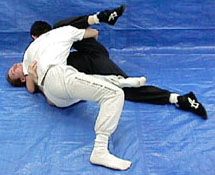
I'm not commiting enough to the pass, especially Saulo's pass, which I know like the back of my hand. And I'm not completely comfortable with the standing guard pass that Rodrigo has shown us (though I'm more and more comfortable with standing in the guard ...).
I think a part of it is that I'm not completely sure what move I make after the guard has been opened. A technical problem.
Anyway, here are a couple of passes.
Basic Leg on Shoulder
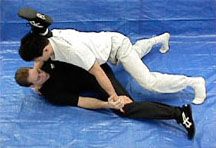
Inside Knee
Never mind the description of this at the website.
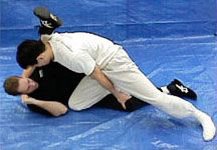
"Outside Knee"
They call this "Near Knee" but it seems like he's attacking with the "outside" knee. It's "the backstep." Again, ignore the title at the website.

Wednesday, March 22, 2006
Sweet New Choke
I'll post notes about tonight's class and assorted other matters tomorrow night. There's a tournament coming up that I'm probably going to be competing in, and a whole bunch of other jiu jitsu notes worth mentioning
Anyway, I'm watching 101 Submissions Part 2 after class tonight. What's cool about this choke is that it is part of the guillotine family, and I'm impressed by how many times the guillotine is available in sparring. But I find the guillotine hard to finish with. I've actually used the guillotine best in the same way that Stephan Bonnar uses the kimura from the guard: as a way of getting a reversal.
Here's a choke from Noman Rana of Tiger Martial Arts.
Basically you get a good grip on the collar with your right hand. DON'T HESITATE TO USE YOUR LEFT HAND TO FEED THE COLLAR TO YOUR RIGHT. Loop your right hand under the neck toward your right. Now you need a fulcrum. The fulcrum ("the pivot about which a lever turns") comes from your left arm and hand.
Take your left arm. Make sure your elbow is behind/on top of the guy's head. Keeping tight, stuff your left hand under your right arm at the elbow.
The choking pressure comes from the right hand that is pulling the collar to the right--and the fulcrum provide by the left arm and hand: the arm keeps the head down, the hand hooks under the right arm at the elbow, providing a fulcrum for the choking pressure from the right hand.
I think that once the fulcrum is in place (i.e. the left arm and hand in this example), all you have to do is pull with the right, "choking" arm.
I like this as an alternative to the guillotine (which I still like for sweeps). I can't help but wonder if some of the brown belts I've rolled with (Paul and Spencer come to mind) haven't caught me in a similar gi choke. I'll look it up in my books. But for now, I'm calling it the Rana Choke.
I hope I've done a decent job of explaining it. It's a classic example of how technique accomplishes a great deal when properly applied. I definitely want to include this choke in my armory.
Anyway, I'm watching 101 Submissions Part 2 after class tonight. What's cool about this choke is that it is part of the guillotine family, and I'm impressed by how many times the guillotine is available in sparring. But I find the guillotine hard to finish with. I've actually used the guillotine best in the same way that Stephan Bonnar uses the kimura from the guard: as a way of getting a reversal.
Here's a choke from Noman Rana of Tiger Martial Arts.
Basically you get a good grip on the collar with your right hand. DON'T HESITATE TO USE YOUR LEFT HAND TO FEED THE COLLAR TO YOUR RIGHT. Loop your right hand under the neck toward your right. Now you need a fulcrum. The fulcrum ("the pivot about which a lever turns") comes from your left arm and hand.
Take your left arm. Make sure your elbow is behind/on top of the guy's head. Keeping tight, stuff your left hand under your right arm at the elbow.
The choking pressure comes from the right hand that is pulling the collar to the right--and the fulcrum provide by the left arm and hand: the arm keeps the head down, the hand hooks under the right arm at the elbow, providing a fulcrum for the choking pressure from the right hand.
I think that once the fulcrum is in place (i.e. the left arm and hand in this example), all you have to do is pull with the right, "choking" arm.
I like this as an alternative to the guillotine (which I still like for sweeps). I can't help but wonder if some of the brown belts I've rolled with (Paul and Spencer come to mind) haven't caught me in a similar gi choke. I'll look it up in my books. But for now, I'm calling it the Rana Choke.
I hope I've done a decent job of explaining it. It's a classic example of how technique accomplishes a great deal when properly applied. I definitely want to include this choke in my armory.
Saturday, March 18, 2006
Matt Hughes' Flying Armbar
Just for fun ...
Flying Armbar.
A very nice MMA Weekly Tip of the Week from the UFC Welterweight Champion.
Flying Armbar.
A very nice MMA Weekly Tip of the Week from the UFC Welterweight Champion.
Friday, March 17, 2006
Sweet Rickson Sweep
It's against a wrestler, but it's a nice sweep from the closed guard that is simple and worth adding to the arsenal ... Essentially, it's a scissors sweep against the shoulders. From the closed guard, open your guard and bring your legs up high under the arms as possible. Pick a side and bring the leg on that side up a little higher.
Then switch ("scissor") your legs quickly, bringing the higher leg down against the guy's leg who is in your guard. At the same time, swing the other leg up under the guy's arm with the same sort of pummel you'd use to set up an armbar or even an omoplata.
It looks like you want to control the biceps, if possible. That would take care of both the arms and the shoulders. The lower his posture the better. Remember if the posture is good, we prefer the guillotine/kimura/cross-over sweep series of attacks.
Rickson Sweep
The sweep appears a little over halfway through the clip. About where the "E" in "SHARE" is below the player.
Then switch ("scissor") your legs quickly, bringing the higher leg down against the guy's leg who is in your guard. At the same time, swing the other leg up under the guy's arm with the same sort of pummel you'd use to set up an armbar or even an omoplata.
It looks like you want to control the biceps, if possible. That would take care of both the arms and the shoulders. The lower his posture the better. Remember if the posture is good, we prefer the guillotine/kimura/cross-over sweep series of attacks.
Rickson Sweep
The sweep appears a little over halfway through the clip. About where the "E" in "SHARE" is below the player.
Thursday, March 16, 2006
Guillotine/Kimura/Cross-over Sweep Combo
This combination is best against guys who have good, in-guard posture. It's one of the many gems in Kid Peligro's book, The Essential Guard.
Start with the kimura attack (actually, you could start anywhere in the rotation). If he leans in the direction of the kimura in an attempt to counter, then follow-up with the cross-over sweep.
If he postures forward, ducking his head to counter the cross-over sweep (essentially, he would be breaking his own good posture), then go for the guillotine attack--or the modified "front naked choke" that Rodrigo showed us as an alternative. Same choking position with the one arm, but instead of grabbing the hand of that arm and pulling up, you hook that hand with your other arm and put the forearm of that other arm behind the guy's head/neck.
If he tries to posture up from the guillotine attack--especially if he plants his hand on the mat in an attempt to "push up" and relieve the pressure of the choke, then go back to the beginning with the kimura attack on the arm that is posting up.
The order can be switched around depending on the guy's reaction. For example, when I slapped a kimura on Maggie the other day, she countered by ducking her head, lowering her posture and grabbing her own gi. Here, it makes more sense to follow-up with a guillotine attack rather than the cross-over sweep. Why? Because her lower posture would make the cross-over sweep much, much harder to pull off.
(A side note: it wasn't a kimura attack from the closed guard. I was in more of an open/butterfly guard. But I think the principle is more or less the same.)
Start with the kimura attack (actually, you could start anywhere in the rotation). If he leans in the direction of the kimura in an attempt to counter, then follow-up with the cross-over sweep.
If he postures forward, ducking his head to counter the cross-over sweep (essentially, he would be breaking his own good posture), then go for the guillotine attack--or the modified "front naked choke" that Rodrigo showed us as an alternative. Same choking position with the one arm, but instead of grabbing the hand of that arm and pulling up, you hook that hand with your other arm and put the forearm of that other arm behind the guy's head/neck.
If he tries to posture up from the guillotine attack--especially if he plants his hand on the mat in an attempt to "push up" and relieve the pressure of the choke, then go back to the beginning with the kimura attack on the arm that is posting up.
The order can be switched around depending on the guy's reaction. For example, when I slapped a kimura on Maggie the other day, she countered by ducking her head, lowering her posture and grabbing her own gi. Here, it makes more sense to follow-up with a guillotine attack rather than the cross-over sweep. Why? Because her lower posture would make the cross-over sweep much, much harder to pull off.
(A side note: it wasn't a kimura attack from the closed guard. I was in more of an open/butterfly guard. But I think the principle is more or less the same.)
Wednesday, March 15, 2006
More Spider Guard
A smallish class tonight, which probably spared us from the usual blasting we get on Wednesday evenings. Elbow escapes to warm up (three trips). Then straight into drills. I trained with Mario.
The first few drills were spider guard related. Rodrigo first had us practice pivoting in the spider guard from side to side. You want your body/butt to be close to the side where the guard is close, the "pull" side of the spider guard. That is compared to the "push" side, where you are pushing on the guy's bicep with your foot.
Second, Rodrigo had the top guy work a spider guard pass technique that involved dropping a knee on the the thigh of the extended leg in the spider guard. This drop simultaneously removes the cuff grip on that side, as well.
Third, Rodrigo had the top guy work a hand technique to beat the grip in the spider guard. All the top guy had to do was rotate his forearm/hand out and under the leg (generally, the extended leg) and grab the pants inside the knee. This is almost guaranteed to remove the grip.
Lasly, Rodrigo gave the bottom guy something else to do. It was a counter to that third technique. Just as the top guy rotates his hand out and under the leg to break the grip and grab the pants by the inside knee, the bottom guy wants to flicker the lower leg on that side up and out ...
then (and here's the tricky part that I'm not sure I got right) circles the lower leg over the top guy's forearm and then back under the arm higher up. If I'm remembering correctly you'll end up with your foot in the guy's armpit.
We've done a leg-grapevine move likes this from spider guard before. Working with Mario, doing it one way made the move almost impossible to complete, but doing it the other way made the move perfectly easy to do. Like I said, I want to remember how that one worked ...
We finished up with a pair of drills. The first was a repeat of the side control to mount drill we did on Monday. You start in solid side control, then reach over the head, elbow to the mat, with the northmost arm, while simultaneously switching your hips to open them up to the south. That paves the way for the attempt to take mount. You can go completely over the top of the guy's knees, stick your knee in between his knees and belly or, if you are flexible enough, stick your foot between his knees and belly.
The last drill of the night was a sort of takedown from the ground. It involves that "sidecar" hip switch from the JJ Machado book, a switch I've been practicing as a warm-up exercise before classes. Essentially, you start on your back knees up. The guy is in front of you on his knees. The guy takes a step (one knee up, one knee down) toward you, with his leg between your knees. You want to sit up quickly in the sidecar position, with the front leg hooked around his ankle ...
Here's the cool part. You bring that front leg back toward you, sweeping the guy's step-up leg out from under him. Your knee should end up pointing outside (to your right if you are using your right leg) as you take him over. That sweep should do most of teh work of putting him off balance--not the shoulder that you drive into him to "help" put him on his back.
The first few drills were spider guard related. Rodrigo first had us practice pivoting in the spider guard from side to side. You want your body/butt to be close to the side where the guard is close, the "pull" side of the spider guard. That is compared to the "push" side, where you are pushing on the guy's bicep with your foot.
Second, Rodrigo had the top guy work a spider guard pass technique that involved dropping a knee on the the thigh of the extended leg in the spider guard. This drop simultaneously removes the cuff grip on that side, as well.
Third, Rodrigo had the top guy work a hand technique to beat the grip in the spider guard. All the top guy had to do was rotate his forearm/hand out and under the leg (generally, the extended leg) and grab the pants inside the knee. This is almost guaranteed to remove the grip.
Lasly, Rodrigo gave the bottom guy something else to do. It was a counter to that third technique. Just as the top guy rotates his hand out and under the leg to break the grip and grab the pants by the inside knee, the bottom guy wants to flicker the lower leg on that side up and out ...
then (and here's the tricky part that I'm not sure I got right) circles the lower leg over the top guy's forearm and then back under the arm higher up. If I'm remembering correctly you'll end up with your foot in the guy's armpit.
We've done a leg-grapevine move likes this from spider guard before. Working with Mario, doing it one way made the move almost impossible to complete, but doing it the other way made the move perfectly easy to do. Like I said, I want to remember how that one worked ...
We finished up with a pair of drills. The first was a repeat of the side control to mount drill we did on Monday. You start in solid side control, then reach over the head, elbow to the mat, with the northmost arm, while simultaneously switching your hips to open them up to the south. That paves the way for the attempt to take mount. You can go completely over the top of the guy's knees, stick your knee in between his knees and belly or, if you are flexible enough, stick your foot between his knees and belly.
The last drill of the night was a sort of takedown from the ground. It involves that "sidecar" hip switch from the JJ Machado book, a switch I've been practicing as a warm-up exercise before classes. Essentially, you start on your back knees up. The guy is in front of you on his knees. The guy takes a step (one knee up, one knee down) toward you, with his leg between your knees. You want to sit up quickly in the sidecar position, with the front leg hooked around his ankle ...
Here's the cool part. You bring that front leg back toward you, sweeping the guy's step-up leg out from under him. Your knee should end up pointing outside (to your right if you are using your right leg) as you take him over. That sweep should do most of teh work of putting him off balance--not the shoulder that you drive into him to "help" put him on his back.
Sunday, March 12, 2006
Armbar/Omoplata: Inside/Outside
I'm thinking about the armbar and omoplata from the guard as a nice inside/outside attack.
With the armbar from the guard, you want to bring the targeted arm in, with the omoplata, you want the arm of the targeted shoulder out.
I also think of the armbar as an inside-to-outside attack. You're pivoting your body into the guy to begin the attack. The attack is finished on the outside, with your outside leg coming down across the neck to immobilize the guy's body while you hyperextend the arm.
On the other hand, the omoplata is an outside-to-inside attack. You swing your body outside the arm that's on the same side as the targeted shoulder. But the attack is finished on the inside, as you bring the arm of the targeted shoulder backwards across his back ("put his wrist on his ear").
With the armbar from the guard, you want to bring the targeted arm in, with the omoplata, you want the arm of the targeted shoulder out.
I also think of the armbar as an inside-to-outside attack. You're pivoting your body into the guy to begin the attack. The attack is finished on the outside, with your outside leg coming down across the neck to immobilize the guy's body while you hyperextend the arm.
On the other hand, the omoplata is an outside-to-inside attack. You swing your body outside the arm that's on the same side as the targeted shoulder. But the attack is finished on the inside, as you bring the arm of the targeted shoulder backwards across his back ("put his wrist on his ear").
Saturday, March 11, 2006
Ooh-Ooh-Ooh Ooh-moplata
Stefan led the class. Rodrigo was giving a seminar in Port Townsend today.
Stefan had us work two omoplata variations. The first was the standard omoplata. The second was a way of gaining the mount position in the event that the guy rolls out of the omoplata.
I love omoplatas. Some things just seem to work for some people and I think omoplata's work for me. Renato Magno said in that interview in Grappling magazine that omoplatas were the ultimate giant killer. I think this is because you very directly get to use all of your bodyweight on the very specific target of the guy's shoulder. It also involves a roll, which I like, and which can disorient the other guy for long enough for you to really attain a superior position.
Stefan's omoplata works like this. The guys is in your closed guard. You are looking for his arm to be a bit away from his body, if possible, preferably with the elbow poked out a little bit. This is to provide space for your hip as you roll over. One way to set it up might be to force the guy's arm toward the middle as if you were setting him up for an armbar. The action/reaction principle suggests that he will move his arm farther out thaan he needs to because he'll be wary for the armbar. That might make him more vulnerable to the omoplata.
We'll go to my right, attacking his left shoulder. Open your guard and plant your left foot on the mat. You could also probably plant your left foot in his right hip--whichever way gives you the better leverage.
You want to hook your right leg up under his armpit, with your toes pointing to your left. As you roll into the omoplata, your toes will point back toward the position you were just in. Hold his left arm by the wrist or elbow if you can get a good grip. Scott your left leg around behind you--you are doing the "sidecar" hip drill, in a sense.
Stefan likes this next step, though I've seen others do it differently. Stefan has use take the hoooking leg and hook the foot of that leg under the guy's chin. This applies pressure by keeping his head up while you are pressuring his shoulder down with your thigh.
Watch his hand! One defense against omoplatas (and kimura's for that matter) is for the guy to grab his own gi. Keep his lower arm close to you as you roll into the omoplata, only bringing it back close to him as you are applying the pressure. Cesar Gracie describes the pressure as "trying to touch his ear with his wrist." It's the basic handcuff move.
You also want to grab the guy's back or belt to keep him from rolling over and releasing the pressure. If he does manage to anticipate the omoplata, you want to do the variation.
The variation has you roll with him. From the above starting place, if the guy rolls on you, you want to turn around toward your left, keeping your momentum moving in the same direction AND keeping the arm trapped between your legs. You will end up in a starfish pattern in mount high up on his chest. He will be in a bad, bad position. It won't take much to submit him by catching his trapped arm with a keylock, kimura or straight armlock.
These details are a little sketchy, but I've got the main points down.
Saturday rolling was fine enough. Rolled with Arnell and Mario mostly, and once with Stefan. Mario asked if I had somebody to practice with at home because he thought I was getting better very fast. That was a nice compliment. Arnell was going on about how good my arm attacks were. I was rolling with Mario and heard Arnell say, "there he goes for the arm. Once he gets your arm, that's it." Another very nice compliment from two of the good guys at GB Seattle. I really appreciated it--especially after feeling a little shitty about my progress a week or two ago.
Stefan had us work two omoplata variations. The first was the standard omoplata. The second was a way of gaining the mount position in the event that the guy rolls out of the omoplata.
I love omoplatas. Some things just seem to work for some people and I think omoplata's work for me. Renato Magno said in that interview in Grappling magazine that omoplatas were the ultimate giant killer. I think this is because you very directly get to use all of your bodyweight on the very specific target of the guy's shoulder. It also involves a roll, which I like, and which can disorient the other guy for long enough for you to really attain a superior position.
Stefan's omoplata works like this. The guys is in your closed guard. You are looking for his arm to be a bit away from his body, if possible, preferably with the elbow poked out a little bit. This is to provide space for your hip as you roll over. One way to set it up might be to force the guy's arm toward the middle as if you were setting him up for an armbar. The action/reaction principle suggests that he will move his arm farther out thaan he needs to because he'll be wary for the armbar. That might make him more vulnerable to the omoplata.
We'll go to my right, attacking his left shoulder. Open your guard and plant your left foot on the mat. You could also probably plant your left foot in his right hip--whichever way gives you the better leverage.
You want to hook your right leg up under his armpit, with your toes pointing to your left. As you roll into the omoplata, your toes will point back toward the position you were just in. Hold his left arm by the wrist or elbow if you can get a good grip. Scott your left leg around behind you--you are doing the "sidecar" hip drill, in a sense.
Stefan likes this next step, though I've seen others do it differently. Stefan has use take the hoooking leg and hook the foot of that leg under the guy's chin. This applies pressure by keeping his head up while you are pressuring his shoulder down with your thigh.
Watch his hand! One defense against omoplatas (and kimura's for that matter) is for the guy to grab his own gi. Keep his lower arm close to you as you roll into the omoplata, only bringing it back close to him as you are applying the pressure. Cesar Gracie describes the pressure as "trying to touch his ear with his wrist." It's the basic handcuff move.
You also want to grab the guy's back or belt to keep him from rolling over and releasing the pressure. If he does manage to anticipate the omoplata, you want to do the variation.
The variation has you roll with him. From the above starting place, if the guy rolls on you, you want to turn around toward your left, keeping your momentum moving in the same direction AND keeping the arm trapped between your legs. You will end up in a starfish pattern in mount high up on his chest. He will be in a bad, bad position. It won't take much to submit him by catching his trapped arm with a keylock, kimura or straight armlock.
These details are a little sketchy, but I've got the main points down.
Saturday rolling was fine enough. Rolled with Arnell and Mario mostly, and once with Stefan. Mario asked if I had somebody to practice with at home because he thought I was getting better very fast. That was a nice compliment. Arnell was going on about how good my arm attacks were. I was rolling with Mario and heard Arnell say, "there he goes for the arm. Once he gets your arm, that's it." Another very nice compliment from two of the good guys at GB Seattle. I really appreciated it--especially after feeling a little shitty about my progress a week or two ago.
Friday, March 10, 2006
Marquardt's Butterfly Guard Sweep
Here's a great sweep from the butterfly guard by Nathan Marquardt in his recent UFC fight against contender Joe Doerksen.
A poster on Sherdog explains the move a little bit a few posts down.
It's a nice move. Since I've been trying to work the butterfly guard more and more, I'm going to try and incorporate it into my game.
Another point. Having one hook in and the other leg around the guy's back/thigh is okay if you're setting up a sweep in the direction of the "overleg." But you don't want to stay there because it is a holding move at best. It is better to put a foot in the hip to break the guy's posture than to "waste" that leg wrapping it around the guy's back/thigh.
Again, if I'm going to sweep in the direction of the overleg, say while kicking out with the underhook leg on the other side, then fine. But I can't just sit there.
I've also got to sit up and get my hips under me. No lying down in the butterfly guard (they don't call it the "sitting up guard" for nothing!)
A poster on Sherdog explains the move a little bit a few posts down.
It's actually 2 techniques that flow well together... he starts from control of the upperbody from double underhooks from butterfly guard, pushing off and shifting opponents weight and then using the momentum to sit up (in this case they actually stood all the way up), and then before joe could pummel and get and over-under, since nathan already had hip control with his grip (see how he shifts his double underhook from up high when in the butterfly to down low when they're standing), applies pressure with his head up top, pulls in the lower back with his hands, trips and gets the takedown.It seems like Marquardt gets his initial momentum by kicking out with his hooks, driving Doerksen's hips back. That is what gives him the space to stand up (using Jean Jacques Machado's quadraceps killer drill!). It also moves the center of gravity back off of him.
It's a nice move. Since I've been trying to work the butterfly guard more and more, I'm going to try and incorporate it into my game.
Another point. Having one hook in and the other leg around the guy's back/thigh is okay if you're setting up a sweep in the direction of the "overleg." But you don't want to stay there because it is a holding move at best. It is better to put a foot in the hip to break the guy's posture than to "waste" that leg wrapping it around the guy's back/thigh.
Again, if I'm going to sweep in the direction of the overleg, say while kicking out with the underhook leg on the other side, then fine. But I can't just sit there.
I've also got to sit up and get my hips under me. No lying down in the butterfly guard (they don't call it the "sitting up guard" for nothing!)
Thursday, March 09, 2006
Two Takes on the Knee on Belly Escape
I think I've already talked about the escape from the knee on belly position that Saulo Ribeiro has taught. I think the key to that escape--and Saulo sort of suggests it--is the location of the knee on belly. Is it a shallow knee on belly, with only a small part of the knee and shin on you? Or is it a deep knee on belly, with the guy putting much of his lower leg on you, as well?
In the first case, Saulo Ribeiro's escape works well. You roll to your side away from the knee, then hook your elbow under the knee and turn quickly into the guy, dropping your elbow to the mat. It works because since most of the guy's weight isn't on top of you, it is easier to move out from under the knee on belly.
In the second case, it might be too hard to elbow escape and hip out from under the guy. With this situation, I like one of the "guard replacement" strategies that Kid Peligro talks about in his book, The Essential Guard.
Here, the goal is to put the guy in your half guard. To do this, you elbow escape away from the knee with your hands on the knee. But rather than try and move your body entirely away from the guy, you just want to move yourself far enough so that the knee that was on your belly is now by your upper thigh or groin area. From here, hook that inside leg around his knee on belly leg. He is now back in your half guard.
Peligro takes this another step further, taking the guy from half guard to butterfly guard. He does this by rotating his hips (opening them up) to make it easy to squeeze his outside leg in between his leg and the other guy's once-a-upon-a-time knee on belly leg. Then slide both legs over and apply the butterfly guard hooks.
Shaka caught me in a knee on belly mount a couple of times Wednesday night. I need to start trying both of these escape variations as the situation warrants.
In the first case, Saulo Ribeiro's escape works well. You roll to your side away from the knee, then hook your elbow under the knee and turn quickly into the guy, dropping your elbow to the mat. It works because since most of the guy's weight isn't on top of you, it is easier to move out from under the knee on belly.
In the second case, it might be too hard to elbow escape and hip out from under the guy. With this situation, I like one of the "guard replacement" strategies that Kid Peligro talks about in his book, The Essential Guard.
Here, the goal is to put the guy in your half guard. To do this, you elbow escape away from the knee with your hands on the knee. But rather than try and move your body entirely away from the guy, you just want to move yourself far enough so that the knee that was on your belly is now by your upper thigh or groin area. From here, hook that inside leg around his knee on belly leg. He is now back in your half guard.
Peligro takes this another step further, taking the guy from half guard to butterfly guard. He does this by rotating his hips (opening them up) to make it easy to squeeze his outside leg in between his leg and the other guy's once-a-upon-a-time knee on belly leg. Then slide both legs over and apply the butterfly guard hooks.
Shaka caught me in a knee on belly mount a couple of times Wednesday night. I need to start trying both of these escape variations as the situation warrants.
Subscribe to:
Posts (Atom)